Asian Development Bank: Georgia's economy will grow by 5% this year, by 5.5% in 2025
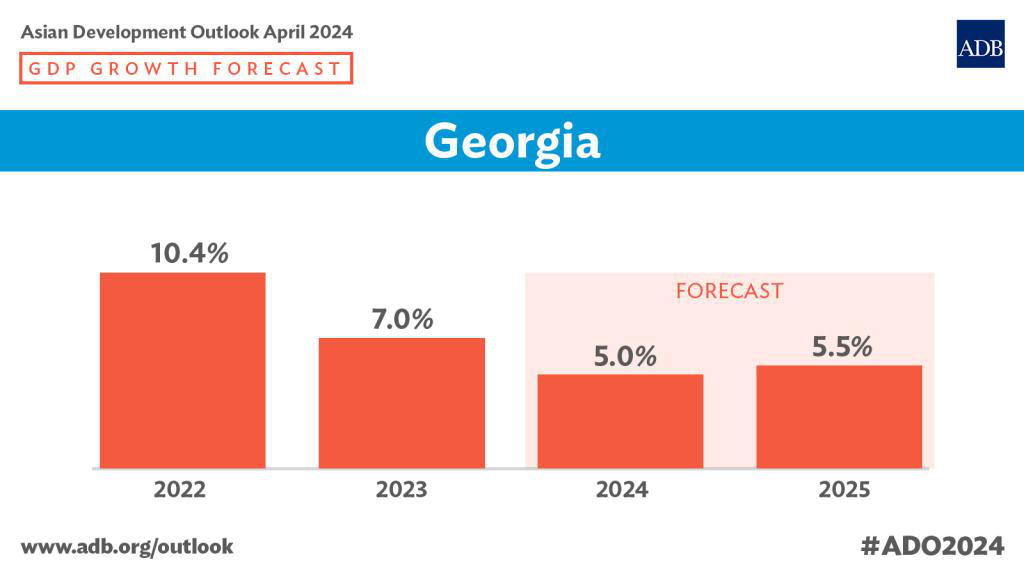
Georgia's economy will grow at an average pace in 2024 on the back of subdued foreign demand and services growth, and more growth is expected in 2025, according to Asian Development Bank (ADB) report.
As noted in the Asia Development Outlook April 2024, ADB's flagship economic publication, Georgia's gross domestic product (GDP) is expected to grow by 5% in 2024, rising to 5.5% in 2025 on the back of growth in tourism and investment.
"Georgia's economy has been steadily growing in recent years. Focusing on regional cooperation, promotion of the private sector, development of human capital and the implementation of policies necessary for the transition to a greener and climate-resistant economy will create a state in the country and strengthen the social protection of the population", said Leslie Bearman Lam, Director of ADB's Permanent Representation in Georgia.
According to the Asian Development Bank, inflation is expected to increase slightly to 3.5% in 2024, and to 4% in 2025, on the back of a slight increase in consumer prices. The fiscal deficit will meet the government's fiscal rule and stay within 3% of GDP in 2024 and 2025, driven by improved tax administration, rationalization of tax expenditures, and prudent external debt management. Revenues will become 28% of GDP in 2024 and 28.5% in 2025 as a result of increased tax collection.
"Geopolitical tensions in the region could slow growth in services to 5.5% in 2024 and pick up to 6.3% in 2025 as a result of rapid advances in tourism." The growth of the industry is predicted by 4.2% in 2024, by 4.9% in 2025, at the expense of high production of ferroalloys. Agricultural growth will slow to 0.5% in 2024, rising to 1.1% next year with government support for agricultural credit and insurance and investment in new technologies.
According to Asia's development forecast, imports will grow at a relatively low rate and increase to 6.1% in 2024, at the expense of slowing domestic growth and reduced re-exports of cars, and will increase to 11.1% in 2025. Remittances are forecast to stabilize to around $3 billion over the next 2 years as outflows linked to Russian migrants slow and reverse, potentially putting downward pressure on the GEL.
Georgia's population is aging due to low-replacement birthrates, improved life expectancy, and emigration of working-age people. Government can increase labor productivity of employees by increasing skill development and use of technology. Despite persistent labor shortages, a large gap remains between male and female labor force participation rates. Therefore, it is very important to introduce policies that will promote the inclusion of women in the workforce.
ADB has been supporting Georgia since 2007 and is one of the largest multilateral development partners of the country. ADB has provided 4 billion US dollars worth of loans, grants and technical assistance to Georgia. ADB's new five-year cooperation strategy with Georgia aims to help the country develop into a green and inclusive regional gateway, promote public and private sector investments, reforms, knowledge transfer, building climate-resilient infrastructure and regional integration.
ADB's mission is to contribute to the successful, multilateral, sustainable and sustainable development of the Asia-Pacific region. At the same time, it continues to work to eradicate extreme poverty in the region. The organization founded in 1966 unites 68 countries, including 49 from the Asian region," the information says.