"Transparency International: Georgia" publishes a report on the situation in four areas important for a democratic environment
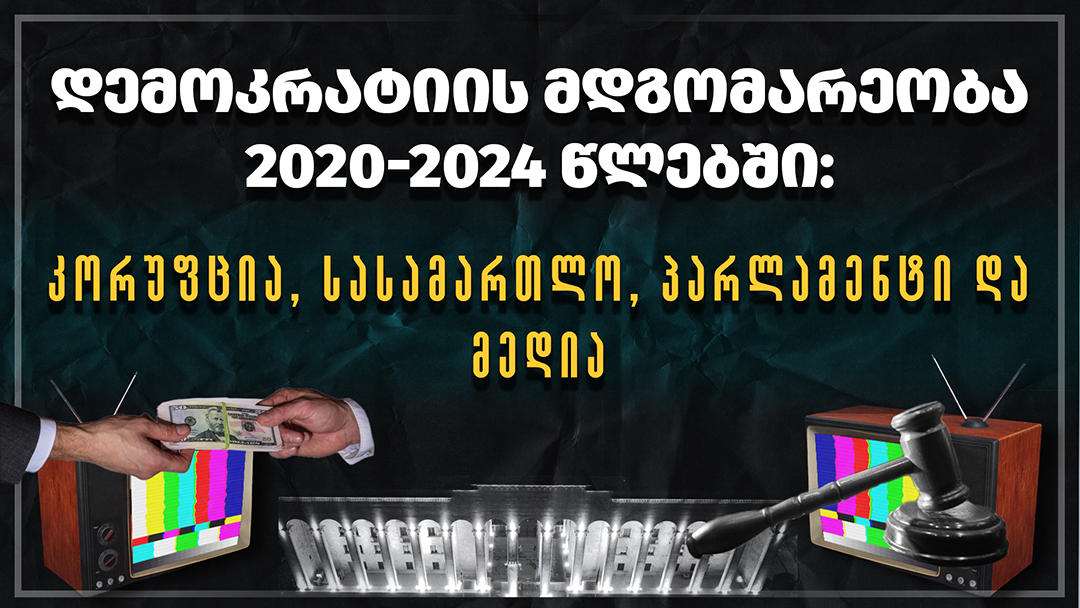
The non-governmental organization "Transparency International - Georgia" publishes a report on the current situation in four areas important for the democratic environment (anti-corruption environment, judicial system, parliamentary oversight and media environment) in 2020-2024.
According to the organization, during the last 4 years, before the decisive parliamentary elections, the situation in the country in terms of democracy has deteriorated alarmingly.
According to them, the process of state capture continued and deepened, impunity for high-level corruption reached the level of kleptocracy, clan rule in the judicial system was further strengthened, parliamentary supervision remained a formality, a hostile environment was formed for critical media, and journalistic activity became dangerous.
The main findings of the "Transparency International - Georgia" report are as follows:
Anti-corruption environment
Finally, the process of state capture was confirmed, continued and deepened;
In the last 4 years, the problem of high-level corruption has especially worsened; The signs of kleptocratic rule were clearly visible;
Although the anti-corruption bureau was created, which was evaluated positively at first, it failed to act effectively against corruption, as it also fell into the ranks of hijacked institutions;
Apart from the creation of the anti-corruption bureau, the Georgian government did not fulfill the anti-corruption requirements of the European Commission and the recommendations of the Venice Commission.
Judicial system
The Georgian authorities refused to comply with the demands of the European Union regarding the court;
The so-called existing in the judicial system continued. Consolidation of "Klan" rule with further deterioration of legislation and selection and promotion of new cadres close to the clan in the judicial system;
The imposition of sanctions by the US State Department on the judges at the head of the "Klan" has made it clear how deep is the corruption of a group of influential judges who control the entire judicial system;
The clan court system obediently followed the government's order in prosecuting the participants of peaceful protests;
The clan court system under the government's control was also actively involved in prosecuting politicians and critical media.
Parliamentary supervision
Parliamentary control, in many cases, did not cover important topics for the country, including corruption. The use of parliamentary control mechanisms by the majority was mainly for narrow party goals;
During the crisis caused by the Covid-19 pandemic, Parliament effectively refused to exercise its oversight function over the executive;
Parliamentary supervision of the security sector had a formal character. The Parliament did not comply with the request of the European Commission regarding the strengthening of control over this sector;
The role of the opposition in the process of supervision was significantly weakened - the majority created artificial barriers for the opposition so that it could not supervise the government.
media environment
Following the deterioration of the media environment in the last 4 years, such alarming cases as mass attacks and violence against journalists were revealed, which resulted in the death of the cameraman of "Telecompaniya Pereme" Also, bringing legal cases against the owners and founders of critical broadcasters and arresting them.
The use of the justice system, the Communications Commission and other structures under the government against critical media is alarming;
A number of laws and norms adopted at the initiative of the ruling majority, which further restricted and complicated journalistic activities, are particularly dangerous.