Parliament supported the legislative package related to the ban on political parties in the first reading
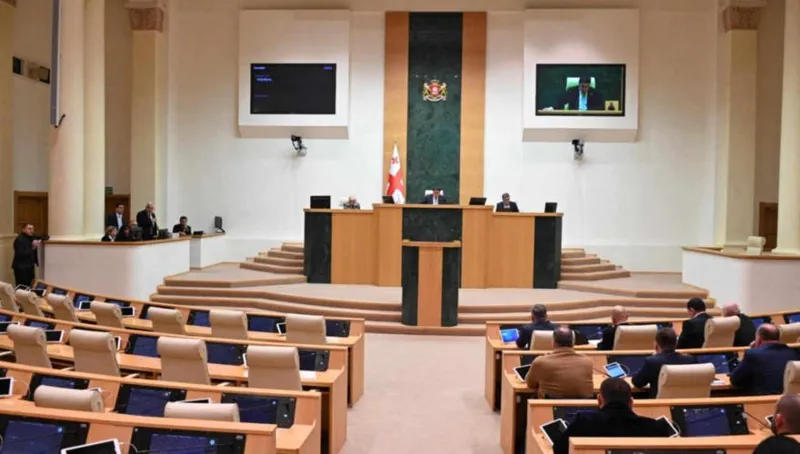
The Parliament supported the legislative package related to the ban on political parties in the first reading. The proposed amendments to the "Law on Political Associations of Citizens" and the "Law on the Constitutional Court" were unanimously adopted with 83 votes.
The legislative package was introduced by the "Georgian Dream" faction.
According to the draft, the Constitutional Court will be able to ban a political party if its declared objectives, the essence of its activities — including its personnel composition — mirror the declared objectives, essence of activities, and personnel of a party already banned by the court.
Within the same set of amendments, "Georgian Dream" also plans to shorten the timeframes for the Constitutional Court to decide on the constitutionality of a political party’s activities and on the termination of a mandate of a Member of Parliament elected under that party. According to the draft adopted in the first reading, the timeframe for delivering a decision on a constitutional complaint regarding a party’s constitutionality should not exceed 9 months from the date of filing the complaint, and during the election period — no more than 14 days.
Additionally, as stated during the plenary session by the rapporteur, "Georgian Dream" MP Tornike Cheishvili, "based on certain logic," the 9-month timeframe could be further shortened. According to him, consultations are ongoing on this matter, and a decision will be made during the second reading of the draft.
Under the current legislation, a party can be banned only by a decision of the Constitutional Court. According to the "Law on Political Associations of Citizens," the Constitutional Court can ban a party whose goal is to overthrow or violently change the constitutional order of Georgia, undermine the country’s independence, violate its territorial integrity, engage in war or violence propaganda, incite national, regional, religious, or social strife, or has created or is creating armed formations.
A party’s activities can also be terminated through reorganization or self-liquidation.
After a party is banned or self-liquidates, its remaining property is transferred to the state treasury.