An Exhibition from the ATINATI Collection - at the ATINATI's Cultural Center

ATINATI is a non-profit charitable foundation dedicated to popularizing Georgian art and culture. The foundation operates as the media platform and ATINATI’S Cultural Center.
One of ATINATI's main directions is the expanding collection of works, which is currently in its fifth year and already includes over 2000 artwors. ATINATI Private Collection includes works created in various media, which provides a vivid picture of Georgian art's continuous growth from the modernism period to the present.
The exhibition - ATINATI COLLECTION presents works in various mediums by two contemporary, distinguished Georgian artists, Andro Wekua and Thea Djorjadze, from ATINATI Private Collection.
Thea Djorjadze was born in 1971 in Tbilisi, Georgia. She studied at the Tbilisi State Academy of Arts, and later at the Kunstakademie Düsseldorf. She currently lives and works in Germany. Her work is characterized by diverse forms of sculpture and installation. Djorjadze often works with a variety of materials - textiles, wood, glass, plaster, metal. By combining materials, she creates gentle, but at the same time strong forms. Her works are often minimalist and abstract, but carry a strong emotional and poetic charge. Motifs of impermanence, temporality and fragility are often found. Her art explores space, time, memory and cultural identity. Thea Djorjadze's art is often considered as a space of border and intercultural dialogue. Her works, on the one hand, are connected to Western contemporary art, and on the other hand, bear traces of post[1]Soviet experience and personal memories. Andro Wekua was born in 1977 in Sokhumi,Georgia. He is one of the most prominent contemporary Georgian artists, whose work is multifaceted and includes painting, sculpture, video art, installation and graphics. He is considered one of the most famous Georgian artists on the international art scene. He spent his childhood and youth in Abkhazia, but after the conflict and war of the 1990s, he was forced to leave the city with his family. This traumatic experience is often reflected in his work. He studied at the Tbilisi Academy of Arts, and later in Basel, Switzerland. His characters are often transparent, dreamlike figures — half-realistic, half-imaginary. He works in many media — creating life-size sculptures, painted abstractions, cinematic videos. His art equally encompasses dreamlike and documentary dimensions. Andro Wekua's art stands at the intersection of personal trauma and collective memory. His works are, on the one hand, very intimate, and on the other hand, they deal with universal themes: war, displacement, time. His style is often described as "melancholic surrealism" - spaces and figures where reality and dream merge.

Andro Wekua (b.1977)
Magnolia
Aluminum and acrylic paints. Opened flower: 10/14/69 cm.
Closed flower: 4.5/7/69 cm.
2019-2020
An aluminum sculpture painted with acrylic paints depicting a magnolia branch. The magnolia flourished in Wekua's childhood city of Sokhumi. The sculpture seems to symbolically preserve the world that the artist lost in his childhood. The work symbolizes the lost experience of childhood places and memories. It is a kind of nostalgic icon for the artist.
In this sculpture, Wekua combines personal nostalgia with the archaic symbolism of nature. At first glance, a simple flower becomes a metaphor for a lost homeland, the impermanence of time, and the continuity of life.
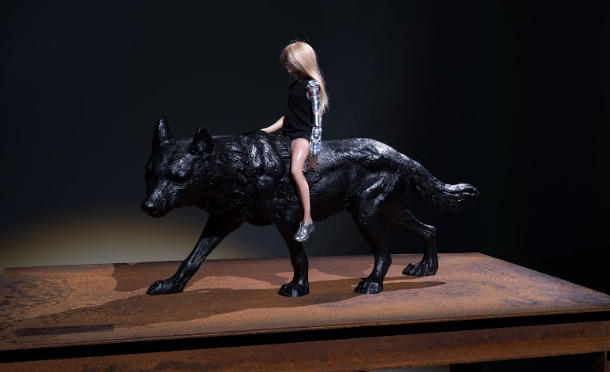
Andro Wekua (b.1977)
Untitled
Wax, bronze, aluminum, silicone, natural hair, fabric and steel.
50/84/24 cm.
2014
The work represents the figure of a girl sitting on the back of a wolf. The girl is depicted with a calm, almost emotionless look, and the wolf is a strong, dark symbolic figure. This image itself creates a symbolic “fairytale scene” that is simultaneously connected to the world of childhood, mythology, and the subconscious. As in other works by Wekua, here too, a kind of boundary between the real and the imaginary world is felt. For Wekua, the wolf is associated with both danger and natural force. The girl is a symbol of peace, a weak being. Their unity shows the simultaneous coexistence of man and nature, weakness and strength. The themes of war and lost homeland are often present in Wekua’s work. Here too, we can see the vulnerability of man in relation to a violent environment. This work can be considered a metaphor for the confrontation between man and the forces surrounding him. The girl on the wolf seems to carry a combination of personal stories, nostalgia, and collective myths.

Andro Wekua (b. 1977)
All is Fair in Dreams and Wars
Soundtrack: Jörg Hiller
2018
Like Wekua’s other works, the film creates an intense and charged space, where time seems to be suspended between the past and the future. The film continues the visual repertoire that Wekua has been using for many years: house, landscape, interior, animal, figure, face, car. These motifs intertwine and ultimately create a kind of weaving of spiritual landscapes. These are like fragments from memory, a unity of places, memories, feelings, fears, traumas deeply embedded in the subconscious, which creates a special emotional charge. We can say that this video is a kind of visualization of memory. His personal stories are transformed into a collective memory, where reality and imagination are intertwined. In the film, we see the influence of the artist’s childhood - the city of Sokhumi, the years spent in Tbilisi, and Georgia, which was affected by the civil war, although he combines all this with Western experience. Here, East and West meet not as clear contradictions, but as a complex and intricate unity. Andro Wekua creates an emotionally powerful mood with minimalist methods. Realistic images, people, animals, objects, places, are transferred to a generalized time and space. The climax of the film can be considered a palm tree engulfed in flames. Here, the palm tree appears to us as a kind of metaphor with its childhood, Abkhazia, which seems to finally transform into a statue and a symbol of eternity.

Thea Djorjadze (b.1971)
Untitled
Steel, paint, foam rubber
100/160/30 cm
2010
The work consists of a thin metal structure that creates a light, minimalist frame. A soft, yellowish-cream material (textile) is inserted into the frame, which seems to be randomly folded and rolled. The composition combines strict geometry and organic soft form. The use of soft material creates a feeling that the work is in constant change, as if it could fall apart or be replaced at any time. This feeling of transience and incompleteness is common in Djorjadze’s work. The metal structure is associated with solidity, and the foam with a kind of vulnerability. Their union expresses the coexistence of opposite states. The work does not have an obvious narrative, but it evokes emotional associations: it can be imagined as a fragment of an internal space, a trace of a body, or an abstract object that combines the existential and the abstract. The work can be perceived as an artifact of personal space, where the soft material resembles the trace of a body or everyday object, and the minimalist frame – the architectural frame of the space. Thea Djorjadze’s this abstract sculpture expresses a sense of transience, vulnerability and contrast. By combining soft and hard elements, artist creates an abstract yet emotionally charged object that can be considered as a combination of body, space and memory.(AD)