Venice Commission publishes opinion on the “Foreign Agents Registration” law and amendments to the “Law on Grants”
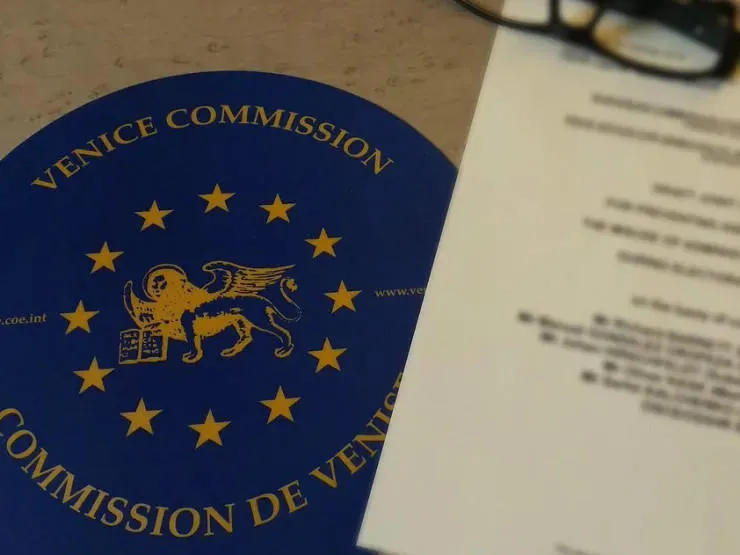
The Venice Commission has published its opinion on the “Foreign Agents Registration” law, amendments to the “Law on Grants,” and other laws related to “foreign influence,” including the Law on Broadcasting and the Organic Law on Political Associations.
As noted in the document, the Venice Commission analyzed these laws using a systemic approach, as they all aim to prevent undue foreign influence.
Regarding the Georgian version of the Foreign Agents Registration Act (FARA), the Venice Commission points out that a lack of clarity and precision undermines foreseeability and legal certainty. The law’s broad scope allows for its indiscriminate application, and the terminology itself is stigmatizing.
“The enforcement authority is assigned to the Anti-Corruption Bureau, which has been granted excessive discretion despite lacking sufficient guarantees of independence and political neutrality,” the document states.
Additionally, violations lead to criminal liability, but the broadly formulated provisions describing offenses allow for interpretation, lack necessary transparency and justification, and impose harsh sanctions that fail to meet the standard of proportionality. The combination of vague provisions, broad powers, and insufficient safeguards creates risks of arbitrariness, selective justice, and political abuse.
The document notes that, overall, the legal regime established by the Georgian FARA threatens the rule of law, civic space, and democratic freedoms. In line with the Venice Commission’s previous recommendations, it recommends repealing the Georgian FARA.
Regarding the “Law on Grants,” the amendments introduce a general requirement for prior government approval for foreign grants, but this lacks justified necessity and proportionality. Furthermore, the amendments do not provide clear and objective criteria for denying approval and include insufficient safeguards, leaving ample room for arbitrary or discriminatory application. The Bureau’s extensive investigative and enforcement powers, combined with limited procedural timelines and disproportionate sanctions, further undermine fairness and due process.
“Given these shortcomings, it is recommended that the amendments be repealed. At a minimum, they should be thoroughly revised to ensure that any restrictions are necessary, proportionate, and clearly defined, accompanied by robust procedural and judicial safeguards,” the Commission’s opinion states.
Concerning the “Law on Broadcasting,” the Venice Commission notes that the amendments impose a complete ban on foreign funding for broadcasters, using an overly broad definition of “foreign power.” The Commission highlights that the ban fails to distinguish between funding that genuinely threatens democratic integrity and funding that supports legitimate journalistic and civic activities. This undermines media pluralism and does not meet the standards of necessity and proportionality. Therefore, the Commission recommends repealing the ban.
As for the Organic Law on Political Associations, the amendments completely prohibit political parties from receiving free lectures or seminars from legal entities or associations, whether in Georgia or abroad. These changes are part of broader restrictions on foreign funding, aimed at addressing legislative shortcomings.
The Venice Commission recommends that future legislative processes in Georgia adopt an inclusive approach to ensure legitimacy and broad acceptance. The Commission expresses regret that the Georgian authorities did not engage in the preparation of this opinion but reaffirms its readiness to address their concerns in accordance with international standards. The Venice Commission also stands ready to provide further assistance to the Parliamentary Assembly on this matter.
The document further states that, in the event of further legislative developments in this area, the following recommendations should be considered:
- Adopt a systemic approach that avoids adopting multiple legislative acts that operate in parallel and cumulatively;
- Narrow the scope of application with precise definitions of key terms and limit the discretion of enforcement bodies to ensure the law applies only when there is a clear and specific risk to national security;
- Avoid using the term “agent of foreign power” or any similarly stigmatizing terms, and remove any requirement for individuals or organizations to publish such labels in their materials;
- Limit obligations imposed on designated entities to those strictly necessary and proportionate to achieve legitimate objectives, avoiding excessive administrative burdens and disproportionate penalties;
- Ensure that sanctions are clearly defined, necessary, and proportionate, with safeguards to prevent unlawful enforcement, upholding the principles of legal certainty and foreseeability;
- Establish robust procedural safeguards, including independent enforcement bodies, clear notification requirements, and effective mechanisms for appealing any designations, measures, or penalties", the statement said.