Parliament supports another planned amendment tightening rules on Assemblies and Demonstrations at first reading
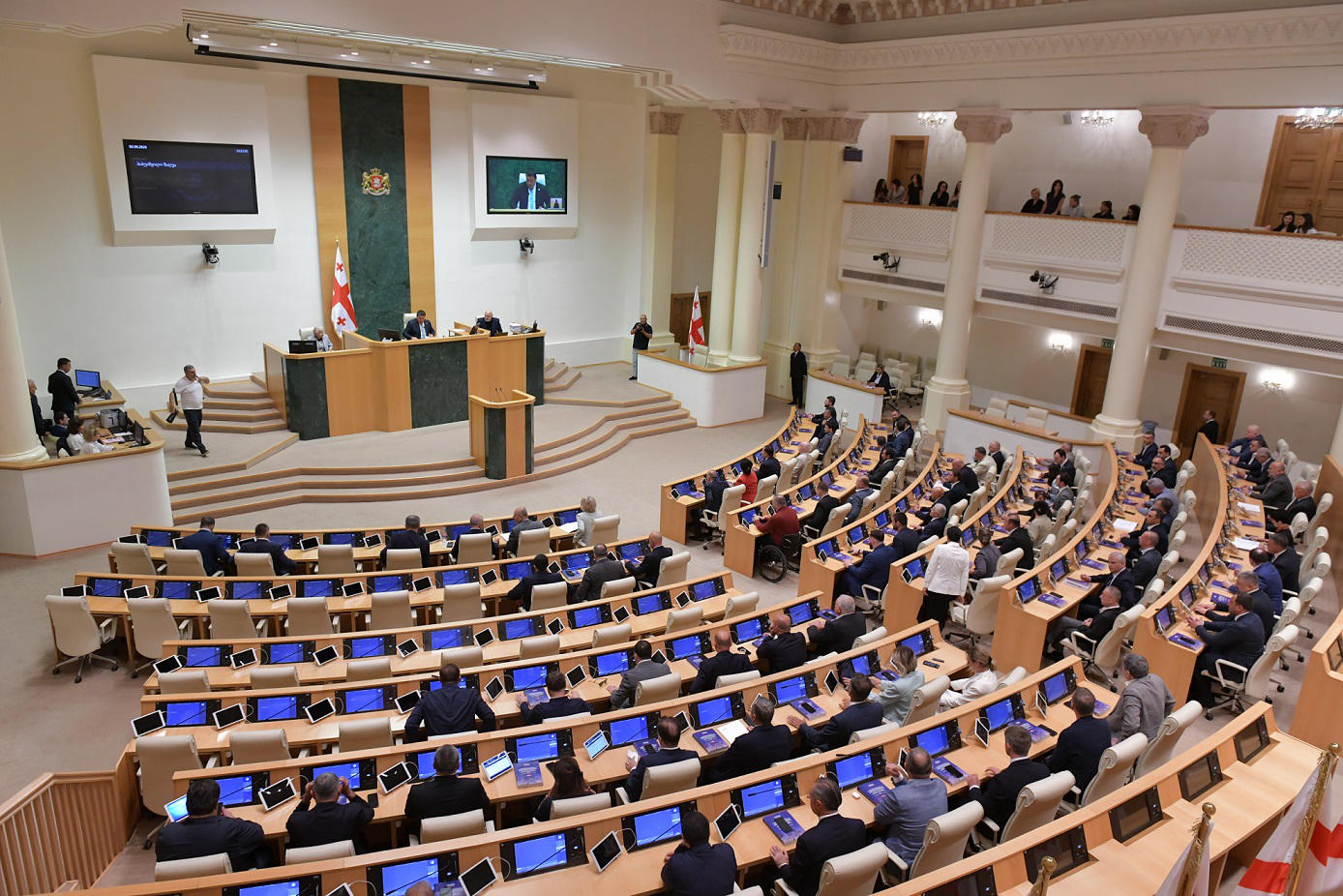
Parliament, in a first reading and under an accelerated procedure, reviewed and supported another planned amendment to the Law “On Assemblies and Demonstrations,” which introduces the obligation for the Ministry of Internal Affairs (MIA) to be notified in advance if an assembly or demonstration is held in a pedestrian area. In addition, similar to the prohibition on blocking road traffic, it will become inadmissible to artificially obstruct pedestrian pathways unless the number of participants in the assembly or demonstration objectively requires it.
The planned amendments were adopted at the first reading with 79 votes in favor and 9 against. The bill was presented both during committee and plenary discussions by the Chair of the Legal Affairs Committee, Archil Gorduladze.
According to Gorduladze, the current legislation does not adequately ensure, on the one hand, the exercise of the right to assembly and demonstration, and on the other hand, the effective protection of the rights of others. He stated that maintaining balance is essential.
Under the amendments, the organizer of an assembly or demonstration will be required to notify the Ministry of Internal Affairs instead of the municipal body. After receiving the notification, the Ministry of Internal Affairs will be authorized to propose to the organizers a change of location or route if it deems that the planned form of assembly, the place of gathering, or the route poses a threat to public order, state or public institutions, enterprises, agencies, organizations, normal functioning of transport, or the uninterrupted movement of people.
If participants of a spontaneous or non-spontaneous assembly do not agree to hold the assembly or demonstration at the location or route proposed by the Ministry of Internal Affairs, and they proceed with the assembly at the originally planned site, participants may face up to 15 days of administrative detention, while organizers may face up to 20 days. In case of repeated violations, participants or organizers will face criminal liability under Article 347 of the Criminal Code, specifically imprisonment for up to one year.
“If an assembly or demonstration does not violate the rights of others at the moment of notification but then evolves into a violation, the Ministry of Internal Affairs will warn the participants and inform them that their action infringes upon the rights of others. Naturally, in such cases, the assembly will not be immediately terminated, but individuals will be subject to administrative liability.
At the same time, if participants of an assembly or demonstration massively block a road, the Ministry of Internal Affairs will warn them and give them 15 minutes to cease the violation. If the violation is not stopped within 15 minutes — meaning the roadway is not cleared — the entire assembly will be deemed unlawful. Accordingly, a decision will be made to terminate the assembly, and each participant will be held liable under the law, which may include up to 15 days of administrative detention or up to one year of criminal liability. Individuals who block the road not en masse but individually and step onto the roadway will also face appropriate liability, whereas other participants who do not block traffic, do not hinder pedestrian movement, and do not violate others’ rights will not bear any responsibility and will be able to express their protest in full compliance with the law,” stated Archil Gorduladze when presenting the legislative initiative.