Tazo Datunashvili: The issue of dispersing protests will not be exhausted until the decision-makers are punished
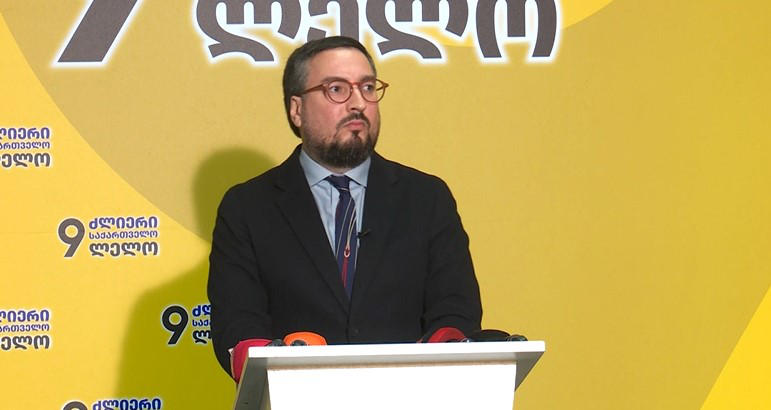
The subject of the BBC’s investigative journalism will not be exhausted until those people who actually made the decisions and participated in the unlawful special operations used to disperse the rallies are punished, said Tazo Datunashvili, one of the leaders of Lelo – Strong Georgia.
According to Datunashvili, it is important that an “international investigation be conducted.”
“This issue will not be exhausted until those individuals are punished who actually made the decisions and took part in the unregulated, improper, and unlawful special actions through which those rallies were dispersed. I am convinced that the investigation conducted by the State Security Service was not comprehensive. I am convinced that now they want to shift all the blame onto the people who participated in the film.
In reality, nothing was investigated. In reality, no information was made public. If there had been a real desire to bring clarity to this case, we said from the very first day and I will repeat it now: there are two ways. One way is a parliamentary commission in a normal country, but unfortunately we are not in a normal country or in normal circumstances. Our parliament is illegitimately formed. It is impossible for any commission to function there. Therefore, I never believed in this option and always said that this path exists only in a normal country.
The second way is that there must be trust. Law enforcement bodies are the alleged perpetrators. International standards require that when one law enforcement body investigates another, it is important that either a parliamentary commission be involved or that an international investigation be conducted.
No component of the case should be classified as ‘secret.’ Until such transparency is ensured, no investigation will earn our trust,” Datunashvili said.
In addition, Datunashvili commented on the conclusions adopted by the Presidency of the Council of the European Union on enlargement, noting that “any structure that prepares reports based on truth can see the democratic backsliding in Georgia with the naked eye.”
“Any structure that has standards and prepares reports based on truth, using empirical and scientific methods, can see with the naked eye what has been happening in Georgia, especially over the past year: the extremely severe backsliding in democracy, the human rights situation, and the constitutional order and system that we are witnessing. All of this is happening not through covert means, but through changes to laws, as well as the introduction of legal norms that contradict not only international human rights protection standards, but even the Constitution of Georgia. Accordingly, there is nothing strange about these assessments. The fact that there is still interest in Georgia and that it continues to be assessed is the result of Georgia still being a candidate country for EU membership. The European Union cares about the state of those values and core principles around which the Union is built in candidate countries. These structures are obliged to objectively assess the political situation in the country,” Datunashvili said.
For reference, the conclusions adopted by the Presidency of the Council of the European Union on enlargement state that Georgia’s EU accession process has effectively reached a deadlock until the authorities demonstrate firm commitment to changing course and returning to the path toward EU membership.
As noted in the document, the Council points to a serious overall backsliding in the areas of democracy, human rights, and the rule of law.
The Council calls on the Georgian authorities to release all unjustly detained politicians, journalists, and activists, repeal repressive legislation, adopt democratic, inclusive, and sustainable reforms in line with the fundamental principles of European integration, and stop using aggressive rhetoric against the EU, EU ambassadors, and the Head of the EU Delegation—as initial steps to re-engage on the EU path. The Council reiterates the EU’s support for Georgia’s sovereignty, independence, and territorial integrity within its internationally recognized borders and emphasizes that the EU remains firmly committed to the peaceful resolution of conflicts and to the policy of non-recognition and engagement, including through the work of the EU Monitoring Mission in Georgia.