Tamar Oniani: We expect that the substantive review of the lawsuit related to the 2024 elections will be completed within no more than one year, after which the Strasbourg Court will proceed to deliver a ruling
The context of freedom of assembly is entirely lost in court proceedings, while people’s liberty is sacrificed in return. In fact, legal analysis may even be completely irrelevant when it comes to issues related to protesting on sidewalks, said Tamar Oniani, Chairperson of the Georgian Young Lawyers’ Association (GYLA), while assessing court decisions that imposed administrative detention on specific protesters for standing on sidewalks.
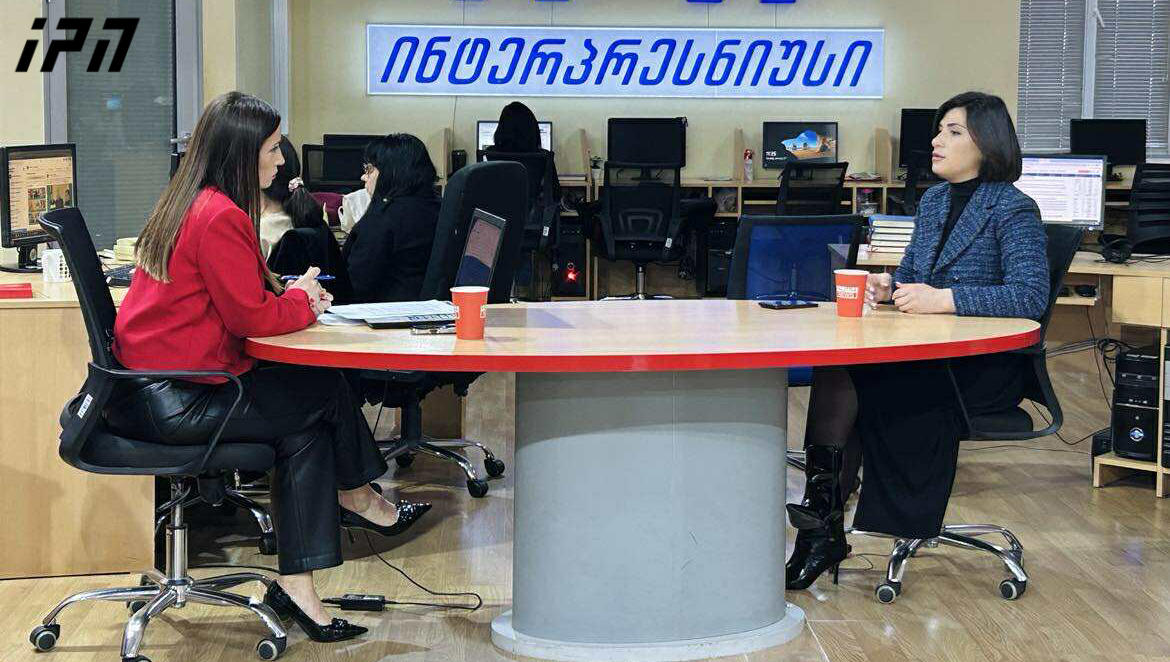
Speaking on PalitraNews program “Day’s Newsroom”, Oniani stated that detaining people for protesting on sidewalks may have a chilling effect.
“There are many legal arguments. In some cases, legal analysis may be entirely inappropriate when dealing with issues related to sidewalk protests, where people may first be subjected to administrative detention and, in the case of repetition, later punished under criminal law - with up to one year of imprisonment.
“In reality, we are faced with a situation where we are told that protesting on sidewalks obstructs pedestrians’ movement. However, in this context, there is no assessment whatsoever of the rights of those exercising freedom of assembly. The cornerstone of this right is precisely that the place where people gather matters to them. One of the main purposes of assembly is to convey a message - whether to society or to the authorities.
“In court proceedings, we see that the entire context of freedom of assembly is lost, and the price paid for this is people’s liberty. Even one day spent unjustly - whether in an isolation facility, prison, or any other type of institution - constitutes a gross interference, especially when it happens for the exercise of freedom of expression.
“We assess the detention of people for protesting on sidewalks not only as repression against individual activists, but, in a broader sense, as an impact on freedom of assembly itself. This may have a chilling effect. If a person believes that there is no protest space available to them without fear of subsequent repression in various forms, this will seriously undermine the fundamental pillars that a democratic society must have - a society that is, first and foremost, based on free thought,” Oniani said.
At the same time, the GYLA Chairperson assessed the statements made during the review of Georgia’s national report within the framework of the 51st session of the UN Human Rights Council’s Universal Periodic Review (UPR). According to her, the statements voiced during the review are not “recommendations that are issued once and never revisited.”
“During the Universal Periodic Review, confirmation by various states of what is happening in the country - that there is a human rights crisis, that we have political prisoners, that there has been particularly strong pressure recently on freedom of assembly and expression and on civil society organizations - is extremely important. Because these are not recommendations that are issued once and then forgotten. Georgia will have to subsequently report, on a regular basis, on how these recommendations have been implemented.
[As for the fact that Georgia was represented at this event by Deputy Interior Minister Aleksandre Darakhvelidze, who is under sanctions], for any state that values a rules-based international order and sees human rights as an important prism, it should matter that the country is represented at such events by individuals who do not have conflicts of interest, and by people who are not accused, through their activities, of violating various human rights.
In this case, when we speak about the Ministry of Internal Affairs, there are numerous assessments regarding what happened in the country in 2024 in terms of freedom of assembly. Among them are many serious questions - if we can even call them questions rather than assessments - regarding the mixing of chemical substances into water cannons, as well as issues related to systemic torture,” Tamar Oniani stated.
In addition, she spoke about the lawsuit prepared by GYLA regarding the 2024 parliamentary elections, which has already been taken up by the European Court of Human Rights in Strasbourg. According to Oniani, the substantive phase of the case, in terms of communication between the parties, may be completed within no more than one year.
“It is difficult to say when we can expect a judgment. The Strasbourg Court does not have fixed deadlines. The state has already been given a deadline in May to submit its response to our application. We can assume that, approximately within no more than one year, the substantive examination phase of the case, in terms of communication between the parties - that is, between the applicant and the state - will be completed. After that, the Court will proceed to deliver a judgment,” Tamar Oniani said.