Parliament adopts legislative package on grants, political activities and political activism in the first reading
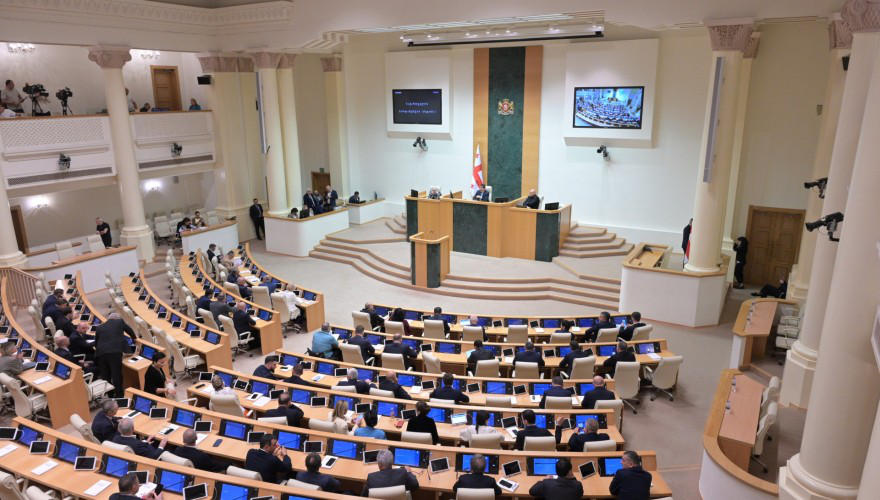
82 - in favor, 10 - against - with this result of the vote, the Parliament, in the first reading, adopted the legislative package of the Georgian Dream faction, as a result of which new restrictions and prohibitions are established regarding grants, political activities and political activism.
In this direction, changes are being made to the following laws: - Law on Grants, Code of Criminal Procedure, Code of Administrative Procedure, Code of Administrative Offenses, Law on Political Unions of Citizens and Law on State Audit Service.
According to the amendments to the Law on Grants, the definition of a "grant" is expanded and it is determined that a grant is also considered to be funds transferred by any person to any person in cash or in kind, which are used or may be used with the belief or intention of exerting any influence on the Georgian government, state institutions, or any part of society, for activities carried out or to be carried out, which are aimed at forming, implementing or changing the domestic or foreign policy of Georgia, as well as for activities that are used or may be used for activities that stem from the political or public interests, approaches or relations of a foreign government or a foreign political party. A person will be able to receive such a grant only with the prior permission of the Government of Georgia.
The law defines a legal entity of another state whose activities essentially involve activities on issues related to Georgia. It is determined that such a legal entity may receive a grant only after the prior consent of the Government of Georgia. As the Georgian Dream faction explains, for example, an organization registered abroad that essentially carries out its activities in Georgia will have to apply to the Government of Georgia to receive funding. Otherwise, it will be held criminally liable.
Funds transferred in cash or in kind are also considered a grant, in exchange for which the grant recipient provides technical assistance in the form of sharing of technologies, specialized knowledge, skills, expertise, services and/or other types of assistance. As the Georgian Dream faction states, if a foreign power hires experts in Georgia in exchange for money, this money will be considered a grant and the issuance of this grant will require the prior consent of the government.
If a representative office, branch, or department of a non-resident legal entity receives a grant, including from the legal entity of which it is a branch, this branch requires the prior consent of the Government of Georgia to receive the grant. The draft law stipulates that the receipt of a grant by this branch without consent will result in administrative liability - in the form of a fine in the amount of double the amount of the illegally received grant.
The amendments are being made to the Criminal Code. According to the draft, criminal liability is established for violation of the rules established by the Law on Grants. The corresponding violation will result in a fine, community service for a term of 300 to 500 hours, or imprisonment for a term of up to 6 years.
An aggravating circumstance is added to Article 194 of the Criminal Code. In particular, money laundering for the purpose of carrying out activities on political issues in Georgia will result in imprisonment for a term of 9 to 12 years.
The draft law imposes criminal liability on a leading official of a political party who violates the Organic Law on Political Unions of Citizens - in particular, accepts foreign funding. This violation will result in a fine, community service for a term of 300 to 500 hours, or imprisonment for a term of up to 6 years.
External lobbying will become punishable under criminal law. In particular, the direct or indirect transfer of money, securities, other property, property benefits or any other xx to a citizen of another state or legal entity in exchange for carrying out activities on political issues related to Georgia will result in a fine, community service for a term of 300 to 500 hours, or imprisonment for a term of up to 6 years.
The amendment related to the restriction of political party membership is being implemented in the Organic Law on Political Unions of Citizens. The draft law defines the grounds for inadmissibility of political party membership. In particular, a person who is employed under an employment contract in an organization that receives more than 20% of its annual income from a foreign power will be prohibited from being a member of a political party for 8 years.
The State Audit Office will monitor the financial activities of a political party member.
The term “declared electoral purpose” is replaced by the term “declared party-political purpose” and its content is expanded. All restrictions provided for by the legislation that are defined for political parties will also apply to entities with “declared party-political purpose”.
In the case of receiving foreign funding, the criminal liability of the head of the political party and the entity with a declared party-political purpose is determined.
Amendments to the law are also being made regarding the public political activity of an entrepreneurial entity. Within the framework of the legislative package, amendments to the Code of Administrative Offenses were also submitted to the Parliament, which establish a new administrative offense for the implementation of public political activity by an entrepreneurial entity that is not related to its main entrepreneurial activity. In case of committing the above-mentioned violation, the State Audit Office will fine the business entity in the amount of 20,000 GEL, and in case of repeated and subsequent commission of the act - in the amount of 40,000 GEL.
In addition, as it was decided during the first reading of the draft, the amendments will be corrected in this direction and business entities will be subject to criminal liability instead of administrative liability in case of repeated political activity.