Parliament approves legislative package on reorganization of Higher Education institutions under accelerated procedure
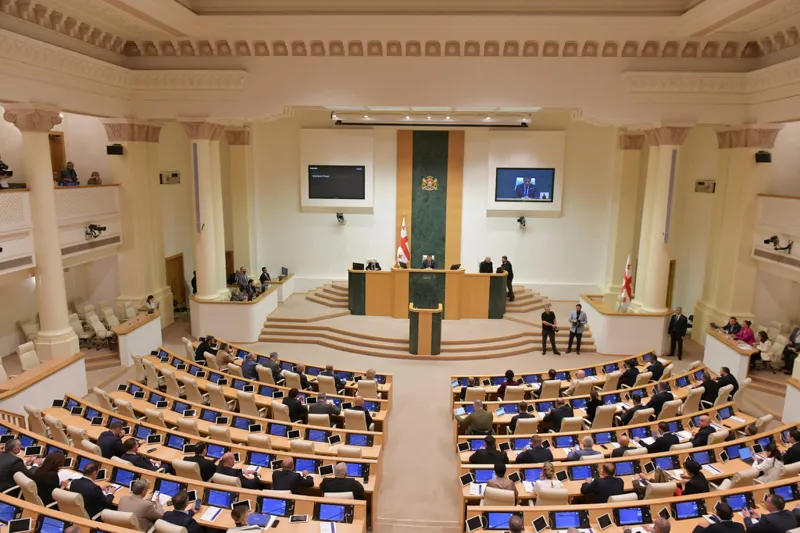
Parliament reviewed under an accelerated procedure and adopted in the third reading a package of legislative amendments, one of the main components of which concerns the reorganization of state-founded higher education institutions.
Amendments to the Law on Higher Education were adopted in the third reading with 86 votes in favor and 10 against. Along with this law, changes were also made to the Law on the Development of Education Quality and the Law on Science, Technology and Their Development.
Under the adopted decision, new articles are added to the Law on Higher Education, according to which, in the event of reorganization of a state-founded higher education institution, the government is authorized to issue a decree defining the goals, form, and timeframe of the reorganization, temporary mechanisms for managing the reorganization process, as well as special rules for exercising the powers of governing bodies of the state-founded higher education institutions involved in the reorganization.
By government decree, during the reorganization period and for a specified timeframe, the exercise of powers of certain governing bodies defined by law and/or the statutes of state-founded higher education institutions may be suspended or modified, if this is necessary to achieve the objectives of the reorganization.
In such cases, the Minister of Education is authorized to appoint an acting rector, an acting head of administration, an acting head of the quality assurance service, and to establish a temporary collegial governing body - a temporary governing council, which, within the scope and timeframe defined by the government decree, will exercise the powers of the Academic Council and the Representative Council.
According to the draft law, these powers are temporary and targeted, apply only to issues directly related to the reorganization process, and terminate upon completion of the reorganization or after the formation of governing bodies of the higher education institution(s) involved.
In addition, amendments to the Law on Higher Education allow higher education institutions to implement, under a phasing-out regime and for a specified period, those programs that are not provided for by a government decree. Students already enrolled in such programs will be able to continue their studies at the higher education institution for the corresponding period. This provision stems from a law adopted by Parliament in December 2025, according to which higher education institutions are authorized to carry out educational and research activities only within the framework of educational programs (curricula) defined by the government.
Another innovation is the addition of the position of Leading Professor to the list of academic staff positions in higher education institutions.
The amendments define who may be elected to the academic position of Leading Professor: a person holding a doctoral degree or an equivalent academic qualification, with at least 8 years of scientific-pedagogical experience, outstanding scientific achievements (including publications in leading local and international journals and other publications, participation in national and international research projects, etc.), and who meets additional requirements set by the statute of the higher education institution.
Another change under the amendments is the abolition of the integrated bachelor’s-master’s program for teacher training. Teacher education will instead be carried out at the bachelor’s level.
The legislative package was submitted to Parliament by the Ministry of Education and Science.