Europe Press Freedom Report - The situation in Georgia continued to deteriorate at an alarming rate
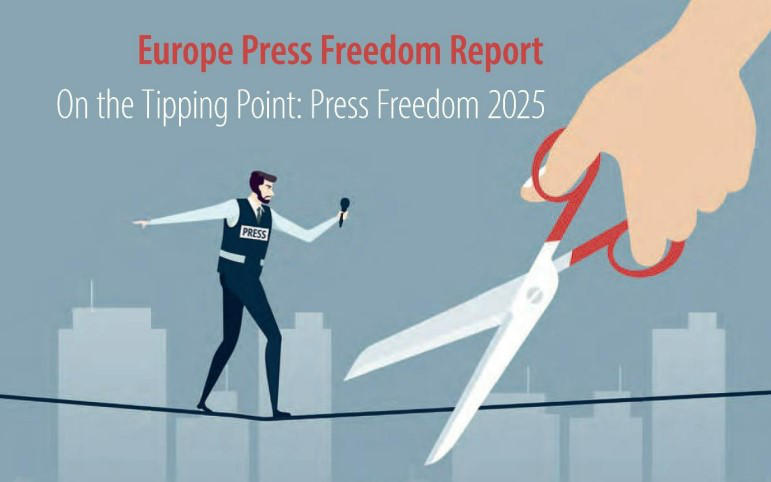
In 2025, the situation in Georgia continued to deteriorate at an alarming rate. A total of 32 alerts were submitted to the Platform, representing a 78% increase compared to 2024, the situation in Georgia deteriorated at an alarming rate in 2025. The platform received 32 reports, a 78% increase compared to 2024, according to the annual Europe Press Freedom Report presented by the Council of Europe Safety of Journalists Platform.
According to the document, the alerts refect a broader dismantling of press freedom, driven by institutional repression, politicised law enforcement, the capture of state institutions and public service media and the erosion of e‑ective checks and balances.
“On 6 August 2025, following more than 200 days in pretrial detention and a highly politicised trial, Mzia Amaglobeli, the founder and director of two of Georgia’s most prominent independent media outlets, Batumelebi and Netgazeti, was sentenced to two years in prison. Since her arrest, Amaglobeli and her media organisations have faced smear campaigns, degrading treatment and economic retaliation.
Arbitrary arrests are a signicant issue. On 3 November 2025, Ninia Kakabadze, a journalist for Mediachecker, was detained on administrative charges of “blocking the road” after she covered a rally. Previously, in October, the police also briey detained Mamuka Mgaloblishvili, a journalist for the media outlet Publika, on similar administrative charges.
The Georgian Parliament adopted several repressive pieces of legislation despite a national and international outcry. On 1 April 2025, the Parliament passed a new version of the “foreign agent” law, entitled the Foreign Agents Registration Act, which imposes obligations carrying nes up to GEL 25 000 (€8 250) and up to ve years in prison.
On 12 June 2025, the Parliament adopted amendments to the Law on Grants that require foreign donors to obtain prior approval from the executive branch before disbursing grants. The amendments to the Law of Broadcasting, which went into force in June 2025, expanded the powers of the captured media regulatory body, Georgian National Communications Commission (GNCC), to regulate factual accuracy, fairness and privacy - previously overseen through self-regulation. The amendments enabled the GNCC to issue penalties of up to 3% of a broadcaster’s annual revenue or revoke its license for breaching the new rules. Using the new amendments to the law on broadcasting, the authorities have already led complaints against Formula TV and TV Pirveli with GNCC.
In June 2025, Parliament adopted amendments to Georgia’s Law on Freedom of Speech and Expression that narrowed existing protections and increased liability for defamation and insult.208 In the same month, Parliament advanced draft amendments to the Organic Law on Common Courts that would signicantly restrict journalists’ ability to report from court premises by prohibiting photo, video and audio recording or broadcasting in courthouses, courtrooms, and surrounding areas unless specically authorised by the court.
By court orders, the bank accounts of several NGOs, including press freedom groups, were frozen. Media organisations have also been targeted including online media Project 64, the organisation running Mtis Ambebi and the Organised Crime Research Media Centre, which runs investigative news outlet iFact.
Concerns persisted regarding the editorial independence of Georgia’s Public Broadcaster (GPB). As noted in the 2025 Communication on EU enlargement policy, “the public broadcaster lacks independence, has a biased editorial policy and has contributed to the promotion of anti-EU rhetoric”. The management of GPB dismissed journalists Vasil Ivanov Chikovani and Nino Zautashvili after they publicly raised concerns about political interference at the broadcaster and subsequently cancelled Zautashvili’s talk show. Several other journalists were dismissed in the period that followed. Taken together, these dismissals, programme changes, restrictive editorial practices and developments a‑ecting funding and governance have underscored ongoing concerns about the vulnerability of GPB’s independence to political influence.
Georgia continued to deny entry to foreign journalists, including freelance British journalist Will Neal, freelance French photojournalist Jérôme Chobeaux, Italian journalist Giacomo Ferrara and Swiss photojournalist Gregor Sommer.
Dozens of journalists continued to be physically attacked by law enforcement forces. They have been repeatedly ned, their work obstructed and their equipment conscated. Impunity for crimes against journalists remained widespread, with investigations often insuficient and perpetrators not held accountable, particularly those from the law enforcement structures.
Despite an unprecedented crackdown on the media in Georgia, independent journalists have shown remarkable resilience and continue reporting from the ground. However, in the absence of e‑ective checks and balances, legal safeguards and independent institutions, journalism in the country risks becoming unsustainable without immediate international support and pressure”, reads the report.