Professors from Ilia State University have prepared 14 counterarguments regarding the risks and threats of the planned education reform and have developed a package of recommendations
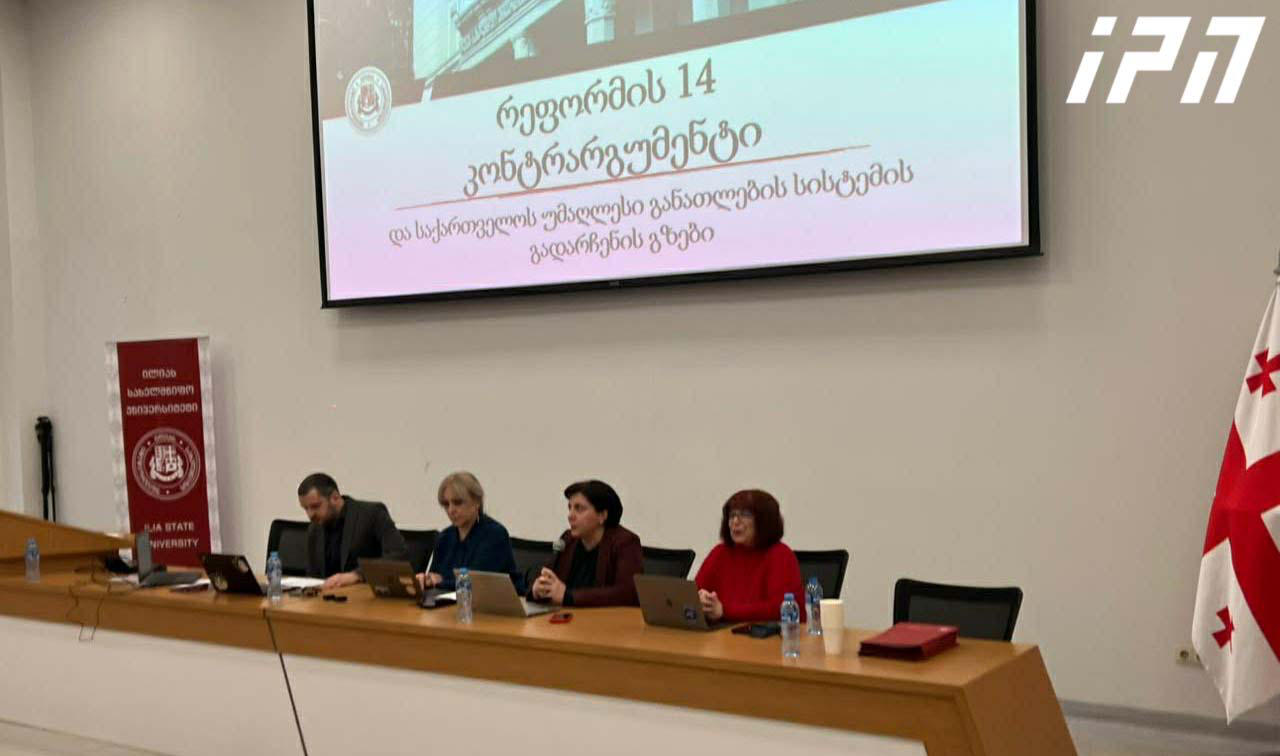
Professors from Ilia State University have prepared 14 counterarguments regarding the risks and threats of the planned education reform and have developed a package of recommendations.
Based on the analysis of the planned reform in the education sector and the developed concept, professors from Ilia State University have prepared 14 counterarguments on the risks and threats and have also elaborated a package of recommendations.
The relevant document was presented to the public today by the professors of Ilia State University.
Counterargument 1: The process of developing the reform does not comply with the basic standards for planning and implementing reforms: The reform is proceeding without a strategy that would formulate the vision, values, key principles of the reform, as well as specific objectives and expected outcomes; the reform began without an action plan aligned with the strategy, which would outline measurable indicators for achieving each objective; it is proceeding without a clearly defined budget, and its development process was neither participatory nor transparent, with discussions involving interested parties occurring only after implementation had begun.
Counterargument 2: The ongoing reform restricts the right to higher education in Georgia: The current number of students in Georgia corresponds to the European average (78% relative to the relevant cohort of the population; similar indicators are 84% in Bulgaria, Sweden, and Belgium, 80% in the UK, etc.). Halving the available places for higher education, as declared by the reform's authors, will lead to a restriction of the right to education, a decline in this percentage, and an approximation to Russia (where the similar indicator is 54%).
Counterargument 3: Quotas for study places based solely on labor market research are a flawed approach: When planning higher education, in addition to the market, the following must be considered: the country's national and strategic interests, students' interests and choices, long-term prospects for technological development and innovation, university profiles, traditions, infrastructural and academic capabilities. All of this is currently completely ignored.
Counterargument 4: The reform creates a high risk of detachment from the European educational and academic space: The uniform application of an 11-year school and the 3+1 principle without a diversified approach to disciplines will lead to a sharp decline in the quality of academic education in universities, the abolition of a range of qualifications, and incompatibility of local education with the European educational system.
Counterargument 5: The reform is incompatible with the principles of academic freedom and university autonomy. The government is depriving universities of the right to independently determine or participate in determining academic programs and their duration, directions of study, and student admission quotas for particular directions or programs. This contradicts the principle of academic self-governance and replaces academic freedom with administrative directives, which will lead to a decline in the quality of education and science in the country.
Counterargument 6: The "one city – one faculty" principle is incompatible with academic freedom, autonomy, and diversity. The concentration-deconcentration principle eliminates healthy competition between universities, which is one of the important mechanisms for ensuring quality; it eliminates mobility opportunities and thus restricts students' freedom of choice. This entails risks of institutional monopoly and corruption, as well as creating geographical inequality from a financial perspective.
Counterargument 7: The pyramidal disciplinary hierarchy of professors stifles the development of science and the possibility of quality teaching. Professors' "pyramids" limit the diversity of research and teaching methods, which does not promote the development of critical scientific thinking; this hinders career growth opportunities for young scientists, creates risks of suppressing new research initiatives, and generally poses a high risk of corruption.
Counterargument 8: Foreign students are mistakenly viewed as "business." The reform's authors regard the teaching of foreign students as business rather than as accepted in the university space. An internationalization strategy is a prerequisite for encouraging diversity in the university, increasing visibility and citations; it is an internationally recognized way for universities to accumulate social capital. The average percentage of international students in European universities is 8–10%. State universities in Georgia should not fall below this threshold, as this would hinder university development.
Counterargument 9: If the goal is to improve the quality of university education, it is unclear why 92% of the programs at one of the highest-quality universities are being abolished. Ilia State University ranks first in highly reliable ranking systems such as Times Higher Education and Nature Index—not only among Georgian universities but also in the region. Against such massive success, it is incomprehensible how abolishing 92% of Ilia State University's successful programs could contribute to raising the quality of higher education in Georgia. This will result in a waste of resources.
Counterargument 10: Integration of research and teaching cannot be achieved through the steps planned by the reform's authors. There are 19 state and 45 private universities in Georgia. At the same time, in a number of fields, according to Scopus data over the last 10 years, Ilia State University leads the country in scientific publications (e.g., Iliauni accounts for the following percentages in these fields: 50% in agriculture and biological sciences; 80% in forestry; 77% in biodiversity conservation; 73% in zoology; 67% in ecology; 66% in developmental psychology; 52% in ethnic studies; 49% in clinical psychology; 40% in multidisciplinary psychology; 40% in interdisciplinary social sciences; 37% in general internal medicine; 22% in social psychology; 22% in psychiatry). Against this background, it is unclear how abolishing 92% of Ilia State University—as a base for research and teaching—could strengthen the integration of teaching and research in the country's universities.
Counterargument 11: There is discriminatory treatment. The abolition of 90% of Ilia State University's programs constitutes a discriminatory decision, especially given the university's success, which is internationally recognized in both research and teaching; there is also the closure of unique programs in other universities and, in some cases, the transfer of programs to universities lacking relevant experience and human resources. All of this will lead to a decline in the quality of teaching-learning and research.
Counterargument 12: The issue of excessive geographical concentration in the capital cannot be resolved by reducing access to higher education in the capital. The problem of excessive population concentration in the capital cannot be solved by deconcentrating students. They do not represent a numerous group relative to the capital's population. Returning/anchoring people to the regions must occur through developing decent living opportunities in regional areas, creating employment opportunities, developing appropriate infrastructure, promoting self-governance, etc.
Counterargument 13: The reform contains numerous legal flaws. The points provided in the reform concept violate the Constitution of Georgia and a range of rights protected by legislation, specifically:
- Constitution of Georgia – Article 27 (right to education) – Article 11 (right to equality)
- Law of Georgia "On Higher Education" – Article 3, paragraph 2, subpoint "v" (autonomy) – Article 10 prima (legal capacity of a public law legal entity – higher educational institution) – Article 16 (principles of governance) – Article 34 (procedure for holding academic positions) – Article 48 (bachelor's and master's programs)
- Labor Code
- Law of Georgia "On the Development of Education Quality" – Article 7 (purpose, content, standards of authorization) – Article 18 (accreditation standards)
- Law of Georgia "On Science and Technology" – Article 10 (scientific-research institution)
- Law of Georgia "On Public Law Legal Entities" – Article 3 (legal capacity) – Article 5 (acquisition of legal capacity).
Counterargument 14: The financial provision of the reform is in question. A full-fledged and sustainable reform of the higher education system is impossible without adequate financial provision. The reform concept, adopted legislative changes, the state budget law, and public statements by the reform's authors do not provide grounds to assume that the necessary financial resources for implementing the concept have been calculated and subsequently accounted for in the medium-term public finance planning process. Accordingly, the so-called reform is not adequately resourced financially, which makes its successful implementation doubtful.
What do we see as the way out? Higher education reform must be based on the following five fundamental principles:
- Academic freedom, autonomy, and diversity (and not restriction of autonomy and self-governance, as is happening today)
- The reform must ensure accessibility of higher education for students (and not at the expense of halving accessibility, as is happening today)
- The reform must involve investment of financial and material resources in higher education (and not at the expense of expropriation of resources, as is happening today)
- The reform must utilize the successes and achievements in higher education in the country as resources (and not destroy them, as is happening today)
- The reform must be directed toward Georgia's integration into the European educational and academic space (and not isolation from it, as is happening today). The reform must proceed within the framework of Georgia's Constitution (and not go beyond the constitutional framework, as is happening today).
The reform process should be planned as follows:
- The reform of the education system must be a unified (and not disjointed) process – higher education reform must be a logical continuation of school education reform; it must be a unified plan and process.
- The reform must be based not only on labor market research but also on assessing educational needs, existing resources, infrastructure, and (socio-political and economic) context. That is, the reform must be grounded in a series of qualified research conducted with proper scientific methodology.
- A unified reform strategy document must be created, clearly articulating the vision, values, principles, relevant objectives, and expected outcomes of the reform.
- An action plan must be attached to the reform strategy, outlining measurable indicators for fulfilling each objective and the resources needed for implementation; also – risks associated with implementation and ways to mitigate them.
- The reform must be budgeted, with a transparent budget.
- A working group must work on the reform with the participation of all key interested parties, including education and sectoral experts and the university community.
Due to the current situation, a strategy to minimize potential harm: Since there is no reform strategy, action plan, or budget today; moreover, it is not transparent what principles and values the started process is based on (and what has emerged contradicts the above 5 fundamental principles) – it carries a high potential for harm. Based on the above, it is desirable to suspend the ongoing reform process and conduct preparatory work for education reform in compliance with quality standards. This will allow us to exit the created deadlock situation with minimal harm," the document states.