Ombudsman: Penalties for violations related to freedom of assembly are disproportionate, and the criminalization of insulting law enforcement officers creates a risk of misuse of the norm against legitimate criticism
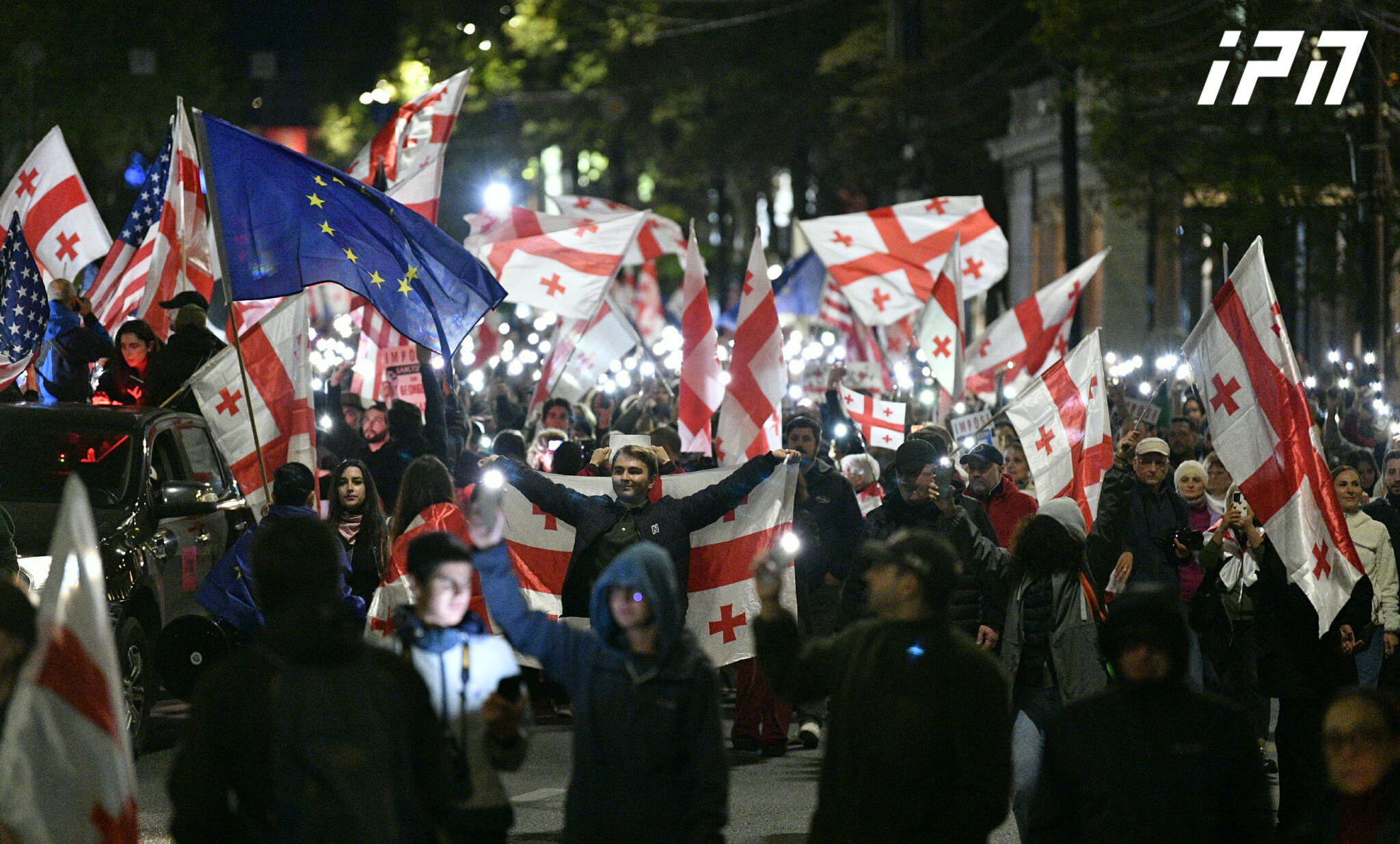
The Public Defender of Georgia has challenged a number of legislative norms restricting freedom of assembly in the Constitutional Court of Georgia. Along with prohibitions related to the rules for holding assemblies, the constitutional claim also disputes the elements of liability provided for by the Code of Administrative Offenses of Georgia — both the mandatory administrative imprisonment and the amount of the fine established by law. This is stated in the Public Defender’s 2025 report.
The document notes that the criminal liability provided for certain actions protected under freedom of assembly has also been challenged.
“Following the amendments made in December 2024 to the Law of Georgia on Assemblies and Manifestations, demonstrators were unconditionally prohibited from covering their faces with masks or other means. In February 2025, even more grounds for interference with the right were introduced (for example, the list of locations subject to blanket prohibitions related to the place of assembly was expanded, and the possibility of setting up temporary structures was sharply restricted). The weakening of legislative guarantees for the protection of the right was accompanied by changes to the Code of Administrative Offenses, which introduced disproportionate penalties for violations related to the exercise of freedom of assembly.
The Public Defender criticized these changes in the previous parliamentary report and demanded the abolition of unjustifiably restrictive rules on freedom of assembly. At the same time, at the request of the Public Defender, the OSCE Office for Democratic Institutions and Human Rights (OSCE/ODIHR) negatively assessed the above-mentioned changes.
Later, the legislative regulation restricting freedom of assembly was further tightened. In particular, amendments made on October 16, 2025, to Article 174¹ of the Code of Administrative Offenses introduced mandatory administrative imprisonment for certain peaceful actions by assembly participants (for example, covering the face with a mask or any other means, artificially blocking the carriageway of transport, or setting up temporary structures in violation of the conditions provided by law), except in narrowly defined exceptional cases. On the same date, an amendment was made to Article 347 of the Criminal Code of Georgia, establishing criminal liability for the repeated commission of any of the listed actions by a person who had already been sanctioned administratively for the same offense.
At the request of the Public Defender, the OSCE Office for Democratic Institutions and Human Rights (OSCE/ODIHR) also assessed these changes negatively and demanded their abolition. The organization noted that deprivation of liberty, including administrative imprisonment, should not be used to punish the peaceful exercise of a right guaranteed by international law. Moreover, the impossibility of applying less severe alternative sanctions also violates the principle of proportionality.
Regarding the criminalization of insulting law enforcement officers, the conclusion notes that the broad and vague terminology of the established regulation, which allows for subjective interpretation, fails to meet the standards of legality, clarity, and foreseeability required by international law. In addition, it creates a risk of incorrect, overly broad, arbitrary, and targeted application of the norm against the legitimate criticism of public officials, which contradicts the standards of freedom of expression and harms civil activism.
Later, on December 10, 2025, another amendment was made to the Law of Georgia on Assemblies and Manifestations, as a result of which the obligation of prior notification for holding an assembly was extended to cases where the assembly is held “in a place used by the public” or “obstructs the movement of people.”
The Ministry of Internal Affairs of Georgia was granted the authority to consider, within 3 days of receiving the notification, the appropriateness of the place and/or time of the assembly, as well as the route, and to issue a mandatory instruction if the assembly, among other things, poses a threat to the unimpeded movement of people. In addition, the artificial blocking of the carriageway used by the public was prohibited.
The Public Defender responded to such a vague legislative provision with a public statement, noting that, taking into account human rights standards, it is impossible to foresee in which cases the expression of protest on the sidewalk may create a legitimate ground for interference with the right.
From this perspective, it is noteworthy that an assembly, by its very nature, may cause some disruption to the usual rhythm of life; however, the authorities should tolerate such disruption unless it excessively harms the opposing interest.
At the same time, since assemblies represent a legitimate form of using public spaces, just like other, more routine ways of using them (for example, pedestrian and vehicle movement), it is unacceptable for the enforcement of legislation to be based on granting unconditional priority to the interests of pedestrians.
Taking all this into account, the Public Defender called on the Ministry of Internal Affairs of Georgia not to restrict the rights of participants in peaceful assemblies when the discomfort caused to pedestrians — taking into account alternative routes, the number of participants, or the duration of the assembly — does not reach a sufficient degree of seriousness.
It is also noteworthy that the automatic enforcement of such legislation in practice creates a serious risk that the possibility of holding an assembly will be subjected to obtaining permission, which is directly prohibited by Article 21 of the Constitution of Georgia.
Ultimately, the Public Defender of Georgia challenged a number of legislative norms restricting freedom of assembly in the Constitutional Court of Georgia. Along with the prohibitions related to the rules for holding assemblies, the constitutional claim also disputes the elements of liability provided for by the Code of Administrative Offenses of Georgia — both the mandatory administrative imprisonment and the amount of the fine established by law. In addition, the criminal liability provided for certain actions protected under freedom of assembly has been challenged,” the report states.
Furthermore, the document discusses amendments made to the law regarding the coverage of court hearings.
“In 2025, the amendments introduced to the Organic Law of Georgia on Common Courts concerned the regulations for covering court hearings, which restricted the principle of publicity of court sessions and, accordingly, the previously existing practice of openness and transparency of justice. Unfortunately, despite the Public Defender’s call, Parliament supported the said bill under an expedited procedure.
Under the model introduced by the legislative changes, it is prohibited to take photos, film, video record, broadcast, or make audio recordings inside the court building, in the courtroom, and in the court yard, except when this is carried out by the court or a person authorized by the court.
It should be emphasized that the geographical scope of the prohibition goes beyond the court building itself and extends to the court yard as well. The regulation also imperatively prohibits audio recording, which was previously permitted under the existing legislation.
As a compensatory mechanism, one can consider the direct institutional obligation imposed on the court to ensure full audio-video recording of the proceedings and to make it available to the parties upon request.
Photo, film, and video recording, as well as broadcasting and audio recording in court, will be allowed only on the basis of a relevant decision taken by the High Council of Justice of Georgia for each specific court hearing. Accordingly, the decision on covering the proceedings with technical means is removed from the discretionary authority of the judge hearing the specific case and takes on a centralized character, which excludes the possibility for the judge to balance the individual circumstances of the case and the public interest.
Moreover, unfortunately, it is unknown what criteria the Council is guided by when making the above-mentioned decision. No regulation has been adopted that would define the procedures for the Council’s consideration of the issue or the criteria for decision-making. In response to the Public Defender’s inquiry, which aimed to clarify the details of issuing permits for audio-video recording and broadcasting of court hearings, the High Council of Justice referred to the Council’s regulations.
The regulations do not contain special norms that would establish deadlines for responding to an application or, most importantly, define clear criteria for its satisfaction.
It is noteworthy that the request for statistics on the use of this discretionary authority during 2025 remained completely unanswered.
Additionally, the Public Defender inquired whether, under the adopted changes, the parties to the proceedings could be restricted from using electronic devices during court hearings. In response, the Council referred to Resolution No. 76 of July 17, 2025. This act establishes a neutral prohibition and does not provide for any exceptions or special guarantees for the parties and their representatives,” the report states.
At the same time, the Ombudsman addresses the following recommendations to the Parliament of Georgia:
Abolish the unconditional prohibition on demonstrators covering their faces with masks or other means in the Law of Georgia on Assemblies and Manifestations;
Abolish the blanket prohibitions related to the place of holding an assembly in the Law of Georgia on Assemblies and Manifestations and grant the authorized body the possibility to decide the issue individually, in accordance with the international and constitutional standards for restricting freedom of assembly;
In the Code of Administrative Offenses of Georgia, abolish the possibility of using administrative imprisonment as a mandatory administrative sanction for peaceful actions of assembly participants and, taking into account the principle of proportionality, redefine the types and amounts of sanctions;
Abolish the criminal liability established by Article 353³ of the Criminal Code of Georgia for failure to obey a lawful order or demand of a law enforcement officer and/or for committing any other illegal act against this person.