Grigol Gegelia on Marta Kos’s statement: Georgia is no longer part of the enlargement agenda at all; in previous years, we were at least formally part of it - this is a direct result of the “Georgian Dream” policy
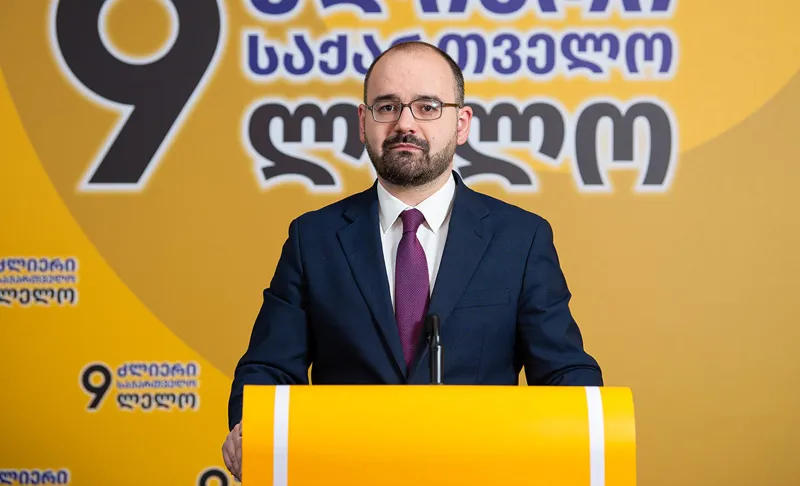
Georgia is no longer part of the enlargement agenda at all and is no longer present at any important table where the fate of the new peace and security architecture of this region is being decided. This is a direct result of the “Georgian Dream” policy, Grigol Gegelia, Foreign Secretary of “Lelo - Strong Georgia,” said, responding to a statement by European Commissioner for Enlargement Marta Kos, who did not name Georgia among the candidate countries.
According to Gegelia, despite setbacks in previous years, Georgia was still formally part of the enlargement agenda, but it has now definitively lost its chance, and “this is the result of the Georgian Dream’s policy.”
“Unfortunately, the moment has come when Georgia is no longer part of the enlargement agenda at all. Over the past years, there were individual moments when we experienced many setbacks, but formally, we were still part of the enlargement agenda. Today, we have reached a critical moment when Georgia is no longer part of the enlargement agenda at all and is no longer present at any important table where the fate of the new peace and security architecture of this region is being decided. This is a direct result of the ‘Georgian Dream’ policy, and because of this policy, Georgia is losing its chances, opportunities, investments and the chance to create a better future that lies before us. This is the result of the ‘Georgian Dream’ policy, and the cumulative outcome of all this will be an isolated, lagging behind and impoverished Georgian state, where people have no prospects. We are being forced to flee and leave the country en masse in search of work abroad. Unfortunately, nothing good, great and Georgian is happening anymore. Therefore, we must peacefully and democratically get rid of the ‘Georgian Dream’ regime and restore the historic foreign policy course that can today create significant prosperity for every Georgian,” Gegelia said.
For reference, European Commissioner for Enlargement Marta Kos said that European leaders would meet at the European Council in October to discuss enlargement. Therefore, she said, in September, in preparation for the discussion among European leaders, the Commission would present ideas on how the EU should prepare for a situation in which candidate countries approach the completion of accession negotiations.
Kos stressed that four issues need to be considered in order to reach consensus at the highest level on admitting new member states.
“First, we need to understand what impact new members may have and, where that impact could be detrimental to our member states, we must act to protect their interests. Second, we need to consider the internal reforms required for a larger Union to maintain its capacity to act and remain flexible enough to adapt quickly in response to crises. Third, every new member must strengthen Europe - politically, economically and in terms of our security. This starts with the rule of law. We need a proven track record of reforms and implementation of accession commitments, but we must go one step further. We need to make sure that we are not letting Trojan horses in. Not today, nor 10 or 20 years from now. Fourth, EU enlargement must evolve in light of today’s realities. Preparing for accession takes time. But time is precisely what our adversaries are no longer giving our candidates. They are not patiently waiting for a 20-year accession process in candidate countries to conclude. They are investing. They are exerting political pressure. They are creating dependencies. They are exploiting uncertainty. Therefore, in the enlargement process, we must abandon the ‘all or nothing’ logic. We need a more structured approach and must seek more ambitious pathways toward gradual integration. We want to bring the benefits of our Union to candidate countries before accession so that they can better withstand external pressure. These benefits should focus on strategic sectors that serve both current and future members. However, the principle remains unchanged: benefits come in line with commitments and reforms,” Kos said.
According to her, 2026 will be a record year in terms of progress on EU enlargement.
“Montenegro has closed more than half of the negotiating chapters, and member states have begun preparing the accession treaty. Albania has also recently passed a crucial interim rule-of-law benchmark and begun closing chapters. Ukraine and Moldova have made significant technical progress across the entire body of EU legislation over the past two years. By the end of this week, Iceland will vote on restarting accession negotiations. It is already part of the single market and could conclude accession negotiations within one or two years. I also want other candidate countries to join this group of leaders. And they can, if they demonstrate the same determination, fulfil their commitments and build trust with all our member states. However, in today’s world, this trust is based on much more than the adoption of European legislation,” Kos said.