Archil Gorduladze on Marta Kos: They should look at the map and realize that speaking from a position on the brink of a civilizational abyss is still unhealthy for them - just as Georgia needs the EU, the EU may need Georgia even more
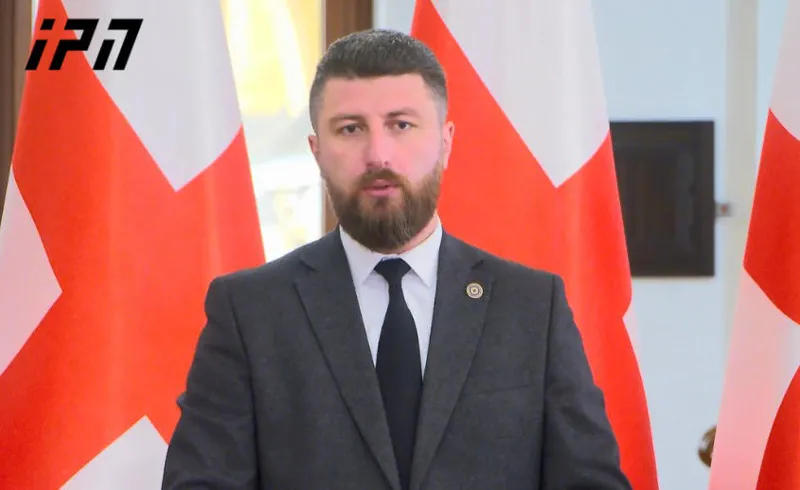
“We advise them to look at the map and realize that speaking from their position on the brink of a civilizational abyss is still unhealthy for them. Just as Georgia needs the European Union, at this moment the EU may need Georgia even more, given our geographical location,” Archil Gorduladze, Chairman of the Parliamentary Committee on Legal Affairs, said, responding to a statement by European Commissioner for Enlargement Marta Kos, who did not name Georgia among the countries seeking EU membership.
According to him, Marta Kos is concerned that it is no longer possible to bring “black money” into Georgia, while she does not speak about the fact that, according to studies and reports conducted by various EU institutions themselves, Georgia holds leading positions compared with Moldova and other candidate countries.
“Marta Kos mentions Georgia only and exclusively when she is concerned that, under the legislation adopted at the initiative of our team, it is no longer possible for ‘black money’ to enter our country. That is the only thing she is concerned about. She is concerned that they are looking for every possible way to somehow bring this ‘black money’ into our country, which is then used for violence, demonstrations and xenophobic campaigns. She is concerned about this and always mentions Georgia in this context, but she does not talk about the fact that, according to studies and reports conducted by various EU institutions themselves, Georgia holds leading positions compared with Moldova or other candidate countries.
This is yet another confirmation that, for them, it does not matter at all what Georgia is doing or what steps it is taking to develop the country. What matters is political expediency, and when they are directly subordinated to external governance, they must speak about Georgia only in a negative context, even when they go against geopolitics, geography and the map.
We remember that whenever summits are held among countries with access to the sea, Georgia tends to be forgotten. We advise them to look at the map and once again realize that speaking from their position on the brink of a civilizational abyss is still unhealthy for them. Just as Georgia needs the European Union, at this moment the EU may need Georgia even more, given our geographical location,” Gorduladze said.
For reference, European Commissioner for Enlargement Marta Kos said that European leaders would meet at the European Council in October to discuss enlargement. Therefore, she said, in September, in preparation for the discussion among European leaders, the Commission would present ideas on how the EU should prepare for a situation in which candidate countries approach the completion of accession negotiations.
Kos stressed that four issues need to be considered in order to reach consensus at the highest level on admitting new member states.
“First, we need to understand what impact new members may have and, where that impact could be detrimental to our member states, we must act to protect their interests. Second, we need to consider the internal reforms required for a larger Union to maintain its capacity to act and remain flexible enough to adapt quickly in response to crises. Third, every new member must strengthen Europe - politically, economically and in terms of our security. This starts with the rule of law. We need a proven track record of reforms and implementation of accession commitments, but we must go one step further. We need to make sure that we are not letting Trojan horses in. Not today, nor 10 or 20 years from now.
Fourth, EU enlargement must evolve in light of today’s realities. Preparing for accession takes time. But time is precisely what our adversaries are no longer giving our candidates. They are not patiently waiting for a 20-year accession process in candidate countries to conclude. They are investing. They are exerting political pressure. They are creating dependencies. They are exploiting uncertainty. Therefore, in the enlargement process, we must abandon the ‘all or nothing’ logic. We need a more structured approach and must seek more ambitious pathways toward gradual integration. We want to bring the benefits of our Union to candidate countries before accession so that they can better withstand external pressure. These benefits should focus on strategic sectors that serve both current and future members. However, the principle remains unchanged: benefits come in line with commitments and reforms,” Kos said.
According to her, 2026 will be a record year in terms of progress on EU enlargement.
“Montenegro has closed more than half of the negotiating chapters, and member states have begun preparing the accession treaty. Albania has also recently passed a crucial interim rule-of-law benchmark and begun closing chapters. Ukraine and Moldova have made significant technical progress across the entire body of EU legislation over the past two years. By the end of this week, Iceland will vote on restarting accession negotiations. It is already part of the single market and could conclude accession negotiations within one or two years.
“I also want other candidate countries to join this group of leaders. And they can, if they demonstrate the same determination, fulfil their commitments and build trust with all our member states. However, in today’s world, this trust is based on much more than the adoption of European legislation,” Kos said.