Salome Zurabishvili: We had the “Russian elections”, this is not the usual kind of electoral fraud one might expect, it was meticulously planned
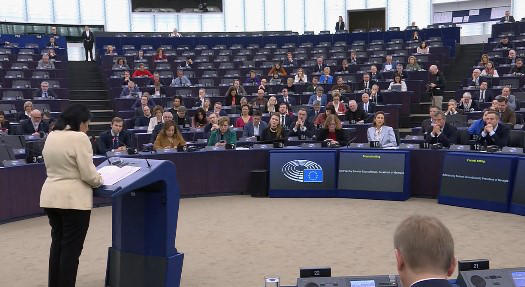
The construction of a Russian-style state is progressing gradually but definitively. All institutions are falling under the control of a single party - the parliament, the government, the central electoral commission, the central bank, the anti-corruption office, and even the pension fund, which has been reformed. Most notably, the justice system is entirely under control, from the lower courts all the way to the constitutional court. This leads us to what can only be called "Russian" elections, - Georgian President Salome Zurabishvili stated in her speech to the European Parliament.
As the President explained, she wanted to talk to the Minister of Internal Affairs about the cases of violence that occurred during the elections, but she could not get in touch with him.
“The construction of a Russian-style state is progressing gradually but definitively. All institutions are falling under the control of a single party - the parliament, the government, the central electoral commission, the central bank, the anti-corruption office, and even the pension fund, which has been reformed. Most notably, the justice system is entirely under control, from the lower courts all the way to the constitutional court. This leads us to what can only be called "Russian" elections - though the term "Russian" is in quotes, because these elections are systematically rigged, highly sophisticated, and far more advanced than typical fraud. This is not the usual kind of electoral fraud one might expect; it was meticulously planned. The changes to the electoral code began much earlier, ensuring full control of the central electoral commission by those appointed by the head of the commission, who himself was not chosen according to the guidelines proposed by the European Union, but was instead appointed for a term of four to five years.
The electronic voting system was also designed in a specific way, lacking essential controls such as fingerprint or facial recognition. Call centers, which had previously been denounced by the Georgian Dream party for using the pensions of European elderly citizens in their investigations, were utilized again during the elections - 3,500 such centers.
Administrative resources were heavily mobilized, with intimidation tactics used on the public sector long before the elections.
The propaganda, Russian-style, was pervasive both before and during the elections. There were posters, which you may have seen, comparing the destruction of cathedrals and theaters in Ukraine with the supposed "blooming" of Georgia. These posters shocked the Georgian public to such an extent that they had to be withdrawn, as they did not reflect Georgia’s values and character, but were clearly influenced by Russian imagery. Videos of a similar nature and hate speech were widespread, and the ruling party repeatedly accused opposition parties of plotting to overthrow the government. They claimed the opposition leaders would be arrested and their parties abolished after the elections.
Massive amounts of black money were used, with around 600 million Georgian Laris (approximately 200 million US dollars) being exchanged in October alone to cover the illicit funds spent during those two months.
On election day, there was an absence of police presence. I personally witnessed violence in some districts and at voting stations, and when I attempted to contact the Minister of Internal Affairs, I could not reach him - neither by mobile phone nor through the government network, and neither could I reach his deputy. To this day, I have not received a return call.
There was no court to address the irregularities and appeals that were filed, except for one highly publicized case, which demonstrated the lack of confidentiality in the electronic voting system. However, the judge who courageously upheld this case was not supported by the Court of Appeals, and none of the other appeals were ever recognized.
Two fundamental principles were violated during these elections, and these violations are enough to demonstrate that any result would have been completely different.
One principle that was violated was universality. Georgia's diaspora, which includes over a million members, was highly mobilized, especially in Strasbourg - an important case, as it was here that the opening of a voting station was denied. Despite Strasbourg being home to many Georgians, and meeting all the necessary criteria for opening a voting station, the request was refused. Of the more than one million diaspora members, only 34,000 voted, despite their strong engagement, as they knew that these elections were about a choice between Europe and Russia.
The second violation was the principle of confidentiality, due to the way the electronic voting system was implemented. Party cameras were positioned over the voting machines, and the election commission members were all appointed by the head of the Central Electoral Commission. These issues were raised in the Constitutional Court, despite concerns about its independence. Our hope was that the court might recognize that the results were rigged and take steps to facilitate a step out of constitutional crisis, a constitutional path toward new elections, but unfortunately, that hope was not realized,” the President noted.