Shalva Papuashvili: Are you implying that Ukraine will sign an agreement with Russia that will hand us over to Russia?! Or that the European Union will hand us over to Russia?!
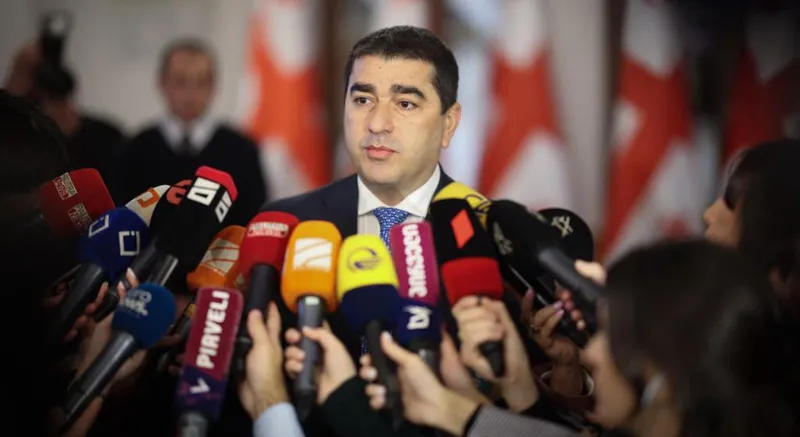
"If the war ends, it will be an agreement with Ukraine as the main signatory. Do you think Ukraine will hand us over to Russia?! Are you implying that Ukraine will sign an agreement with Russia that will hand us over to Russia?! Part of these negotiations will also involve the European Union. Do you think the European Union will hand us over to Russia?!"
This was the response of the Speaker of Parliament, Shalva Papuashvili, to a question about how a possible cessation of hostilities in Ukraine, considering the Kremlin’s conditions, might affect Georgia, the issue of occupation, and whether this means that, aside from Ukraine, Georgia’s fate could also be decided.
As Papuashvili stated, “This question is based on the assumption that there could be a geopolitical reshuffling, which would involve Ukraine signing an agreement with Russia, through which we would be handed over to Russia, while Ukraine itself would become part of the European Union.”
He also noted that "the participants in the negotiations are the USA, Ukraine, and the European Union, and this suggests that Ukraine and the European Union will hand Georgia over to Russia.
One thing is important—this is the national interests of your country. We are not relying on what kind of agreement Ukraine will reach with Russia! We are only relying on our people and our national interests. We have already learned this lesson. We have already experienced this lesson. We know how such wars start, as we saw in 2008, and now we understand that the war could have been avoided. We understand all of this, including from the United States.”
Georgia paid its share of blood in the war. Fortunately, it did not face the massive destruction and casualties that Ukraine is experiencing now, which has lost hundreds of thousands of people—youth, an entire generation lost in the war, the consequences of which are now being discussed, with claims that it could have been avoided.
“We also know how such wars end. Eight years after the 2008 war, U.S. Secretary of State Hillary Clinton handed the Russian Foreign Minister the reset button. A year and a half after the August war, on May 9th, U.S., British, French, Polish, and Ukrainian armed forces were participating in the military parade on Red Square in Moscow.”
From our recent history, we know how world politics and geopolitics are arranged. Because we know this, we put nothing above Georgia’s national interests!
In February 2022, the opposition, its media, and NGOs placed the interests of Ukraine—and some European countries—above Georgia’s national interests. They demanded sending volunteers to Ukraine and imposing sanctions on Russia. They said we should risk entering the war and destroying our economy. Today, the same people are telling us that we should consider their opinion. If we had listened to them in February 2022, today we would be a war-torn country, and whose tank would be there and whose bullet would be fired would have been part of foreign concerns.
Geopolitics and international politics are cold-blooded matters. Every country acts based on its own interests. We saw that two years ago, a certain country had a different interest in response to Russian aggression, and today that interest may have changed. When you follow the interests of others, you ultimately harm your own interests.
A lot can happen—some things we can influence, some things we cannot. As a country with limited influence on world politics, Georgia will not have a major impact, but what we can influence is how we act and what we do to ensure the fulfillment of our national interests.
Our national interest is two main objectives: the unification of the country and the well-being of the people.
The main guarantor is the steadfast focus on protecting Georgia’s national interests, which serves as the main filter for all our decisions," stated Shalva Papuashvili.