Rasa Juknevičienė: It is difficult to talk about Georgia’s progress on the path to the European Union – we need to reconsider our policy towards Georgia, including the visa-free regime and the Association Agreement
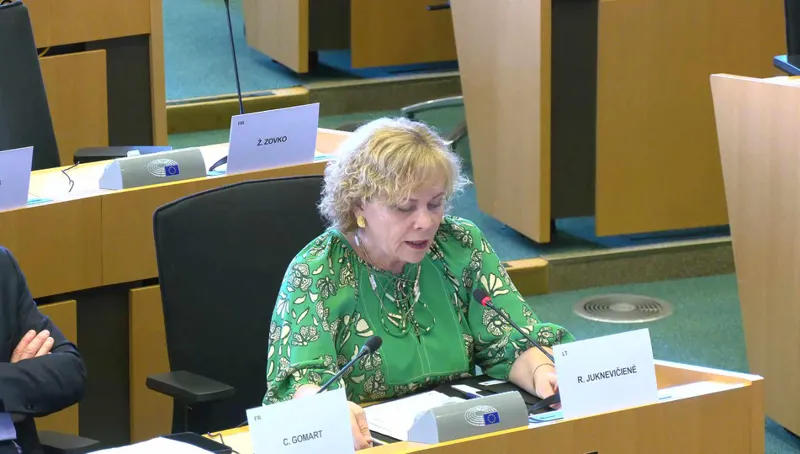
After the falsified parliamentary elections, the violence against peaceful protesters, and the subsequent political repressions, it is difficult to speak about Georgia’s progress on the path to the European Union – said Lithuanian MEP and the European Parliament’s standing rapporteur on Georgia, Rasa Juknevičienė, during the presentation of the draft 2024 report on Georgia at the European Parliament's Foreign Affairs Committee meeting.
“Theoretically, the aim of the report is to assess the progress of Georgia, as an EU candidate country, on its path to EU membership.
Of course, we all understand that today’s situation is very far from what we would consider progress for a candidate country. After falsified parliamentary elections, violence against peaceful protesters, and subsequent political repressions, it is hard to talk about progress.
Georgia’s candidate status is de facto suspended. The self-appointed government of Georgian Dream has distanced itself from the European Union, halted accession talks, is destroying the values upon which our cooperation is based, and is actively attacking the EU with hostile rhetoric and disinformation. In contrast, thousands of Georgians continue to take to the streets every day, fighting for their country’s democratic and pro-European future,” Juknevičienė said.
According to her, the initial draft of the report is based on the last three European Parliament resolutions on Georgia.
“The main points are as follows: We condemn the democratic backsliding of recent years, culminating in the falsified 2024 parliamentary elections. We reject the legitimacy of the self-appointed Georgian Dream government. We condemn the violence against civil society,” said Juknevičienė.
She stated that the only way out of the crisis is through new democratic elections.
“The report notes that the EU has a significant role and responsibility to reconsider its relationship with Georgia. Unfortunately, the response from most member states — including from the Council and the Commission — has been inadequate, with only a few exceptions.
Firstly, we need urgent and well-coordinated sanctions from the member states against those officials responsible for democratic backsliding, especially Bidzina Ivanishvili.
Secondly, we must reconsider our policy toward Georgia, including the visa-free regime and the Association Agreement.
Thirdly, we must provide stronger support for civil society and independent media.
According to our rules, the initial draft of the report has a limited scope. In the coming weeks, we will have the opportunity to further clarify our position and propose changes. To be honest, there’s not much to add, since Georgia’s EU accession process is de facto suspended,” Juknevičienė concluded.