Salome Zurabishvili addresses the foreign ministers of the European Union member states and Kaja Kallas in an open letter
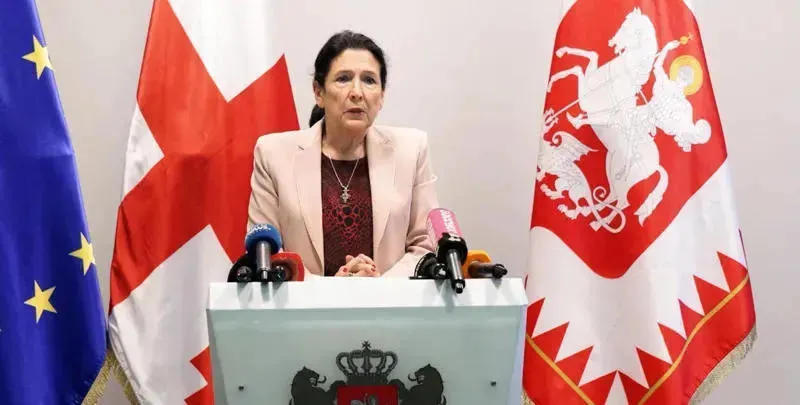
Georgia’s 5th President Salome Zurabishvili has addressed an open letter to the foreign ministers of the European Union member states, the Vice-President of the European Commission, and the EU High Representative for Foreign Affairs and Security Policy, Kaja Kallas.
In the letter, Zurabishvili states that “the current situation in Georgia is not merely an internal political crisis caused by rigged elections; Europe faces a new challenge—one that contradicts and harms its democratic vision.”
She says the situation has reached a critical point, and if the European Union does not respond clearly, unitedly, and with concrete results, it will not only lose Georgia as a strategic partner but will also set a dangerous precedent where no one counters the decline of democracy and Russian interference on Europe’s borders.
Salome Zurabishvili urges the EU and its member states to assess the situation in Georgia, unequivocally support the Georgian people, and take coordinated political steps.
The 5th president also notes in her letter that the time for strategic patience has ended and that moral courage and political clarity are now essential.
She emphasizes that Georgia’s democratic future, Europe’s credibility, and geopolitical integrity hang by a thread.
To the Foreign Ministers of the European Union Member States, the Vice-President of the European Commission, and the EU High Representative for Foreign Affairs and Security Policy, Kaja Kallas:
Following the European Parliament’s resolution, at the moment when the Foreign Affairs Council prepares to discuss the situation in Georgia, it is my duty to draw your attention to the extremely alarming internal political and geopolitical developments facing the country that holds EU candidate status and thus deserves your serious attention and response.
Beyond the accelerated democratic backsliding clearly highlighted in the European Parliament resolution, and despite decades of effort by our European partners to build democratic institutions and conditions, the country is rapidly turning into a quasi-totalitarian (almost authoritarian) system. It is clear that Russia is attempting to subjugate this country with a new hybrid strategy based on rigged elections, large-scale propaganda, and indirect interference.
Given Russia’s failure to achieve its military objectives in Ukraine, it is difficult not to question the lack of response—beyond specific condemnations and partial sanctions—needed to stop the “peaceful capture” of state institutions. This process does not involve military intervention but is no less alarming and poses a serious threat.
It is known that Russia has made similar, though so far unsuccessful, attempts in Moldova, Romania, Serbia, and other countries, clearly indicating the need for a strategic reassessment of the region and how to counter Russia’s new strategies.
The Caucasus region remains an essential element of the EU’s future enlargement.
Currently ongoing positive processes between Armenia and Azerbaijan open new opportunities that Russia can no longer directly block, as it had for years, and now seeks to counter through control over Georgia’s government. By doing so, Russia obstructs the formation of a peaceful, stable, and united Caucasus open to closer cooperation with the EU. Through control over Georgia, Russia also seeks to maintain exclusive influence in the Black Sea region.
The country’s ruling regime, politically subordinate to Russia’s dictatorship, is opening economic routes for Chinese investments on the Black Sea coast, including the Anaklia port, creating competition for European and Western investments, which aligns with Russia’s strategic interests.
I want to emphasize that the current situation in Georgia is not only an internal political crisis caused by rigged elections; Europe faces a new challenge that contradicts and harms its democratic vision—a challenge that blocks the EU’s growing influence and enlargement, fundamentally a crisis for Europe itself.
The situation has reached a critical point. If the EU does not respond clearly, unitedly, and with concrete results, it will not only lose Georgia as a strategic partner but will create a dangerous precedent where no one counters democratic backsliding and Russian interference on Europe’s borders.
Ahead of the Foreign Affairs Council meeting scheduled for July 15, 2025, I urgently call on the EU and its member states to:
Assess the situation in the country as an authoritarian seizure of power and a clear strategic shift toward alliance with Russia.
Clearly and unconditionally support the Georgian people, who stand with European flags against cruelty and fear. Less response means abandoning a nation that has never lost its goal of joining the European family.
Act with coordinated political steps: clearly, unanimously, and effectively, as demanded by the European Parliament resolutions. Any delay at this stage means surrendering to authoritarianism and Russian influence.
The time for strategic patience has ended! Now moral courage and political clarity are necessary. Georgia’s democratic future, Europe’s credibility, and geopolitical integrity hang by a thread, — Salome Zurabishvili