Tata Khvedeliani: The goal of merging TSU and GTU is land and property seizure, destroying the century-old technical university, and replacing it with Ivanishvili’s 4-5-year-old Kutaisi Technological University
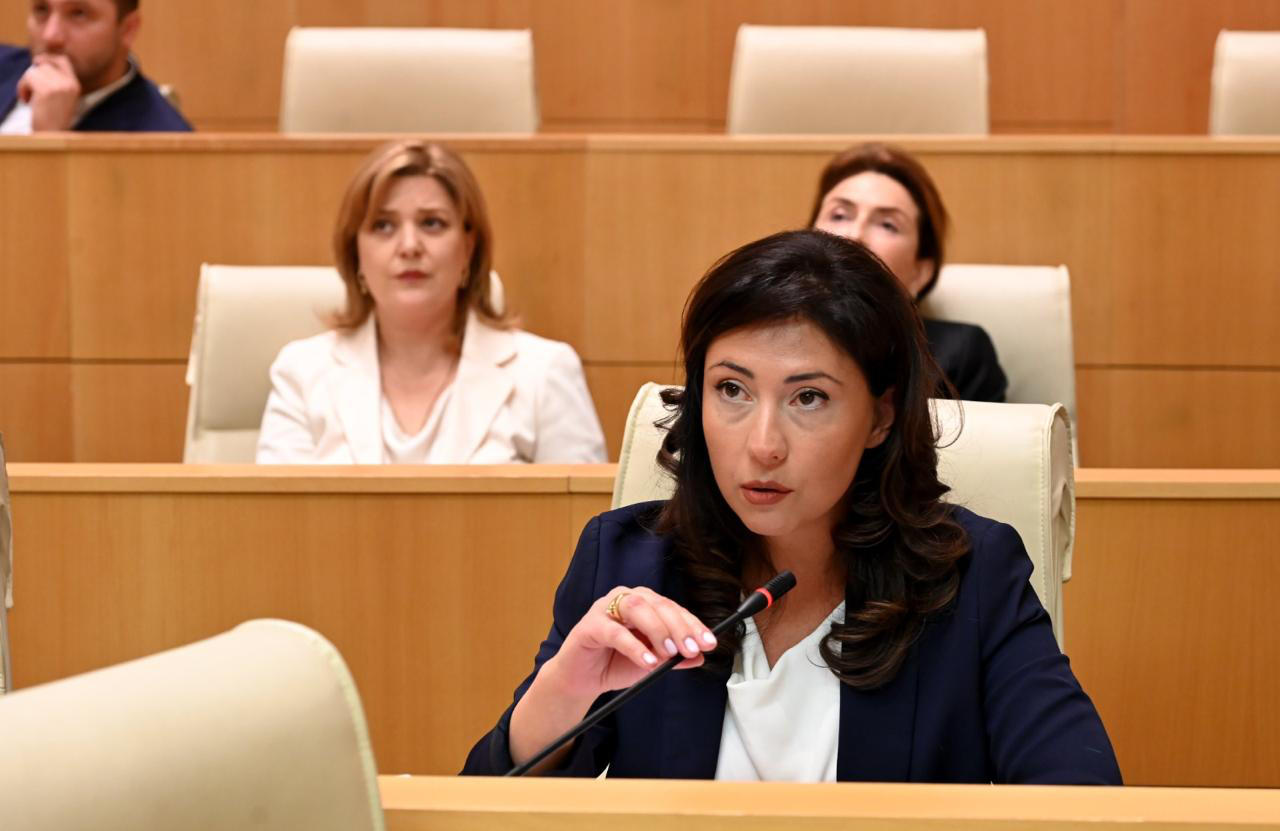
“This draft law you submitted has nothing to do with solving challenges in the education system. Your Prime Minister, who gave a lengthy speech from the parliamentary tribune about education and the ‘Eagle Hills’ project, did not even mention the issue of merging the two universities!” - this statement was made by Tata Khvedeliani, a deputy from the “For Georgia” faction, during a plenary session of Parliament where proposed changes in higher education were reviewed article by article in the second reading.
According to Khvedeliani, the merger of Tbilisi State University (TSU) and the Georgian Technical University (GTU) is aimed at:
-
Seizing the property of state universities, including land and buildings.
-
Completely eliminating the century-old state technical university.
-
Replacing it with Ivanishvili’s 4-5-year-old Kutaisi Technological University.
-
Abolishing academic freedom.
Khvedeliani argued that the legislative changes presented in Parliament constitute a direct attack on the quality of education, causing serious harm to the younger generation.
“The change under consideration is an instrument that allows the state to bypass university internal democracy if it decides to make structural changes in universities. Especially in a context where significant protest arose against the merger of these two historically long-standing universities, behind which the government’s corrupt interests are hidden.
This change allows the government, during the merger or reorganization of universities, to abolish university autonomy and establish direct control. Until now, state universities had the authority to elect their own rector, academic council, and administration. Under this change, if the government decides to reorganize - for example, merge two universities - the minister will have the right to directly appoint the rector, head of administration, and acting head of quality assurance, instead of having them elected.
During reorganization, the representative council will replace the academic council, meaning that professors and students, who were elected to these councils, will no longer make decisions during the reorganization period. Instead, decisions will be made by a council appointed by the government. Although this is temporary, the duration of reorganization depends entirely on the government, and during this period, professors’ critical opinions can be easily neutralized by the authorities.
By politically intervening, the state deliberately blocks Georgia’s path toward the European educational space. These decisions isolate our country and cast doubt on the legitimacy of Georgian diplomas worldwide.
This is a conscious undermining of students’ future. Current processes ignore university autonomy, exclude the academic community from decision-making on higher education reform, and violate European higher education quality standards. This, in turn, fundamentally contradicts the principles of the Bologna Process, thereby violating Georgia’s Association Agreement with the European Union,” Khvedeliani stated.
Khvedeliani also noted that, according to international research, preparing a university merger usually takes at least two years. In his view, no well-known merger of two universities has ever been planned in less time.
“Before making a decision, an analysis of the merger’s feasibility is conducted - financial, academic, and legal risks must be assessed. You have not presented such evidence publicly; moreover, the studies and experts involved in developing this reform remain secret because you simply do not have them.
The planning of a merger must involve all stakeholders - academic staff, students, administration, etc. - in our reality, none of this happened; even the rectors were surprised by the decision, as reflected in their statements.
The state must see such a fundamental change at least several years in advance - in no strategy are the idea, funds, or position fixed,” Khvedeliani concluded.