Peter Fischer - We are not regime change agents, we don't care who governs Georgia
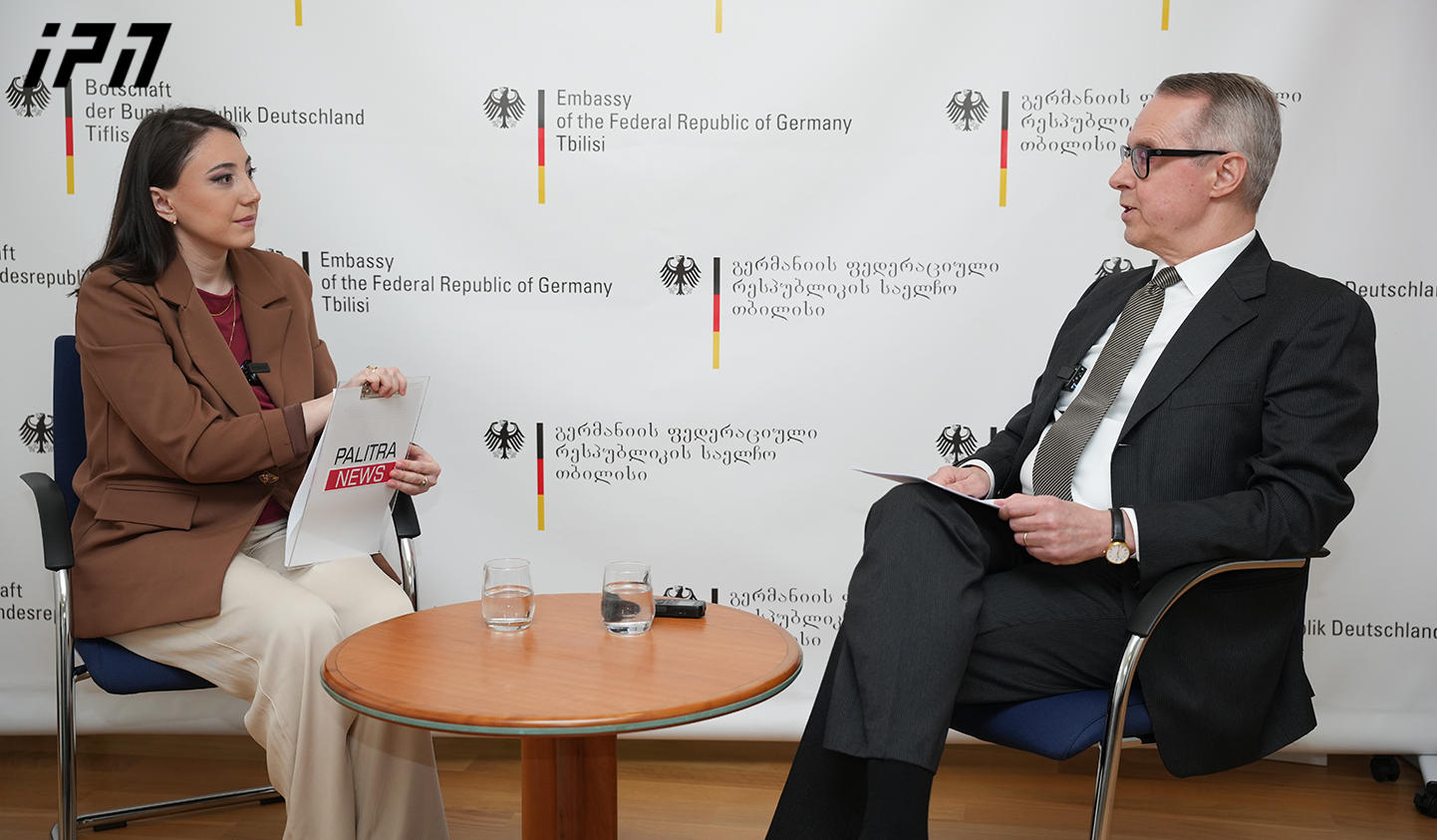
Stop the disinformation attacks against Germany, the German Ambassador and the European Union - this is one of the messages that the German Ambassador to Georgia, Peter Fischer, brought to Georgia after almost three weeks of consultations.
In an exclusive interview with InterpressNews, the Ambassador had to explain once again that they do not represent the “global war party” or agents who want to change the government in Georgia.
In addition, the ambassador clearly stated that the legislation that the ruling power is passing one after another does not lead Georgia closer to the European Union, but rather moves it away from it at a rapid pace.
What is the limit to interfering in the internal affairs of a country and indicating to a partner country that it is not fulfilling its obligations, how effective he sees the sanctions mechanism in relation to Georgia, and how he responds to Shalva Papuashvili's statement that individuals who have received foreign funding should not be able to directly enter politics – the Ambassador talked about these issues in detail in the interview...
Let’s begin the interview by discussing the international response to the developments in Georgia, and first and foremost, the decision to activate the “Moscow Mechanism,” adopted with the support of 23 OSCE participating States, including Germany. What specific information and facts formed the basis for the decision to trigger this mechanism, and to what extent is it connected, among other things, to reports regarding the possible use of chemical agents against protesters during the dispersal of demonstrations in November-December 2024? Additionally, what signal does the OSCE send to the Georgian authorities by activating this international mechanism?
Georgia is a participating state in the OSCE. It's like membership in this international organisation. And membership in international organisations comes with commitments and obligations. So as a participating state in the OSCE, Georgia committed, freely signed up and undertook to uphold human rights and fundamental rights. The philosophy of the OSCE is that the human rights and fundamental rights of the citizens are essential for peace, justice, well-being and friendly relations among the participating states. That's the black on white text of the OSCE agreements. The point of the OSCE is to cooperate for a peaceful world. And all participating states, including Georgia, have agreed, black on white in writing, that human rights and fundamental rights “are of immediate concern to all participating states, and do not belong to the exclusive area of internal affairs." So, these are the rules of the game. If you're part of an organisation, sign up for these things, you may expect, and you must expect that you'll be measured by the rules that you signed up to. So the procedure is, in December 2024, OSCE, the participating state, invoked the Vienna mechanism. Georgia made a response which was not satisfactory, and then in late January, we activated the Moscow mechanism -23 states, including Germany. And that means that the OSCE will appoint an expert mission to come here to establish the facts, to make recommendations. Those recommendations will go back to the participating states for review. Georgia has the opportunity to take a position vis a vis the recommendations, and then it will go to the OSCE permanent council to follow up. The scope of the expert mission is quite long. I have the text with me. You can check it all. It's all on the record, everything is black on white and can be read. There's no need to imagine things or speculate. It's about human rights and fundamental freedoms, the rule of law in Georgia. It includes the demonstrations at the end of 2024 and early 2025. What I want to say is, Georgia signed up to the OSCE. Georgia is a member of the United Nations. The United Nations has a declaration of human rights and other instruments. Georgia is a member of the Council of Europe. Georgia signed the EU Association Agreement. The Association agreement also has, in its preamble and in its general principles, reference to human rights, fundamental freedoms, rule of law, and to Georgia's European values and aspirations. Georgia signed the DCFTA (deep and comprehensive free trade agreement) with the EU. It also refers to human rights and fundamental freedoms. Georgia signed the EU visa liberation and liberalisation agreement with the EU. It also refers to human rights and fundamental freedoms. And finally, Georgia applied to join the EU and the EU is a place, more than anything else, of human rights and fundamental freedoms of citizens. And now what's happened? Georgia got a very harsh review at the UN Human Rights Council, the United Nations. Georgia is, at present, not participating in the Parliamentary Assembly of the Council of Europe. Georgia is facing sanctions under the EU visa liberalisation regime and the process of EU membership has come to a standstill for Georgia. So everybody's wrong - the OSCE is wrong, the United Nations are wrong, the Council of Europe is wrong, and the EU is wrong. Everything is wrong and unfair about what's happening to Georgia. Is that possible?
Since we mentioned the November-December 2024 demonstrations, here I would also like to ask you about the investigation conducted by the BBC, according to which the Georgian Dream government allegedly used a forbidden chemical substance-Camite against their own people. In response to the prepared report, Georgia’s State Security Service launched an investigation and, within a few days, published a conclusion stating that “the police did not use the banned Camite against protesters, but rather Chlorobenzylidenemalononitrile,” and that “Camite has never been procured by the Ministry of Internal Affairs.” How reliable do you find the results of the investigation conducted by the State Security Service? Accordingly, should this issue be considered closed, or do you see a necessity for an international investigation?
So I'm quite sure that the technical Secretariat of the international organisation called OPCW (Organisation for the Prohibition of Chemical Weapons), is following this issue quite closely. As far as I know from the media, Georgia has undertaken proceedings against the BBC, and I imagine that will bring more facts to light. And of course, it's always better if you have more than one source establishing the facts.
Let us return once again to the issue of the OSCE expert mission - there are some expectations in Tbilisi that the report prepared by the expert mission will serve as a signal to international organisations and Western countries to make tough decisions in response to the situation in Georgia. Do you think that an expert report can form the basis for sanctions and hard political decisions? If sanctions are in place, will they be directed towards the ruling elite or the country?
Well, the expert mission, as I said, will first establish facts and make recommendations. I speak for Germany. I'm the German ambassador and Germany already assesses that there have been violations of human rights and international commitments by Georgia in connection with the demonstrations, at the end of 2024, early 2025. We have to see where the OSCE process leads. It's an international organisation that works along its own rules and with the participating states. But I'd like to say something fundamental about sanctions, because it always comes up in every conversation I have with Georgian people, and it's important to have realistic expectations about sanctions. The first thing - it is completely exceptional for one state or one organisation like the EU to establish sanctions against citizens of another state for acts that they have committed in their own state or outside our state. We call that extraterritorial jurisdiction. That is a big exception that shouldn't be. Germany looks after Germany; The EU looks after the EU; Georgia looks after Georgia. So foremost, it's exceptional, and it can only happen if there's a legal basis, if there's a law or an international agreement. Now the legal basis can be violations of international agreements; it can be violations of human rights; it can be waging a war of aggression on another state. That's also a violation of international law. It can be for owning or using forbidden weapons - again, violation of something that is written black on white, and it can be for violating international sanctions regimes. Plus, there has to be hard evidence that such a violation has occurred. We say evidence has to be enough to be sustained before a court of law. We don't want to, and we can't legally impose sanctions against people that we think are unfriendly or harmful. To put it in a casual way, just because we don't like someone, we can't establish sanctions against them. That's illegal, and we don't do it. We also can't have sanctions against family members of people unless there is hard evidence that a family member has committed a violation of the legal basis that I mentioned. And finally, on sanctions, and I would just like to repeat this to my Georgian friends, yes, it's an instrument that is used. It's an effective instrument, but it's not a fast instrument. Look at Russia under sanctions, look at Iran under sanctions, look at North Korea under heavy sanctions. It still hasn't stopped its illegal activity. So, sanctions are not a solution to everything, and you have to have realistic expectations about sanctions.
For example, we are concerned about what decision may be made regarding Georgia's visa-free regime. Under what circumstances could EU member states reach this decision, and what position will Germany have? On the other hand, if visa liberalisation is suspended, will it be used as a punishment for the Georgian Dream government, the country as a whole, or Georgian society?
The first thing I want to say about this is that, Germany, and I think it's fair to say to the EU, we don't want to suspend visa-free visas for Georgians. What we want is the contrary - actually, we want you to join the EU. That's our offer. You have candidate status. You don't just need a visa. You can be our co-citizens. It's there for the taking. You just have to do what's necessary. So that's the first thing. We don't want to stop Georgians from coming to our country. We think Georgians are our friends, and we want you to come as often and as freely as you want, as tourists, as students, to have jobs. If you're co- citizens, then you have freedom of movement within the EU, you can even vote in local elections and so on. So, that's not what we want, but then I have to come back again to international agreements. The visa liberalisation agreement between the EU and Georgia has four so-called blocks and benchmarks, which we look at to decide whether we should suspend the obligation for citizens of a foreign country to get visas to our country. Three of these blocks have to do with passports, migration and unfounded asylum claims. But the last one also has to do with the state of our relations. Are we in a friendly state or not so friendly, and are our fundamental rights protected in that country? The commission, in its seventh report, and commission every year reviews the status of this suspension of the obligation to have a visa. And I guess it was last year that it came to the conclusion that Georgia is violating some of the benchmarks that we both agreed to, that we both signed up to, and therefore, as a consequence, the formal decision will be suspending visa-free visas for Georgian diplomatic passports and official passports. The next step, if there is a next step, depends on Georgia, not on us. We will again review the benchmarks that are in our bilateral agreement to suspend the obligation to have visas. And it really depends on what the development is here, including whether we are friendly to each other and whether human rights are respected in this country. And finally, to travel to the European Union, visa free, is a privilege, not a right. To require a visa is not a punishment. It's still possible to travel, you just have to apply for a visa. Most countries have to apply for visas. You have to apply for visas to most countries. It's not the end of the world.
What would be the position of Germany? Will you support whatever the EU decides?
Depends on what our assessment is at the time, but our basic position is, we want you to keep visa free. We want you to be our friends. We want you to come to Germany, to other EU countries, to do your thing, as you do now. Georgians are very welcome in the EU. That shouldn't even be a matter of debate. After all, you have candidate status. It's obvious that you're welcome in the EU. We want you to be a member.
Let’s now turn to the processes that unfolded on the streets of Tbilisi last year and, first of all, recall the events of October 4, 2025. For more than a year, Georgian Dream and its leaders - particularly the Speaker of Parliament, Shalva Papuashvili - have been demanding condemnation of that day’s events and clear distancing from them by Brussels and by ambassadors accredited to Georgia (it could be said that for quite some time after the events of October 4, Shalva Papuashvili posted criticism of Brussels on social media almost every morning, calling for such distancing). In this context, could you tell us how you assess the events of October 4, and at the same time, how you would respond to the Speaker of Parliament’s criticism that “Brussels does not condemn the attack on the Presidential Palace because, just a few days before the events, it effectively expressed support for it through its press spokesperson”?
So I would like to say that, of course, the EU and EU member states are opposed to violence. We don't need to prove that, everyone knows this. The EU was created out of the lesson that nationalism and violence lead to a catastrophe. Our founding treaties, which are like the constitution of the EU founding treaties, the constitutions of every EU member state, our legal systems, are all opposed to violence, extralegal violence. They're all based on the rule of law. You know, we're not the global war party. I don't know what the global war party is, but it's not us. We're the global peace party. We made peace in Europe, and we've had peace in Europe since 1945, only interrupted now by the Russian aggression against Ukraine. That's a pretty good record. We are not foreign agents. We don't care who governs Georgia. I'll come back to why we comment on certain things. I think that almost all Georgians know that the EU, and perhaps especially, Germany, have been the best friend and partner of Georgia for the past 30 years. Since your most recent independence, we have been your best friend and partner in building up democracy, in building up the economy and in pursuing Euro Atlantic integration, those are the three wishes that Georgia has consistently addressed to us, and we have responded with partnership, with friendship, with generosity and with effectiveness, because Georgia has made giant progress in all those three areas. Now, all of a sudden, we're some kind of enemy? Do we support violent coups in Georgia? It's just not true! And I honestly don't think that very many Georgians really believe that. Yes, we express ourselves in favour of human rights and fundamental freedoms, as I mentioned, based on Georgia's own commitments towards us, bilateral things that we signed together and on our own values. But we are not regime change agents. And, let me say something - we live in a time when the information space has turned into a horrible space. There is an age-old manipulative propaganda trick. That's when the presumption of guilt is the default assumption. So to say, I presume, by default, the EU is guilty - always. The EU is a global war party, Deep State, EU is something sinister. Then you make an unfounded accusation, and you ask the other side to declare that they're innocent. That's why some propaganda specialists say, just throw some dirt at someone and something will stick. Don't worry. It doesn't matter what the facts are. I think many Georgians might remember this kind of tactic from another historical time. I personally think it has to do with the dignity of the EU and the integrity of the EU, that we don't owe anyone a declaration of innocence for inventive accusations. And again, it seems to me that most Georgians consider the EU a friendly and good place, and don't give any credence to this invented accusation that we support violent coups in other countries and especially in Georgia.
Brussels bureaucracy is often accused of encouraging the radical processes in Georgia. The Georgian Dream government claims that external forces are behind the political groups, NGOs, and civil society activists, whose goal is to return to power in Georgia a political force that is easy to control. Your meeting with the group of young people was evaluated in the same context, and in general, the ruling party accuses you personally, as well as Brussels as a whole, of interfering in Georgia's internal affairs. What do you think is the line between the involvement in the country's internal affairs and the partner states' right to point out human rights violations, democratic backsliding, or other types of problems…
There's a clear line. There's a line where there's universal norms like human rights, where, according to our reading of international law, and according to the Georgian reading of international law and the things they signed up to, there is an obligation to protect human rights worldwide. I mentioned right at the beginning the UN Charter for human rights and OSCE agreements, Council of Europe agreements, all the agreements that Georgia has signed within the European Union are all based on the protection of human rights and the fundamental freedoms of citizens. That's the line. So, these accusations that we interfere in internal affairs are not correct. I'm even tempted to say total nonsense, and at the same time, it's totally legitimate that we address the central issues of things that Georgia signed up to, partially with us, we're in this together. We have a shared responsibility to implement it together, and it is our duty to say when Georgia, in our opinion, is not living up to what it signed up to. There's a legal principle for the lawyers out there; Pacta sunt servanda - stick to agreements, and agreements have two parts, and both parts have rights and obligations. I have told you plenty of examples, but the central one is Georgia's application to join the European Union. Georgia applied to join the European Union. The European Union did not apply to join Georgia. Georgia did this voluntarily. We don't want a state that doesn't want to be with us. If you don't want to be with us, stay away! I've said this many times on the record, but it is worth repeating - a candidate country must transpose European legislation into its own legislation. Joining is a legal process. Once existing European legislation is the law in your country, you can join, until then you cannot. There are some European laws that have to do with the environment, with building safety and with traffic, CO two emissions. All good and important. You must transpose those. But there are laws that are much more important and much more fundamental, the laws about the functioning of a democratic state, human rights and fundamental freedoms, the rule of law. If you don't transpose those laws, the other things, the environment and traffic, don't matter. Those are the preconditions, and one of the areas that is the law in the EU and reflects a fundamental principle is that a democracy needs a lively civil society, civil society sector. What is civil society? Civil society is you and me! Are the citizens! The citizens have rights, the citizens have interests, and the citizens must be free. They must be unhindered, to form associations, to express their interest. It can be to protect the environment; It can be against violence against women; It can be election integrity; It can be anti -corruption; It can be the protection of traditional handicrafts in remote areas. But that is part of what it means to join the European Union. If you don't have that, you can't join now. What is happening in Georgia? I'm telling you that we have come objectively to the assessment that Georgia is passing laws that are not European legislation. That's what you would need to do, but you are passing laws one after the other that are completely contrary to in those fundamental areas. Plus, every day, Georgian dream officials are explaining how terrible the EU is. At the same time, they say they want to join, right? So they say they want to join, but they're moving away at great speed. We think that's an objective assessment. Just look at the laws, and you can see - this is the Georgian law, this is the European law. The two are very, very far apart, so it doesn't make sense. It's my job. It's my duty. I'm on the other side of this agreement. I'm the ambassador of Germany. It's my job to point out this contradiction, to speak about it, and to try to make sense of it, and report it home, if we can make sense, and what I'm reporting home is that there is no logical explanation for this. What can it possibly mean? Passing laws that are contrary to European Union legislation will definitely not lead you any closer to the EU, but further away. This is just a fact now, then we hear the argument regularly made that by 2030 the EU will change fundamentally, and then the EU will be ready to accept Georgia, because, as they say, the European bureaucracy, whatever that's supposed to be, will change. It seems to be the hope of the Georgian dream, that the right-wing populist parties in Europe, like the party AFD in Germany, will come into government immediately. So two things about that, two very important things. First, most important, it's not going to happen! That's my prediction. And it certainly won't happen in many EU member states. And for enlargement, we still have the rule of unanimity - for a new member to come, every state has to say yes. So even if it were to happen in some states, even if the dream of some comes true, that the Chancellor of Germany will be from the AFD, it won't be in all 27 member states, so you won't get unanimity. So it's not going to happen. And let's assume, even theoretically, if it did, here comes the crazy part - there will be no more EU to join. AFD and those parties are against enlargement. They don't want any more enlargement. It's in their party programs. They say so every day. If you ask AFD if you want Georgia to join the EU, the answer will be no.
They're against the free movement of labour within the EU. So even if there's an EU, they will say Georgia shouldn't come to Germany to take jobs. They're against migration. They're against foreigners. Georgians are foreigners, in the view of the AFD, and they're against all the solidarity mechanisms that we have now in the EU that would be favourable to a new member like Georgia, for example, pre - accession supports, you know, all the EU programs to prepare you for a succession. They're against, they say, keeping that money in our budget.
They're against the regional and cohesion funds with which Europe supports economically weaker areas. Georgia would be one. They're against the Stability Mechanism, which the EU supports countries that have had an economic shock, an external shock. They're against the agricultural policy with which the EU supports farmers throughout the EU and especially in places where it's not so easy to do agriculture, like Georgia. They're against the trans-European networks funded through the connecting Europe facility, which Georgia seems to be banking on to pay for middle corridor infrastructure. Who's going to pay for the electricity cable? If the chancellor is from the AFD and says, stop all that funding. If there's no contribution from the EU to the Black Sea cable, I mean, it won't be able to be financed.
They're against free trade agreements, they're against the euro, and they're against Energy and Climate funding. So what's the game plan here for Georgia, objectively moving away, pinning the hope that by 2030, people will come in, who will be against enlargement and against what is now constituent of the EU? As the ambassador of a member state, it's legitimate for me to raise those questions. It's not only legitimate, it's my job. It's necessary.
“The Fischer file is closed to us” - this is the position of the Speaker of the Parliament of Georgia towards you. By the way, Shalva Papuashvili is the most active and sharp among the leaders of the “Georgian Dream”, in terms of criticism of Brussels, individual European countries, or you personally. Why do you think, among other ambassadors, you are the most often the target of attacks?
There's an invented narrative in this country. Invented narrative, the story that there's a global war party - that doesn't exist, a deep state that doesn't exist, that wants to harm Georgia. None of that is true.
The contrary is true. Europe has been and will be a friend to Georgia. I really hope Georgians realize and don't believe this invented narrative.
And we talked about manipulative techniques. This is also a technique. It's as old as history to invent a foreign scapegoat, an outside enemy, and everything can be blamed on this outside enemy.
Now, yes, I am the ambassador of the Federal Republic of Germany. We are by far the most populous state in the European Union. We are by far the largest economy in the European Union. We are the fourth-largest economy in the world.
And I think the record shows, perhaps, with the USA, we have been Georgia's best friend and partner throughout history, even before the USA was engaged here in 1918, I remind you,
So I'm abused by this inventive narrative of external enemies, and I'm taken as a welcome scapegoat and whipping boy to fit into this narrative. One of your famous politicians said, I'm just a small cog in the deep state.
But that's why I'm helpful with this invented narrative. That's the only reason. It's not about me. It's about the narrative. But I would say, don't you think it's strange that, of all the political parties in the world, the Georgian dream talks about a deep state and about opaque forces and informal rulership.
The narrative here seems to be going in the direction, who is not for us is against us also, an age-old technique, who is not for us is against the state. What's the logic of that? GD is the state that sounds pretty deep to me.
In October 2025 - specifically on October 19 - it became known that the German Federal Foreign Office had recalled you for consultations. The consultations lasted for approximately two weeks, and you returned to Georgia on November 6. I understand that you cannot speak openly to the media about all the details; however, could you tell us what adjustments were made on Germany’s side in its relations with the Georgian government, and with what directives you returned to Tbilisi?
Yeah, so, of course, I can talk about it. Nothing is secret about it, and I wasn't summoned. I was recalled for consultations, recalled for consultations as a fixed diplomatic term to express protest or disagreement. That's what Germany did. We expressed protest/disagreement against Georgia, and the main reason was the continued disinformation attacks against Germany, against the European Union and against the ambassador of Germany to Georgia. That was the occasion, plus the worrying developments in terms of legislation.
I was there for a little bit more than almost three weeks. I spoke to all the relevant government ministries at quite a high level. I spoke to the German Foreign Minister, I spoke to members of parliament, and my directive to come back was to make sure and make clear that the door remains open for Georgia to join the EU. The candidate status does not go away. The EU is a hopeful union. If a candidate turns away from us, we're still hopeful that maybe they will turn back towards us. So that's the first thing. The door is open for Georgia to return to the path of Euro-Atlantic integration. That's our wish. That's what I'm supposed to work for. That would be the optimum outcome. Joining the EU is something unique and super special. It's the highest level of integration that you can think of. But if Georgia chooses another path, it's for Georgia to choose. We don't insist that you join the EU. But then we will have to adjust. And compared to joining the EU, compared to the path you've been on, it will be a downgrade. It will be less intense, that's clear. And we have already done some downgrades.
You know, as you approach the EU, we say more for more. The closer you get, the tighter the relationship gets. The pre- accession aids kick in, and all the cooperation becomes stronger. As you distance yourself from the EU, it's less for less, right? And my directive is to help manage that process, aim for the best - prepare for the worst, deal with everything as it is in Georgia. We don't determine the course of Georgia. We see what is and we deal with it. Another directive and another request from Germany to Georgia was to stop the disinformation attacks on Germany, on the European Union, on the German ambassador. But unfortunately, that request was not met.
So, you delivered the message and it has not been met already?
Yes, the message was delivered, and you see that I'm a continued victim of disinformation attacks.
What kind of relationship do you have with the representatives of the Georgian Dream government, both you and Berlin officials? How frequent is this communication, if there is any type of communication at all?
Germany and Georgia have built up a deep and broad relationship since 1991 -1992. We opened the embassy in 1992. We were the first to accredit an ambassador across all sectors. Let me just recapitulate the kind of things we do together. We had very close political cooperation. Of course, if you're on the path to Euro Atlantic integration, we have a very close Development Corporation. We did work on the electrical grid in Georgia, the water supply, private sector reform, legal reform, entrepreneurial training, vocational training, environmental protection, urban planning, tourism development, military cooperation, very strong, other elements of security cooperation, academic and scientific exchange, all the scholarships we gave, language learning, music, theatre, fine arts, cinema, etc, etc, across the board. Much of that continues every day. There's cooperation between Germany and Georgia, and there's the appropriate contacts that happen all the time.
Now you probably have noticed that there haven't been any high-level meetings recently. High level meetings happen when there's a positive agenda, when there's something positive to be done. And right now, we don't have a positive agenda.
And if you ask about me, I know so much about the GD leadership. I know them very well. I speak German to some of them, they speak fluent German. Many have been to the German ambassador's residence. I think happily, I'd have all kinds of meetings with them. I've had confidential meetings, in groups. The photos exist. Everybody has seen the photos of me with Georgian leadership. We made “Supra” together. We had a toast, friendship, partnership, the European future of Georgia, everything was wonderful. Now a lot of them don't want to be my friends any more. I have the feeling it's not opportune to be seen with me, it's not opportune to reach out to me, not opportune to send me messages, and they don't want to be friends with me because of this mad narrative that Germany and the EU are bad, but we're not bad. I don't take that personally. The attacks were directed against the ambassador of the Federal Republic of Germany. Could it be someone else sitting in my chair? You know, I have many friends in Georgia and you know what these people tell me, friends, they say: “Thank you, Germany, thank you, Ambassador, thank you, Peter. We, Georgians, are Europeans. We want a European future. Please don't abandon us”! My answer is, we haven't and we won't.
You will often hear the assessment regarding the Georgian Dream that it has legitimacy issues both internally and externally. Therefore, it’s interesting what your position is - how legitimately elected is the Georgian Dream government for Germany?
So for once, I can give you a short answer: We recognise states, not governments. We deal with the people who are de facto in the state offices.
Since we have mentioned the issue of legitimacy, I would like to ask one more question related to an initiative voiced by the ruling party. Georgian Dream plans to introduce criminal liability for individuals who do not recognise the legitimacy of constitutional bodies and who call on others to have the same position. The working draft of the bill is not public yet. However, based on statements by representatives of Georgian Dream, they intend to share Germany’s experience, specifically the case in which the German government banned the Reichsbürger political movement. How acceptable do you consider the use of strict legislative instruments to reinforce legitimacy? And on the other hand, could you tell us more about the movement that was banned by the German state? Why did Germany resort to punitive measures against the Reichsbürger movement? What good an example is this?
It's not a good example. I think it's a misleading statement. Germany has not banned the so-called Reichsbürger. The Reichsbürger are people who think the German Empire didn't perish in 1945 but continues to exist. So you might say they're a little bit crazy, right?
The Reichsbürger is not even a formal organization. So the Reichsbürger is not banned. We have banned certain clubs and associations where people who call themselves Reichsbürger were organised and for concrete activities, some of them directed against the constitutional order, and we have prosecuted some of these people for murder. One shot a police officer. Ones were plotting to overthrow the government. Yes, that is illegal in Germany, like every normal country.
I think this statement, that is based on German law, is misleading, just as misleading as it was to say Georgian FARA is identical to US FARA, which it wasn't and it isn't. So it's a misleading statement. And I would say one thing - In Germany, freedom of association and expression is among the highest priority constitutional freedom rights of citizens. The burden of proof is very high to forbid a political group, extremely high, because, first of all, it's the right of the citizens to form political groups and to have political opinions and to have NGOs and to express themselves. That's the highest right in Germany. We've only been two political parties. One in 1952 was a neo-Nazi Party, and one in 1956, which was the Communist Party. So the principle in Germany is that the state serves the citizens. The citizens don't serve the state.
I would also like to ask about the legislative amendments recently prepared by Georgian Dream, including the tightening of laws related to grants and political activities. By the way, when explaining the reasons for further tightening the Law on Grants, representatives of the Georgian Dream often refer to a statement made in November by EU Commissioner for Enlargement Marta Kos, in which she said that they were “looking for ways to transfer funds to civil society in Georgia without damaging its existence.” For members of the ruling party, this statement by the EU Commissioner serves as proof that previously adopted laws were being circumvented, and they argue that this is precisely why they decided to “close all loopholes.” How do you assess this renewed tightening of regulations related to grants and political activities, and on the other hand, how should we interpret Marta Kos’s statement itself?
Let's see what the Georgian parliament decides. It's impossible for me to make a serious comment about legislation that hasn't been decided yet, but it looks pretty clear that this is another piece of legislation that is completely contrary to EU legislation in the fundamental areas of democracy, human rights, rule of law. It looks like it's another piece of legislation that is leading Georgia away from the EU. I think that is clear now, because, as I mentioned in the EU, we consider civil society organisations, non-governmental organisations, an essential part of a functioning democracy. Citizens first! Citizens - organise, citizens - express their interests, citizens - lobby the government.
The state is there for the citizens and, in the EU, we don't have a problem with international cooperation between our citizens and their organisations. We're happy for our NGOs to cooperate internationally, and to have financial flows internationally, unless it's for criminal things. But the principle is that most NGOs are doing criminal things or expressing citizens' interests.
And so we think that cooperation within the EU, that this is a fundamental point, because we always speak about sovereignty in the EU, we feel we are all small states, especially now in the situation when the big states are, you know, flexing their muscles and saying we have more rights than others. We are all small states, and we think our cooperation and the cooperation of our citizens, including with financial flaws, increases our sovereignty, it strengthens our sovereignty. It's not a threat to it.
What strikes me is sometimes that Georgia is a small country. Georgia has always been a crossroads of civilisations, a big part of this wonderful, beautiful intelligence and cultural civilisational sensitivity that characterises Georgia, which would be an asset for the EU to have you with all your, let's say, wisdom would be good for us. It's because you're international. And now, does Georgia really want to take another path? Close off from being international and close off from Europe, while you say you want to join, but European money is dangerous again? It doesn't make sense. Let's see what comes out. But it's clear to me that this package of laws will move Georgia, objectively, clearly and decisively further away from Europe.
I must mention Shalva Papuashvili once again. The Speaker of Parliament says that individuals who have received foreign funding should not be allowed to enter politics directly. His statement has drawn particular attention also because, prior to entering politics, he represented a German foundation for many years, held a senior position at the German Agency for International Cooperation (GIZ), and was paid by the German government. The German government is presumably aware of Papuashvili’s current statements and views. What would your response to him be?
I happen to know Mr. Papuashvili well, but according to Wikipedia, he studied in Germany for four years on a scholarship from the German Federal Government. And then he spent 17 years with GIZ, which is the technical implementation agency of German development cooperation. And overwhelmingly, GIZ development projects in Georgia are financed by the German Federal Government. So four plus 17 means 21 years that Mr. Papuashvili has been on the German payroll. I believe he's 48 years old. 21-48 - I don't have any special comment about it.
And finally, I would like to ask about an opposition politician - former Prime Minister Giorgi Gakharia - who has been living in Germany since the summer of 2025. As you know, criminal prosecution was initiated against Gakharia in Georgia several months ago, and two cases have been opened against him. Can you tell us what legal status he holds in Germany? It is also interesting whether Germany considers him to be politically persecuted and, accordingly, whether it would cooperate with Georgia’s investigative authorities if an international search were declared for Gakharia.
Unfortunately, I cannot give you information about that, because we're a rule of law state, and I'm legally prevented from commenting. I'm aware that he's in Germany. His status and any international investigations are a matter of the specific competent authorities in Germany, not a matter for the federal government for which I work, and I'm not allowed to comment or interfere with their authority.
Salome Abulashvili
InterPressNews