Parliament approves legislative amendments that further tighten rules on receiving grants and political activities
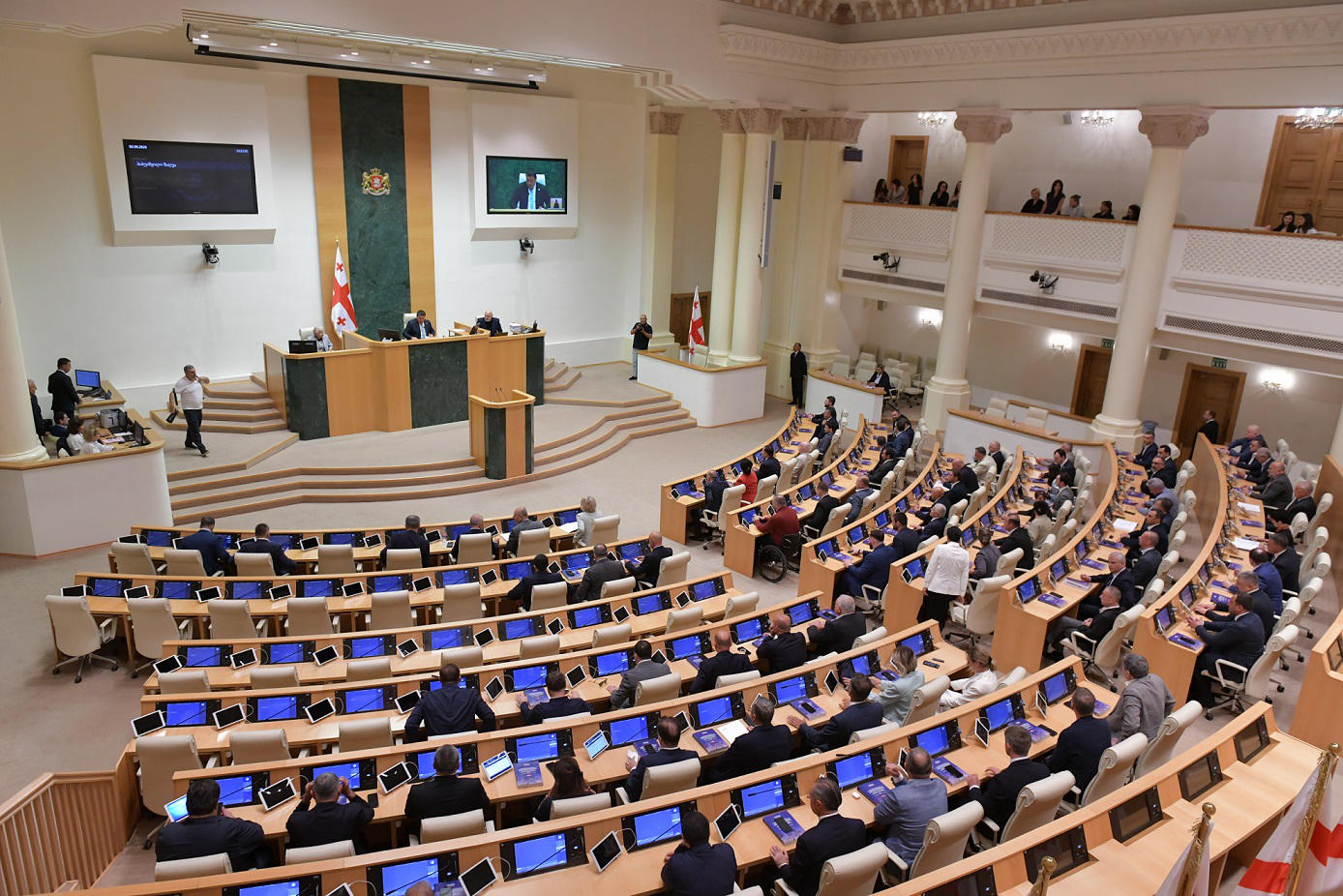
The package of legislative amendments, which further tightens the rules and legislative norms related to receiving grants, as well as political activities and political engagement, was approved by Parliament in the third reading.
The voting result in the third reading was 78 in favor and 9 against. The changes were made to the following laws:
- Law on Grants
- Criminal Code
- Administrative Procedure Code
- Code of Administrative Offenses
- Organic Law on Citizens’ Political Associations
- Law on the State Audit Service
Changes to the Law on Grants The concept of “grant” is expanded. According to the bill, a grant is considered to be funds (monetary or in-kind) transferred by a subject specified in the relevant article of the law, which are used or can be used for activities carried out or to be carried out with the belief or intention of influencing in any way the Georgian authorities, state institutions, or any part of society - activities aimed at forming, conducting, or changing Georgia’s domestic or foreign policy - as well as activities arising from the political or public interests of a foreign country’s government or foreign political party.
A legal entity of another state whose activities essentially involve actions related to Georgia is also considered a grant recipient. Foreign-registered legal entities will be obliged to obtain prior consent from the Government of Georgia before receiving a grant. If a legal entity of another state that has a registered branch, representative office, or division in Georgia receives a grant without consent, this will entail liability.
According to the bill, persons who received a grant before the law enters into force will have a 1-month period after the law takes effect to apply to the Government of Georgia. The government, in turn, will have 1 month to respond - either granting consent or refusing it.
Changes to the Criminal Code The bill introduces criminal liability for violating the rules established by the Law on Grants. The corresponding violation will result in a fine, community service from 300 to 500 hours, or imprisonment for up to 6 years.
An aggravating circumstance is added to Article 194 of the Criminal Code. Specifically, money laundering for the purpose of carrying out activities on political issues in Georgia will result in imprisonment from 9 to 12 years.
According to the bill, criminal liability will be imposed on the head of a political party who violates the Organic Law on Citizens’ Political Associations - specifically, by receiving foreign funding. This violation will result in a fine, community service from 300 to 500 hours, or imprisonment for up to 6 years.
Foreign lobbying also becomes criminally punishable. Specifically, the direct or indirect transfer of money, securities, other property, property benefits, or any other advantage to a citizen of another state or a legal entity in exchange for carrying out activities on political issues related to Georgia will result in a fine, community service from 300 to 500 hours, or imprisonment for up to 6 years.
A new norm is added to the Criminal Code - Article 316¹ titled “Extremism against the Constitutional Order.”
This article provides for criminal liability in the following case: systematic public calls by a citizen of Georgia or a stateless person with status in Georgia for mass violation of Georgian legislation, mass disobedience to government bodies, or the creation of alternative bodies to government bodies; systematic public presentation by the same person of another person or themselves as a representative of Georgia’s government arbitrarily; or other systematic actions by the same person aimed at establishing the perception of the illegitimacy of Georgia’s constitutional order or constitutional bodies and damaging Georgia’s interests or creating a real threat of damage to Georgia’s interests.
Such actions will result in a fine, community service from 400 to 600 hours, or imprisonment for up to 3 years. In the case of a legal entity, the legal entity will be punished by a fine or liquidation and a fine.
Changes related to public political activities by business entities Public political activities by a business entity that are not related to its main entrepreneurial activity will result in an administrative fine of 20,000 GEL; in case of repetition, criminal liability will be imposed on business entities for political activities.
Changes to membership in political parties A change related to restrictions on membership in political parties was made to the Organic Law on Citizens’ Political Associations. The bill defines grounds for prohibiting membership in a political party. Specifically, a person employed under an employment contract in an organization where more than 20% of annual revenue comes from a foreign power is prohibited from being a member of a political party for 8 years.
The term “entity with declared electoral goals” is replaced by “entity with declared party-political goals,” and its content is expanded. All restrictions provided in the legislation for political parties will also apply to entities with declared party-political goals. In case of receiving foreign funding, criminal liability is established for the head of a political party and for an entity with declared party-political goals.
The package of legislative amendments was prepared by the “Georgian Dream” faction.