Aleksandre Maisuradze: The Government of Georgia expresses deep concern over the report prepared under the Moscow Mechanism; it contains serious factual inaccuracies, selective interpretations, and politically biased conclusions that call its credibility into question
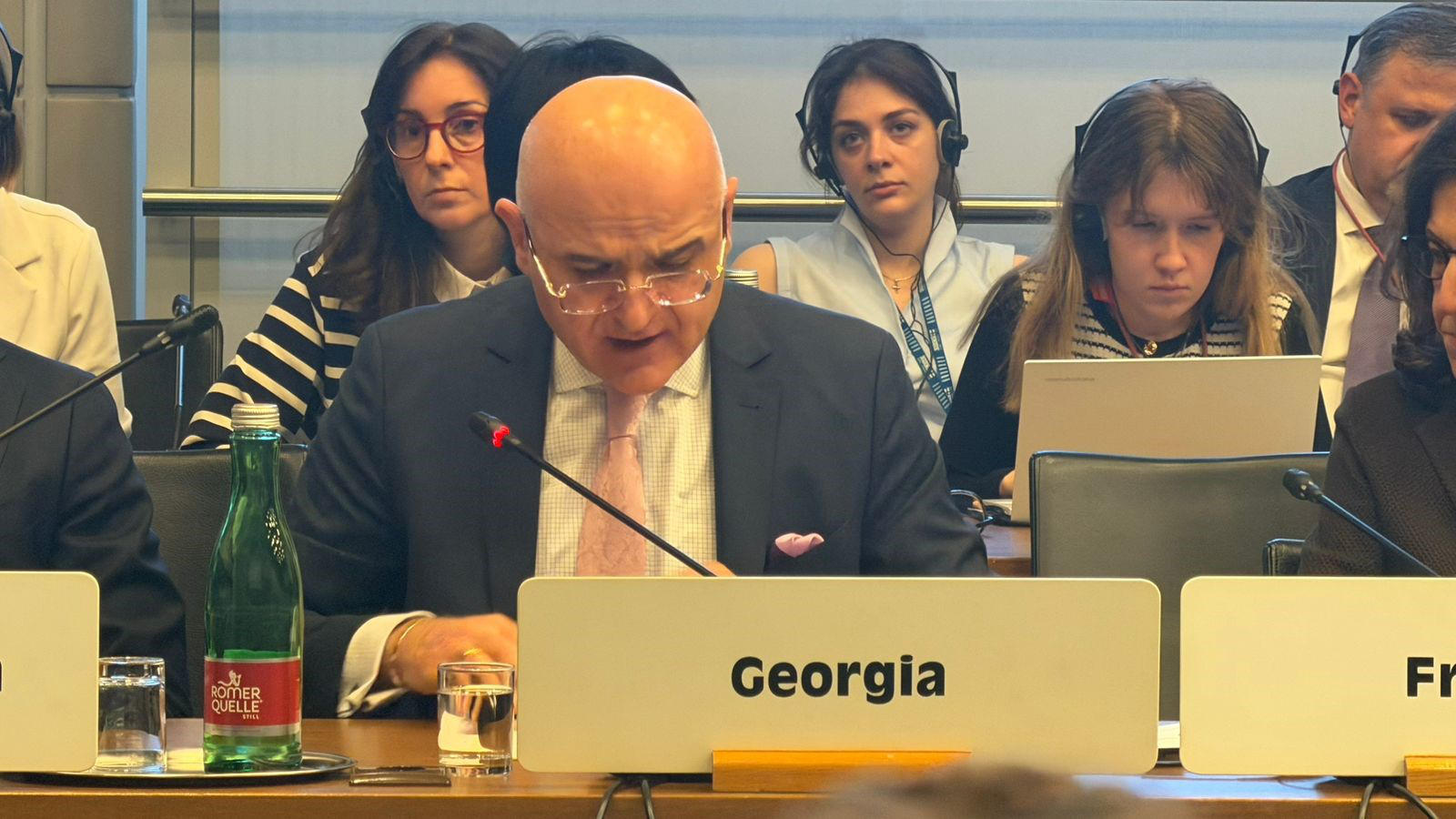
“The report fails to reflect the complexity of Georgia’s political and legal context, does not take into account important explanations provided by competent state authorities, selectively focuses on individual cases, and portrays them as ‘politically motivated,’” states a declaration by Aleksandre Maisuradze, Georgia’s Permanent Representative to the Organization for Security and Co-operation in Europe and other international organizations based in Vienna. The statement concerns the report of the OSCE fact-finding mission established under the OSCE Moscow Mechanism.
According to Maisuradze, the selective presentation of information in the report and the timing of its publication indicate a tendency toward politicization of its conclusions, while also ignoring Georgia’s long-standing achievements.
“The Government of Georgia expresses deep concern regarding the report of the OSCE fact-finding mission established under the Moscow Mechanism, which reflects developments in Georgia since the spring of 2024.
Although Georgia remains firmly committed to supporting the principles of the OSCE and its obligations within the human dimension, the report contains serious factual inaccuracies, selective interpretations, and politically biased conclusions that call into question its credibility and objectivity.
From the outset, Georgia expressed serious doubts regarding the possibility that the Moscow Mechanism - activated by 23 OSCE participating states - could be used selectively and for political motives.
Nevertheless, in full compliance with OSCE norms and in the spirit of constructive engagement, Georgia fully and transparently cooperated with the fact-finding mission.
The expert appointed under the Moscow Mechanism visited Georgia on February 17–18. The Ministry of Foreign Affairs ensured all requested meetings with Georgian authorities at the highest level, including meetings with the Prime Minister, the Speaker of Parliament, the Minister of Internal Affairs, the Minister of Justice, the Minister of Education, the Chair of the High Council of Justice, and the heads of key institutions, including the Prosecutor’s Office, the Central Election Commission, the Communications Commission, and the Public Defender.
The expert was provided with extensive written materials and given access to relevant institutions and documentation, ensuring the necessary information for preparing a substantiated assessment.
Despite this cooperation, the report fails to reflect the complexity of Georgia’s political and legal context. It disregards important explanations provided by competent state authorities, selectively highlights certain cases and presents them as ‘politically motivated,’ while ignoring legal safeguards, ongoing court proceedings, and internationally recognized standards of fair trial.
The description of legislation, electoral procedures, and investigative actions related to protest demonstrations contains factual inaccuracies and misleading interpretations.
Furthermore, the report includes recommendations that go beyond the mandate of the Moscow Mechanism, including calls on other international organizations and states to act against Georgia, which also exceeds the scope of the mission’s authority.
The selective presentation of information and the timing of the report’s publication indicate a tendency toward the politicization of its conclusions. At the same time, the report ignores Georgia’s long-standing achievements in democratic reforms, political pluralism, judicial independence, human rights, and fundamental freedoms, as well as the more than 85% reduction in applications submitted to the European Court of Human Rights over the past decade, which demonstrates the effectiveness of domestic legal remedies and institutional reforms.
Considering that the mission was given an extremely limited timeframe of only 14 days to complete its work - and that the report was prepared only a few days after the visit - these shortcomings further deepened the problem and resulted in an incomplete analysis of extensive documentation.
It is surprising that the fact-finding mission failed even to correctly identify the official name of the country and repeatedly used ‘Republic of Georgia’ instead of ‘Georgia.’
Mr. Chairperson,
The Government of Georgia categorically rejects the conclusions and recommendations presented in the report and calls on the OSCE and its participating states to properly consider the legal arguments, achievements, and detailed explanations presented in the Georgian government’s comprehensive response.
This response consolidates the official explanations and positions of the Georgian authorities regarding the assumptions made by the fact-finding mission.
It also clarifies factual inaccuracies, highlights the overlooked context, and confirms that Georgia fully complies with its commitments to the OSCE and international standards.
By presenting these materials, the Georgian side aimed to ensure that OSCE participating states and interested international actors had access to comprehensive factual information, enabling an objective, balanced, and evidence-based assessment of Georgia’s fulfillment of its obligations within the human dimension.
Unfortunately, participating states were not given sufficient time to analyze the extensive materials submitted by the Government of Georgia before the meeting of the Permanent Council.
Mr. Chairperson, distinguished colleagues,
Once again, I would like to reaffirm that Georgia has always acted responsibly and in a spirit of cooperation, demonstrating full respect toward the OSCE and its independent institutions and mechanisms.
Georgia’s actions have consistently been guided by a commitment to dialogue, transparency, and good-faith cooperation.
Independence and impartiality are of decisive importance for the credibility of any monitoring or fact-finding process.
Regrettably, we increasingly observe attempts to use international organizations and institutions for harmful purposes, which undermines their reliability and public trust in their institutional neutrality.
We must not allow the OSCE to be damaged by such inappropriate practices or be used as a political instrument. For this reason, we believe that these issues should receive appropriate attention from the Permanent Council.
Rejecting such flawed and biased reports is a necessary step to protect the credibility of international processes.
Ensuring the independence, balance, and mandate-based operation of expert mechanisms is in the interest of all participating states and of the organization itself.
The Government of Georgia once again calls on the OSCE and its participating states to properly consider the legal arguments presented by the Georgian authorities and to reject and refrain from endorsing the contested conclusions and politically motivated recommendations presented by the fact-finding mission in violation of its mandate,” he stated.