Author of the “Moscow Mechanism” report: The initiation of an investigation by the Hague Court is a very complex process. At the same time, we must distinguish between the government’s harsh rhetoric and its actual efforts to address the problem - progress is possible
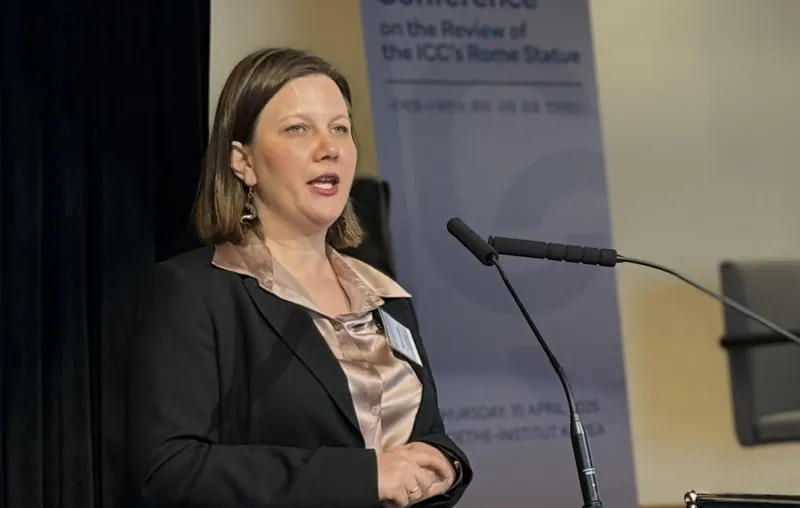
“I emphasized that, in light of signals regarding persecution, possible torture, and other inhumane acts, if the relevant threshold is reached - something I was not able to confirm during my mission - there is a possibility that the International Criminal Court could have jurisdiction over the mentioned human rights violations. Of course, initiating an investigation by the International Criminal Court is a very complex process,” said Patricia Grzebik, rapporteur of the “Moscow Mechanism” and author of the report on Georgia, in an interview with Interpressnews.
According to her, when issuing this recommendation, her goal was not to start a “legal war,” as claimed by the Georgian government.
“Georgia is a party to the Rome Statute, and I emphasized that, in light of signals regarding persecution, possible torture, and other inhumane acts, if the relevant threshold is reached - something I was not able to confirm during my mission - there is a possibility that the International Criminal Court could have jurisdiction over these human rights violations. Of course, initiating an investigation by the International Criminal Court is a very complex process. It operates on the principle of complementarity, which means that if Georgia is unable, unwilling, or inactive in investigating specific allegations, then the international court can act. Given that my report also pointed to the issue of impunity in Georgia, the involvement of the International Criminal Court cannot be ruled out.
I do not have information about the initiation of a situation assessment in Georgia since 2024. Nevertheless, I cannot exclude the possibility that some victims of violations may have individually approached the International Criminal Court through its portal.
My recommendation was cautiously formulated and only states that participating states ‘may consider,’ meaning they should verify whether the case meets all the jurisdictional requirements of the International Criminal Court. During my mission, I was unable to make a firm conclusion on this matter; I only pointed to a possible avenue, taking into account Georgia’s international legal obligations.
I did not intend to start a ‘legal war,’ as claimed by the Georgian government. My goal was to carry out my mission and outline various possible paths that could be used in the future if states consider that certain issues are sufficiently serious to initiate relevant procedures,” the rapporteur stated.
In addition, the expert noted in the interview that, during her mission, given Georgia’s very constructive and cooperative approach and based on statements by the Prime Minister, she saw signs of implementation of the recommendations.
“Possible pathways are outlined in the recommendations attached to the report. At the same time, during my mission, given Georgia’s very constructive and cooperative approach, I hope that at least some of the concerns raised in the report will be addressed, and I had the impression that some of the Prime Minister’s statements were moving in that direction.
The implementation of most recommendations is primarily the responsibility of the Georgian authorities. I believe that, ultimately, we must distinguish between harsh political rhetoric and the government’s real efforts to address evident problems. The Georgian authorities have already acknowledged the issue of insufficient identification of police officers and stated that identifying all law enforcement officers involved in dispersing protests will be straightforward. Progress is possible,” the expert said.