Gia Volski about Moscow Mechanism expert – The statements she made to justify herself does not balance our distrust - announced that she used to get up at 5 am and write it before arriving in Georgia, this admission also indicates that she is motivated to harm the government
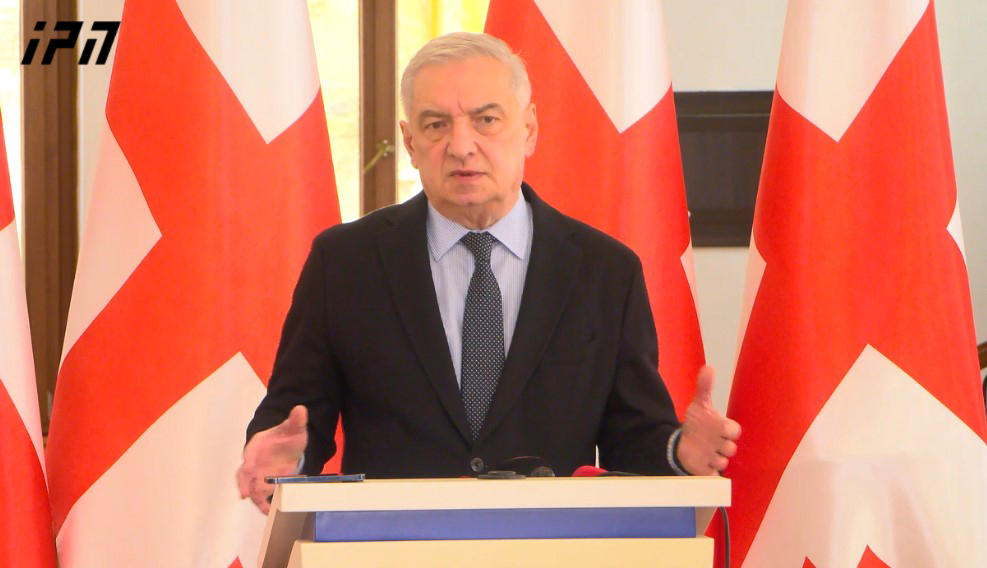
She didn’t even read the arguments, a rather thick document, and then announced that she used to get up at 5 am and write it before arriving in Georgia, which was ultimately reflected in the report - even if this admission indicates that this person is motivated to harm the Georgian government, - this is how the First Vice-Speaker of the Parliament, Gia Volski, assessed the statements of the Moscow Mechanism expert, which she made in an exclusive interview with InterpressNews.
According to Volski, the Georgian government has doubts about the expert’s competence and objectivity, and the statements made by the expert do not balance this distrust in any way.
"When this reporter was asked about the need for a specific example to justify a change in foreign policy or election fraud, she refused. Some of the information she received was used in the report, but this information came from the people who are the executors and writers of this revolutionary plan. She did not even read those arguments, a rather thick document, and now she has announced that she used to get up at 5 am and write it before arriving in Georgia, which was ultimately reflected in the report - even if this admission of her indicates that the person is motivated to harm the Georgian government. It is directly related to the Polish government. We will not comment on the policy that the Polish government has on various topics, but when the issue concerns Georgia, let us remember their attitude towards us, that Saakashvili is dying and must be released, that the government is a torturer for demanding answers from a person who has shed blood in the country. This is the position of the Polish government and this person is directly connected, she receives a salary. But it doesn't matter, even if she is not connected, she admits that she absolutely did not take into account anything that the government presented to her, the arguments that a fairly large number of agencies and experts worked on, but took into account only what people who want to start a war here, to start an internal civil conflict, tell her. If anyone doubts that such a long report can be written in 2 weeks, in response to them she says that she started writing it a long time ago and even got up at 5 in the morning, so that this report could be of this volume, which she published in the future, absolutely full of shameless lies. This report is absolutely opposed to the report of the OSCE Parliamentary Assembly Group, it is radically different. She does not evaluate it in any way, not even in a word, that there was indeed an attempt at revolution, an attempt at confrontation, which everyone saw live on air and it seems like it didn’t happen. Of course, we have doubts about such a person, her competence and objectivity, and the statement she made later to justify herself in no way balances the distrust we have towards this specific person,” said Volski.
For information, in an interview with InterpressNews, the Moscow Mechanism expert Patrycja Grzebyk stated that she is not employed by the Polish government and that she prepared the report for the OSCE, not for Poland, of which she is a citizen.
In addition, she responded to criticism related to the preparation of a large-scale report in a short period of time.
“The 14-day working period is defined by the Moscow Mechanism, and Georgia was fully informed about this. I admit that this is an extremely short time. As soon as I was informed (on February 3) that I had been appointed rapporteur, I began collecting and reading all relevant reports (of international organizations, civil society, submissions by Georgia within the Vienna Mechanism), but it was only after my mission officially began and I was informed by OSCE/ODIHR that the time allocated for appointing a second expert for Georgia had expired, that on February 11 I was able to start contacting stakeholders in Georgia. I sent my first letter to the Permanent Representation of Georgia to the OSCE and international organizations in Vienna (at 7:44 Warsaw time), and then began reaching out to other stakeholders, including representatives of civil society organizations. At the same time, I asked a former doctoral student of mine, who is now a Doctor of Law, to assist me in completing my task. During the following two weeks, I woke up at 5:00 a.m. to conduct interviews, analyze documents sent to me, and write the report together with Dr. Grzeszkowiak, properly incorporating into the report the testimonies I collected or those sent to me daily within the mission. I only pointed to issues that were fairly documented and repeatedly appeared in both oral and written testimonies.
Of course, the report was written before my arrival in Georgia, but only after the mission had officially started. During my visit to Georgia, I used all my time to meet with various representatives, and all my interlocutors saw how detailed my notes were, so that I could immediately refer to them in the report. Being aware that the mandate was very broad, I tried to highlight the most important issues while also indicating other possible avenues that the state could use for further investigation. In summary, I consider the Georgian government’s criticism - that the report was prepared in advance - to be an ‘unconventional compliment’ to my work. The report was not prepared in advance. It was written under extremely limited time conditions, as provided by the Moscow Mechanism procedure. I did everything possible to prepare the most comprehensive report within such a short time,” the expert stated.