BTU Becomes a Member of CERN, One of the World’s Most Influential Scientific Organizations
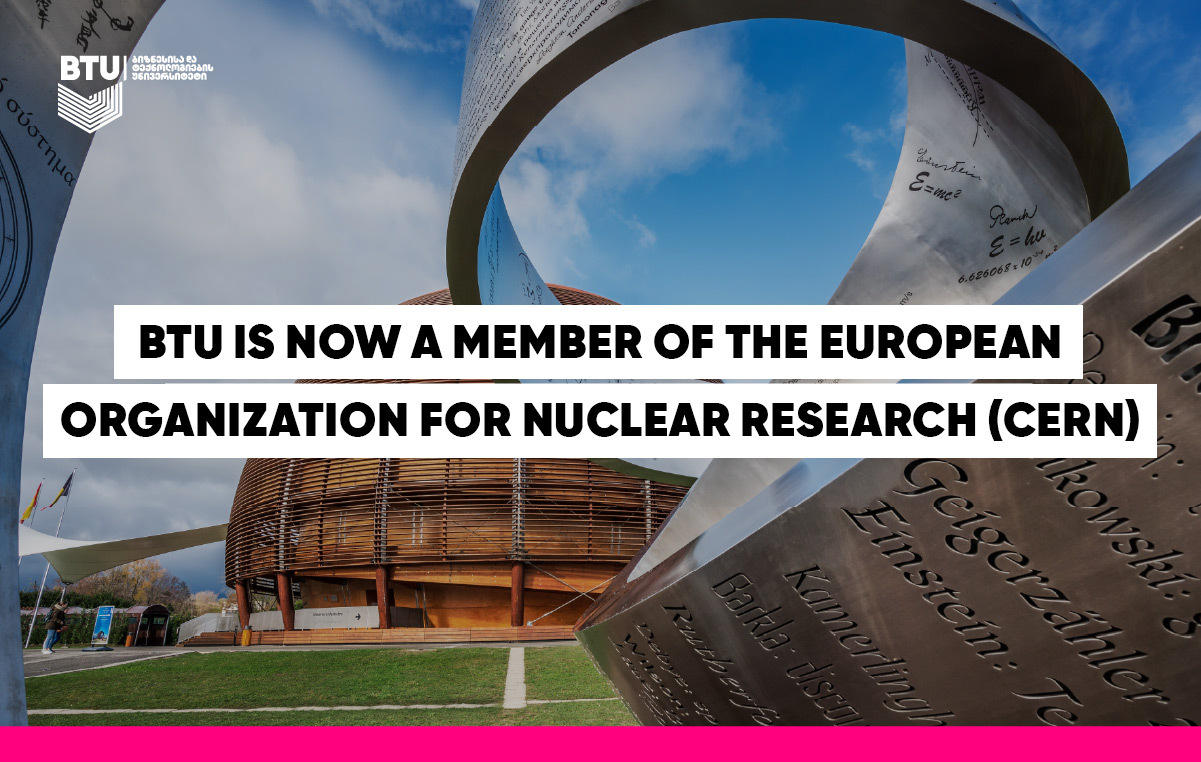
Business and Technology University (BTU) has become a member of European Organization for Nuclear Research - CERN, one of the world’s most influential research centers. BTU and CERN are entering a new multi-year phase of strategic collaboration. Within this framework, BTU will join the prestigious international scientific initiative ATLAS experiment with the status of a Technical Associate Institute.
This marks a first-of-its-kind precedent, where Georgian scientists will develop products in the fields of artificial intelligence and virtual reality, which will be exported to leading scientific institutions worldwide through CERN membership.
The collaboration involves BTU’s technical participation in the project and builds on the university’s expertise in virtual reality (VR), artificial intelligence (AI), 3D modeling, software development, and the creation of digital educational platforms. Georgian scientific and technological products will be gradually introduced to the global market, with leading research centers and institutions as their primary users.
A key component of the project will be the development of VR+AI episodes dedicated to different subsystems of the ATLAS detector. These digital environments will be created with high scientific accuracy and will serve both technical and educational purposes, while also supporting the popularization of science.
In addition, BTU will contribute to the development of educational applications for international masterclasses within the ATLAS collaboration. Specifically, the cooperation includes creating software solutions for ATLAS W-path and Z-path exercises, which will help international students and pupils engage in practical physics learning. As part of the collaboration, BTU will also continue delivering international masterclasses for the broader public within the framework of the IPPOG collaboration.
Within the partnership, BTU will provide the necessary academic and technical resources for the project, including:
A specialized technical and research team
XR/AI laboratory infrastructure
Virtual and augmented reality equipment
High-performance computing resources
This collaboration represents a significant international milestone for BTU and further strengthens its positioning as a higher education institution focused on technology, innovation, and international scientific cooperation.
The ATLAS experiment is one of the largest scientific experiments in the world, conducted at CERN, bringing together more than 3,000 scientists and engineers from approximately 180 institutions across around 40 countries. The collaboration is particularly active among European countries such as Germany, France, Italy, Switzerland, the United Kingdom, and Spain, as well as the United States, Canada, Japan, China, and other technologically advanced nations. This scale makes ATLAS one of the most influential platforms in global science, where participation means direct involvement in fundamental physics discoveries and the development of new technologies.
CERN was founded in 1954 and is today the largest and most prestigious research center in the world. The organization includes more than 20 full member states, as well as associate members and partner countries from various regions. CERN employs approximately 2,500 permanent staff members and hosts over 10,000 scientists and students from more than 100 countries who participate in its experiments. Its main infrastructure is the Large Hadron Collider (LHC), a 27-kilometer underground accelerator where fundamental research is conducted on matter, energy, and the origins of the universe. Among CERN’s major achievements are the discovery of the Higgs boson and the creation of the World Wide Web in 1989, which extended far beyond science and had a transformative impact on global technological development.
Georgia has an international cooperation agreement with CERN, enabling Georgian scientists and universities to participate in CERN’s experiments and research initiatives.
(AD)