GYLA has filed an application with the European Court of Human Rights regarding the criminal case against Mzia Amaghlobeli
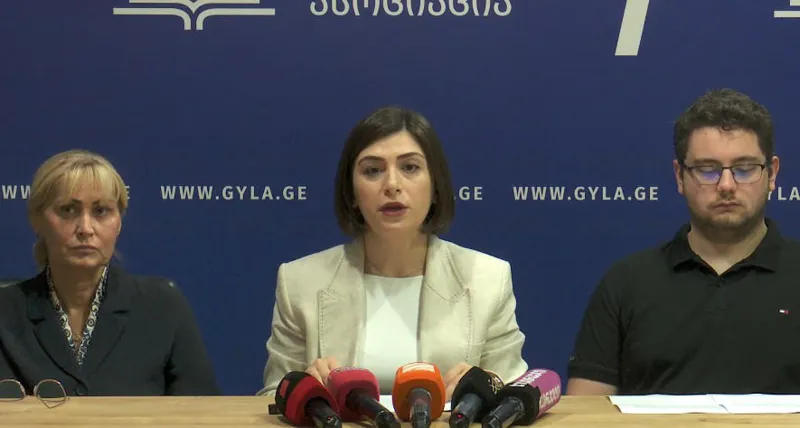
The Georgian Young Lawyers' Association (GYLA) has filed an application with the European Court of Human Rights in the criminal case against Mzia Amaghlobeli.
The announcement was made by the organization's chairperson, Tamar Oniani, during a briefing.
According to Oniani, several of Mzia Amaghlobeli's rights were violated in the Georgian courts, including her right to a defense, her right to a fair trial, and the presumption of innocence.
The Georgian Young Lawyers' Association (GYLA) has submitted an application to the European Court of Human Rights on behalf of Mzia Amaghlobeli, the founder and director of Batumelebi and Netgazeti, a journalist whom the organization describes as a political prisoner.
This is the first case since November 28, 2024, in which a political prisoner has applied to the Strasbourg Court after exhausting all domestic legal remedies in the main criminal proceedings. The application concerns what GYLA describes as politically motivated criminal prosecution and conviction, arguing that Amaghlobeli's right to a fair trial was violated at all three levels of the Georgian judiciary.
The application also outlines what GYLA describes as the growing number of political prisoners in Georgia and the broader context of the consolidation of authoritarian rule. It is the fourth application GYLA has submitted to the Strasbourg Court in defense of Amaghlobeli's rights.
Alongside GYLA, Amaghlobeli is represented by Edward Fitzgerald, one of the heads of Doughty Street Chambers and a leading British barrister specializing in criminal law, public law, and international human rights law.
GYLA maintains that the proceedings against Amaghlobeli are closely interconnected and constitute a pattern of systematic state retaliation.
The application alleges the following violations of the European Convention on Human Rights:
Politically motivated justice (Article 18 in conjunction with Article 6): GYLA argues that the criminal prosecution was initiated not for the administration of justice but as political retaliation aimed at punishing an independent journalist and intimidating others from expressing dissent. The application cites statements by senior government officials referring to Amaghlobeli as a "foreign agent" and declaring her guilty before any verdict had been delivered.
Violation of the right to a fair trial (Article 6):
Lack of an impartial tribunal: According to the application, Judge Nino Sakhelashvili demonstrated a preconceived negative attitude toward Amaghlobeli during the pre-trial detention stage, which persisted throughout the trial.
Lack of a reasoned judgment: GYLA argues that the courts failed to assess the defense's evidence while uncritically accepting the prosecution's evidence. The decisions of the Batumi City Court, Kutaisi Court of Appeal, and the Supreme Court are described as superficial and insufficiently reasoned. The courts allegedly ignored 19 key video recordings submitted by the defense and relied solely on contradictory police testimony.
Violation of the right to a defense: During the final hearing at first instance on August 6, 2025, Batumi City Court reclassified the charges against Amaghlobeli from Article 353¹ of the Criminal Code (assault on a police officer in connection with official duties, punishable by four to seven years' imprisonment) to Article 353(1) (resisting, threatening, or using violence against a law enforcement officer or other public official, punishable by a fine, up to two years of house arrest, or two to six years' imprisonment). According to GYLA, this reclassification was made without prior notice to the parties, depriving Amaghlobeli of the opportunity to effectively prepare her defense against the new charge.
Violation of the presumption of innocence: GYLA argues that repeated public statements by senior officials describing Amaghlobeli as a "criminal" and an "agent" before the verdict violated her presumption of innocence and influenced public opinion as well as the judicial process. The application also states that keeping her in a glass defendant's dock ("aquarium"), surrounded by armed guards throughout the proceedings, served not as a security measure but as a tool of psychological pressure and stigmatization, further undermining the presumption of innocence.
According to Oniani, "Mzia Amaghlobeli's case is an indicator of how the justice system can be used to implement the political will of those in power."