Hearing on bid to declare five opposition parties unconstitutional to begin tomorrow – Georgian Dream is not seeking to ban Droa, Strategy Aghmashenebeli, European Georgia, Freedom Square and Zurab Japaridze’s Girchi at this stage
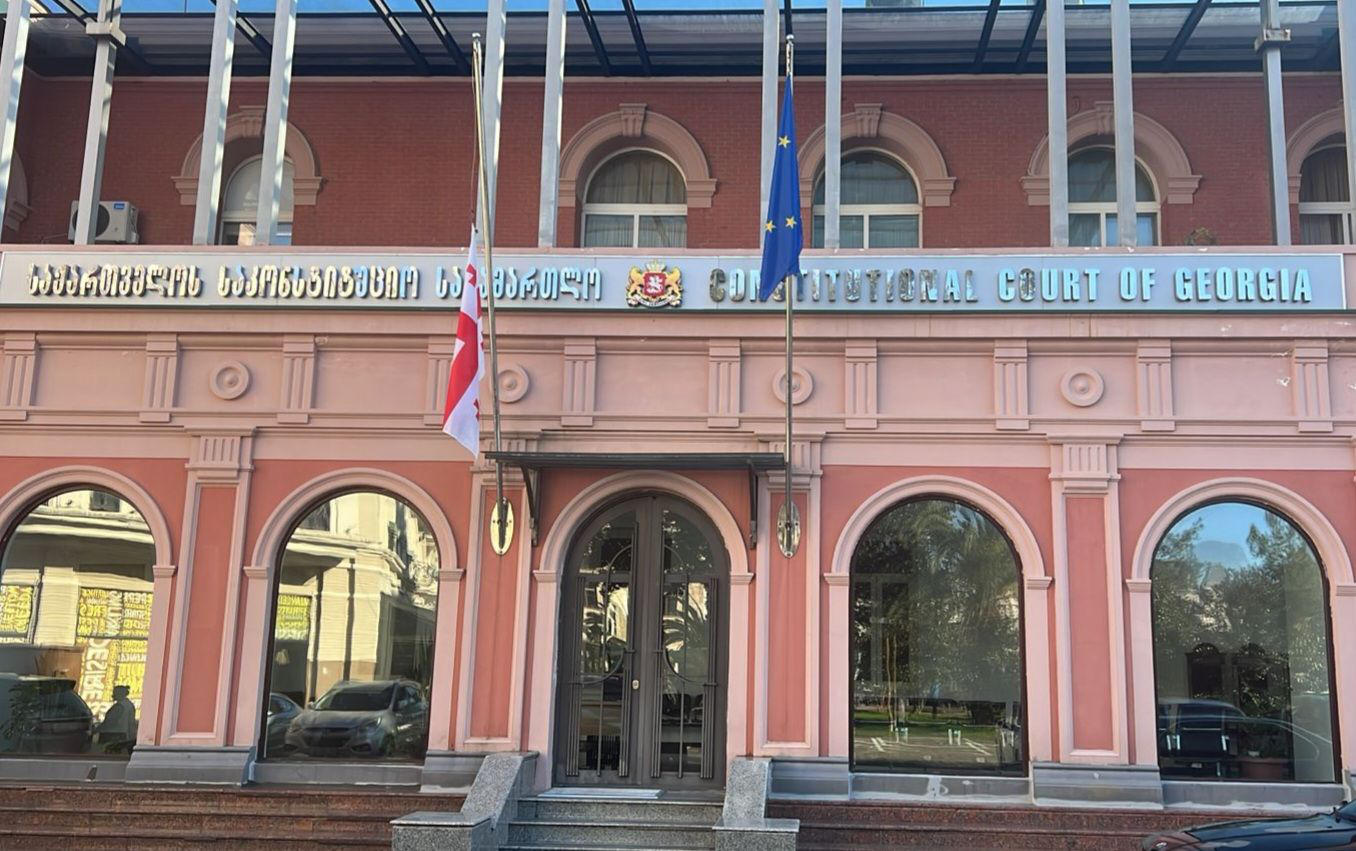
On October 21, Georgia’s Constitutional Court will begin hearing a lawsuit filed by the ruling team seeking to declare five opposition parties unconstitutional, ban them and annul their registration. The substantive hearings are scheduled for October 21, 22 and 23.
The lawsuit submitted to the Constitutional Court has been signed by 88 members of parliament. Based on the claim, the court is to consider declaring the following political associations unconstitutional: Unity – National Movement; Coalition for Change – Gvaramia, Melia, Girchi, Droa; Strong Georgia – Lelo, For the People, For Freedom!; the Federalist Party; and For Georgia, led by Giorgi Gakharia.
According to the authors of the lawsuit, since 2016, the aforementioned political associations have, practically without interruption, denied the domestic and foreign policy legitimacy of Georgia’s current government and the ruling political party. By doing so, they acknowledge that one of the two sides — the opposition or the ruling party — must necessarily be deemed unconstitutional.
The constitutional claim is accompanied by the findings of a temporary investigative commission established in the 11th Parliament.
One of the arguments put forward for banning the political parties is that, over the years, the five parties have demonstrated essentially identical positions in elected bodies, in Georgia’s political processes and in the alleged unconstitutional activities outlined in the claim, including what the ruling team describes as sabotage against the Georgian state. According to the lawsuit, they have formed a coalition united by common objectives and continue to operate in this manner.
“One of the clearest recent examples of this is the establishment of the ‘Opposition Alliance’ on March 2, 2026, by the relevant opposition political parties ‘to work together to achieve common goals.’ One of the alliance’s stated objectives is to promote the ‘strategic unity’ of its member parties, while one of its declared strategic principles is the rejection of the legitimacy of elected bodies and public officials.
“Thus, the political parties identified in the constitutional claim share common goals, aspirations and a unified political position, and express their agreement to carry out unconstitutional actions with a common purpose and shared intent. These include discrediting elections conducted in accordance with the Constitution of Georgia and electoral legislation, as well as deliberately rejecting the will of the people and democracy. Moreover, they have already carried out a series of unconstitutional acts, as clearly demonstrated by the facts and evidence presented in this constitutional claim.
“Examples of the aforementioned political parties forming a coalition united by common aspirations also include various party alliances, platforms and movements established in recent years through the mediation of former Georgian President Salome Zourabichvili, with which the political party For Georgia also cooperated,” the constitutional claim states.
According to the authors of the lawsuit, the formation of coalitions among opposition parties with common aspirations is also illustrated by instances of cooperation between For Georgia and the United National Movement in the municipal assemblies of Chkhorotsku, Tsalenjikha, Rustavi, Zugdidi and Senaki, elected following the October 2, 2021, local elections.
The lawsuit states that one example of such cooperation was the joint election of the chairs of these municipal assemblies and other officials by For Georgia and the United National Movement.
“It should also be taken into account that in February 2021, Giorgi Gakharia, the current chairman of For Georgia, actively supported an attempt by Nikanor Melia, then a member of the Georgian Parliament, the United National Movement and other opposition parties to directly, publicly and explicitly undermine the principle of the rule of law in Georgia. The political party For Georgia has not distanced itself from this act to this day,” the claim states.
Former and current leaders of the relevant opposition parties were elected to various convocations of the Georgian Parliament on the nomination of the United National Movement or an electoral bloc formed with its participation. They held various party positions within the United National Movement and occupied significant positions, including political and state-political offices, during the party’s time in government from 2004 to 2012. Alternatively, during the same period, the United National Movement violated human rights with their assistance and participation, according to the lawsuit.
The claim also states that other political parties are closely associated with the five parties in question. These include Elena Khoshtaria – Droa; Yes to Europe – Strategy Aghmashenebeli; European Georgia – Movement for Liberty; the Republican Party of Georgia; Freedom Square; the National Democratic Party; Girchi – More Freedom; and other parties described by the ruling team as fictitious, one-person or small parties.
However, the ruling team argues that banning these additional parties is not necessary at this stage because they currently have no substantial influence on the political process or realistic prospects of crossing the electoral threshold. It also claims that some are effectively incorporated into the political parties named in the constitutional lawsuit.
“The question of their unconstitutionality may be raised later if they acquire substantial influence over the political process,” the claim states.
The lawsuit focuses extensively on alleged systematic human rights violations during the United National Movement’s time in power. It claims that between 2004 and 2012, the party established and developed a system of torture and inhuman and degrading treatment of people held in penitentiary institutions. According to the claim, numerous acts of violence, torture and other human rights violations took place in these institutions during the same period, extending beyond isolated incidents and becoming systematic and widespread.
“Between 2004 and 2012, the United National Movement violated fundamental human rights guaranteed by the Constitution of Georgia and the European Convention on Human Rights. These violations included systematic and widespread infringements of the rights of people held in penitentiary institutions; violations of the rights to life and health; interference with the right to privacy; extortion of property; systematic violations of property rights; and systematic infringements of freedom of thought and expression, media freedom, and the principle prohibiting the monopolization of mass media or the means of disseminating information.
“Furthermore, the unconstitutional political parties identified in this constitutional claim violated the essence of democracy as protected by Article 3 of the Constitution of Georgia and the European Convention on Human Rights. This was expressed through their unjustified refusal to recognize the legitimacy of elected bodies and public officials chosen through elections conducted in accordance with the Constitution and electoral legislation, as well as their clear and gross disrespect for democracy.
“Moreover, they publicly and explicitly declared that discrediting elections held in accordance with the Constitution and electoral legislation, and deliberately rejecting the will of the people and democracy, constituted one of their common future strategic principles. Most of them reflected this position in the document establishing the Opposition Alliance on March 2, 2026.”
The lawsuit states that the first attempt by the political parties in question to declare a democratically elected government illegitimate was recorded in 2016. According to the claim, this practice became systematic from 2018 and continuous from 2020.
It further alleges that between 2019 and 2025, efforts to delegitimize the democratically elected government were accompanied by six direct attempts to overthrow Georgia’s constitutional order or change it by force. The claim argues that these events demonstrate the prolonged, systematic and ongoing nature of activities allegedly directed at overthrowing or forcibly changing the country’s constitutional order.
“Thus, it is clearly established that the unconstitutional political parties identified in this constitutional claim violated the first sentence of Article 23, Paragraph 3, of the Constitution of Georgia. On the one hand, this was expressed in attempts to overthrow or forcibly change Georgia’s constitutional order, while on the other, it is reflected in the existence of a future objective to overthrow or forcibly change that order. This constitutional violation, including the alleged future objective of engaging in such unconstitutional activities, is attributable to the political parties identified in this claim in relation to the relevant actions.
“Accordingly, the aforementioned circumstances, together with the other facts and arguments presented in this constitutional claim, collectively provide a solid constitutional basis for banning the unconstitutional political parties, taking into account the Constitution of Georgia and the approaches of the European Court of Human Rights,” the lawmakers who signed the claim state.
A substantial part of the lawsuit is devoted to the 2008 Russia-Georgia war and events surrounding the August war. It alleges that during its time in power, the United National Movement committed numerous acts against Georgia’s independence and territorial integrity and engaged in what the claim describes as clearly unconstitutional activities. According to the lawsuit, these actions undermined the prospects of restoring Georgia’s territorial integrity through peaceful means, contributed to the occupation of Georgian territories and helped the occupying power consolidate its political position regarding the occupation.
The claim states that these allegations are supported by facts and evidence presented in the findings of the parliamentary temporary investigative commission, as well as other relevant sources.
“From 2004 onward, the United National Movement systematically and consistently carried out a series of actions and measures that contributed not only to the occupation of Georgian territories but also to the strengthening of the occupying power’s political position regarding the occupation,” the constitutional claim states.
The plaintiffs argue that the activities of the aforementioned political parties are aimed at overthrowing or forcibly changing Georgia’s constitutional order, undermining the country’s independence and violating its territorial integrity. On these grounds, they are asking the Constitutional Court to declare the parties unconstitutional.
They request that the following political parties be banned and their registration annulled:
-
Unity – National Movement, a political association of citizens (identification number: 200078888; registration date: December 10, 2004; legal address: 45a Kakheti Highway, Tbilisi).
-
Coalition for Change – Gvaramia, Melia, Girchi, Droa, a political association of citizens (identification number: 415030022; registration date: June 29, 2016; legal address: Apartment 66, No. 4 Besiki Street, Tbilisi).
-
Strong Georgia – Lelo, For the People, For Freedom!, a political association of citizens (identification number: 415030264; registration date: January 28, 2020; legal address: Plot 05/107, Tbilisi Central Railway Station, Tbilisi).
-
Federalist Party, a political association of citizens (identification number: 415030594; registration date: March 14, 2025; legal address: Apartment 1e, Entrance 4, No. 49b Ilia Chavchavadze Avenue, Tbilisi).
-
For Georgia, a political association of citizens (identification number: 415030497; registration date: June 21, 2021; legal address: Apartment 51, No. 12 Amaghleba Street, Tbilisi).