Ben Hodges: “I think right now there is too much Russian influence inside the Georgian Government”
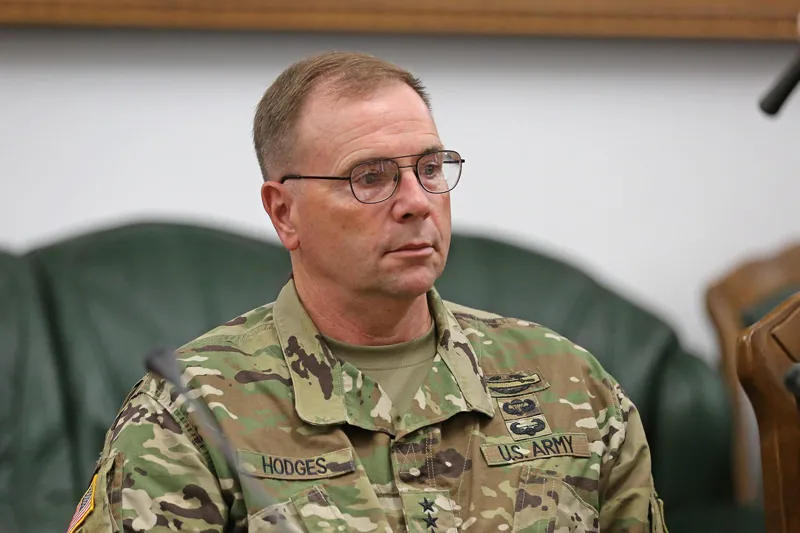
The former head of the US military in Europe, General Ben Hodges, has raised the issue of Georgia's immediate membership in NATO a few times recently. He said this should happen despite the fact that part of the country is occupied by the Russian Federation and a similar case has already occurred in the history of NATO. Ben Hodges spoke to InterpressNews/Georgian Journal about NATO-Georgia relations, the Russian factor, and the factors that Georgia should pay attention to.
Recently we have seen a new report prepared by a group of experts appointed by the Secretary General of NATO: "NATO 2030: United for a new era”. The document notes that NATO should seek to expand and strengthen partnerships with Ukraine and Georgia as vulnerable democracies that seek membership and are under constant external and internal pressure from Russia. Would you assess this as a real step forward, along with the renewed NATO-Georgia Substantial Package?
First of all, I’d take it as a very positive step forward. Number one: because it affirms, the reflections affirm the importance of NATO expansion and specifically, the importance of supporting Georgia and Ukraine. This is not inconsequential, the members of the reflections were included Germany and France and several other critical members of the alliance. So having them affirm this in this report is a very strong endorsement. So I was encouraged by that, obviously we prefer to see Georgia in the alliance already or at least let’s get MAP underway, but this is still a very positive step forward, at a critical time.
There were some talks in the past that it is possible for Georgia to become a member without getting the MAP. Do you think that would be possible or acceptable at all?
I would imagine, anything is possible, it’s up the North Atlantic Council, the 30 members of alliance. But yet to me, this is not useful conversation discussion. Let’s just focus on continuing to build awareness in Brussels, in Washington, in Berlin, in Paris, in London why the black sea region is strategically so important and so why having Georgia in NATO would enhance security and stability in the region. That’s what we need to focus on, the substance. Now whether or not there’s a technical procedural process that is necessary or not. Frankly I think having a MAP is a good idea and Georgia would quickly meet other requirements of the MAP if it were issued. But let’s focus on raising awareness in Washington, in Brussels about the importance of the Black Sea Region. And then it becomes obvious that Georgia should be in NATO.
The NATO Secretary General Jens Stoltenberg stated that NATO is stepping up its practical support for Georgia and Ukraine. He stated he is pleased that Allies and Georgia approved the updated Substantial NATO-Georgia Package and NATO is stepping up its political support. Can you explain, on what hand, what practical support will mean and, on the other, what meaning does the political one really have in this case?
I would expect that we’ll see a continued efforts, military training exercises, continued work on interoperability. But I hope it also will include perhaps the development of infrastructure in Georgia for US Army, US Air force, US Navy. Not substantial, not significant in size but nonetheless, something that makes it easier and more attractive for US and other nations to come to Georgia for exercises or perhaps even to use Georgia as a logistics hub or an important transit point. Somewhere to … Romania for us to have something like that on the other end of the Black Sea I think would be important. If the port of Anaklia Project is ever completed, then I can imagine the US Navy frequent visits to Anaklia, for example, if Georgia had a substantial sea port. These are the kinds of things I think Georgia could do I think NATO would encourage. I think also looking for ways to cooperate on intelligence sharing, information sharing around the Black Sea between NATO allies and partners like Georgia and Ukraine - This is an area where I think Georgia can make itself more attractive by establishing strong, procedural relationships with other countries of the Black Sea for sharing intelligence and sharing information.
Some people in Georgia fear that making Georgia the member of NATO will somehow provoke Russia. We remember that the 2008 August war happened soon after NATO’s reassurance at the Bucharest Summit that Georgia would one day become the member. What would you tell those people regarding their fears?
Well, I think the only thing that provokes Russia is weakness and the lack of resolve, determination by the West – that’s what provokes Russia. If you think about everything that the Kremlin has done in the Black Sea Region since 2008: invasion of Georgia, invasion of Crimea, invasion of Donbass, troops into Nagorno-Karabakh, continued occupation of Transnistria – all of these things happened after the US significantly reduced its military capability in Europe and as did most other European militaries significantly reduced their military capability. So, none of these Russian action is result of a provocation by the West, because we have continued to make ourselves less and less militarily capable up until finally we stopped this in 2014 after Russia’s invasion of Crimea, then made up again to strengthen again, but all of that aggression happened after we made ourselves as weak as we’ve ever been in Europe. So I don’t believe that, that is a totally false that the Kremlin pushes because they don’t want us to have the initiative, they don’t want us to support countries like Georgia, they don’t want Georgia or Serbia or Ukraine or Montenegro, these countries to be integrated into the West, that’s the last thing they want. So I think we should act with strength, I think that the Kremlin respects strength and they despise weakness. Now, though, don’t make a lot of noise about it but to me that’s not consequential. Now this competition has to include diplomacy, information and economy as well, not just military. And I do believe that the great-power competition prevents great power conflict, because we demonstrate we care a certain area, and we demonstrate that by investing there, by holding the Kremlin accountable for its illegal activities. I mean every day there should be something on the front page of the major newspapers about Russian troops still sitting in 20% of Georgia or occupying Crimea or killing Ukrainian soldiers every week in Donbass, every week. But we don’t, we look the other way, this is why we have to compete and hold Kremlin accountable.
You yourself wrote the letter, which reads: “We should also extend an invitation to Georgia to immediately join NATO. The West must compete in the Southern Caucasus while we still have the opportunity, if we want to prevent great-power conflict". Could you explain further what kind of conflict do you expect here?
Well, think about it – the only East-West corridor between Eurasia and Europe that doesn’t go through Russia or Iran goes through Azerbaijan and Georgia. So the South Caucasus is a critical East-West corridor for energy pipelines, telecommunications pipelines, air travel and potential rail for moving large numbers of railcars from China into Europe - all of the should come through Azerbaijan and Georgia. Of course you need a major port on the Black Sea like Anaklia to make that attractive, and now because we’re still on the sidelines, you’ve got Russian soldiers in Georgia, occupying Abkhazia and so-called South Ossetia, you got Russian soldiers in Armenia since the end of the cold war, and now you’ve got Russsian soldiers in Azerbaijan inside Nagorno-Karabakh, So all three South Caucasus countries have Russian troops on the ground, now, what people refer to as peacekeepers, P-E-A-C-E keepers. That’s because we didn’t compete, and now you got Russian troops there. So I think if we demonstrated that we were committed to security and stability in the region that we were going to invest money or private investment in these countries so that people could prosper, or the jobs, young people to want to stay, I think we would not be in this situation right now. I think Armenia should seriously reconsider their dependence on the Kremlin, I mean obviously it did nothing to help them, the Kremlin allowed Armenia to be crushed by Azerbaijan forces. It returned for what? Russia has bases in Armenia, they are threat to Georgia and they make it difficult to exploit the economic potential of the South Caucasus. We fail to compete. I do not understand why Georgia allowed Russia to fly over or through Georgian air space with these so-called peacekeepers into Armenia. Why would Georgia allow that when the 20% of the own country is occupied by Russian troops? I don’t understand that. And I think that the US should be very visible in its support of Georgia, to protect them from Kremlin retaliation or pressure. This is what I’m talking about.
The other fear is that if the country joins NATO without article five covering occupied territories, it can be said those territories are lost forever…
First of all, I think, if we think strategically and if we think long-term, what’s best for Georgia and what’s best for NATO, you know, I would not make a prediction, if somebody says that Abkhazia and so-called South Ossetia will be lost forever, I would not make that prediction. We welcomed the West Germany into NATO and then it was about 35 years later that there would be the end of cold war and that the Eastern part of Germany of course, then became a part of NATO, as reunified Germany. So I think there’s a precedent. But again, I don’t think we should focus too much on what Russia is able to veto, I think the international community should be holding Russia accountable for its violation of international law. Why are they still sitting in Abkhazia and so-called South Ossetia 12 years after the signing of the so-called Sarkozy agreement – why are they still there, for what purpose? This is where US, France, Germany, UK, another countries should be working with our friends in the Black Sea Region, to hold the Kremlin accountable, get them out of there. Now, Georgia has a role, also. I think that Georgia has got to work harder to keep working at building resilience in society, so people trust the elections and electoral process, so people trust the judicial process, the actions of the parliament are transparent, and I think right now there is too much Russian influence inside the Government and of course it’s the last thing Russia wants to see, for Georgia to become totally integrated with the West, so they are undermining these efforts and initiatives and I think Georgia has got to do more to demonstrate that they can resist this.
You said that there is too much Russian influence in the Georgian Government. On what grounds are you saying that, or is it just your opinion?
If the government of Georgia was truly interested in economic prosperity for all of its people, then it would be doing everything possible to make it attractive to foreign investment. The laws, everything would be about attracting German, Dutch, British, French, American business sto come and invest in Georgia. When I look at the failure to support the Anaklia Port Project, to me that was the biggest example of demonstrated failure by the government to support economic development. Why is that? Why would Georgia not want to have a major deep water sea port on the Black Sea that would then become the portal for thousands of railcars bringing products from China to the Caucasus and then across the Black Sea into Romania or Odessa or Turkey? Why wouldn’t want you to do that? And I think that’s because the Kremlin doesn’t want to see Germany, France, UK, US, investing in Georgia. Because if the big businesses from West invest in Georgia, then they will pay close attention to why there are Russian soldiers sitting in Abkhazia and so-called South Ossetia. And those governments will begin to press, why are there Russian troops here? And that’s the last thing that the Kremlin wants. Of course, The Kremlin doesn’t want to see competition for its own ports on the Black Sea, as well. So I think there was an example of Georgian parliament changing the law about telecommunications, pipelines, that made it very difficult for investors to develop this capability. So these are the kinds of the example that either the Kremlin has significant influence over what’s going on or the leadership in Georgia really doesn’t care about serious investment in Georgia. So, you have to make it attractive for people with large amounts of money to want to invest in infrastructure, in production, in whatever is there.
There is a political crisis in Georgia, with the complaint of opposition that the parliamentary election was fraudulent. They refuse to enter the parliament, while the Ambassadors are trying to mediate between them and the ruling party. Do you think if things don’t settle well, parliament with only one party in it might create obstacles in the direction to the NATO as well, because of the lack of democracy?
First, I think we have our own challenges in US when people have no confidence in the election outcome. This is where responsible political figures need to demonstrate and give people confidence in the elections. If people in Georgia don’t have confidence in the elections, that’s a problem, just like the problem in the US. That makes us very vulnerable to Russian influence, that people don’t trust the outcome. So this is part of the societal resilience that I was talking about earlier, where a leadership has to do things to make people confident that the election was fair, transparent and votes were counted correctly – that’s number one. Certainly, if there are issues with democratic institutions, it doesn’t help Georgia’s case. It doesn’t necessarily stop it, but it surely doesn’t help the case.
Some weeks ago, the Secretary of State Mike Pompeo visited Georgia. A few experts on international relations wrote him a letter before his arrival, asking him to deploy American military bases in the country’s territory. Do you think that would be possible prior to NATO membership and what importance or impact would it have?
Of course, I can understand if the government of Georgia wasn’t sure that the US would respond with a “yes”, then they would be reluctant to publicly invite. I can also understand that on the US side there would be reluctance to be too active since we are about to go through change, a transfer of power to the new administration. So I think given those things, this is probably not going to go anywhere for a little while. Having said that, I think it is very feasible that we could have a small amount of infrastructure. I’m talking about logistics, maintenance and refueling facilities for Air Force. for air force, or for land forces on the ground with rotational logistics troops that are there building up transportation in Georgia for example. Doing these kind of things, eventually, Georgia could become a hub for US and others on the East end of the Black Sea. I think it doesn’t have to be large, but if you start building it, I think about air base in Romania, near Constanta – that started off as small logistics hub many years ago and now it is our major base in Romania. I think, some sort of transit hub or logistics hub in Georgia to offer it as a place for exercises and the US might use it for staging base for forces that might have to go back into Iraq or into Syria for example, that’s something what we call “over the horizon”, sitting in Georgia. These are the kinds of discussions I hope the new administration will have with the government of Georgia.
There was an odd circumstance that Pompeo didn’t make any statement in Georgia. Some experts believe he was here just to “check in”, in order to make Russia see that the USA is still interested in the region, since Russia has forces in all three South Caucasian countries now. Do you believe that assumption might be correct, or would you say it had any other purpose?
Of course, I don’t have special insight. I was glad to see that the Secretary of State visited Georgia, that’s important. It gives support to not only Georgia but also to our excellent diplomats that work in our Embassy – we have a very good Embassy in Tbilisi that I’m proud of. But the fact that he didn’t meet the leaders in Turkey during the same trip, I think is a problem. Turkey has such an important role in the Black Sea region, your neighbor, and we have got to fix the relationship with Turkey, and I hope that the next administration will make a point of developing the strategy for the entire Black Sea region as well as right policies for each country. You need the strategy for the region and then you develop the policy for each country, and this is something that I hope the new administration will do.
Do you think the new Joe Biden administration will play a factor in further Georgian integration to the West, and how would you assess the 4 years of Donald Trump in this regard?
To give credit to the Trump administration about the decision to provide Javelin for example, but that pivotal when the Vice President Pence visited Georgia early on – these were strong signals. But providing weapons is not a strategy and I think that the Trump administration never did fully develop the strategy for the region. So we had policies for Ukraine, policy for Romania, but there was not a coherence strategy for the region where there was obvious that Black Sea Region was strategically important for the US and for the NATO. So this was a shortcoming. Now I do hope that the Biden administration will take much more robust approach to the region. I don’t know who the Secretary of Defense will be, that would be a signal. Mr. Tony will be nominated to be Secretary of State, but who comes under him? These will be important signals, to look at the people in the next administration, what their record is about the Black Sea, about Georgia, about Turkey, about Ukraine, and specifically, about Russia. I hope that the Biden administration will be very clear, firm and strong for the Kremlin and hold them accountable. That doesn’t mean that they won’t talk – of course, they should, but I think that there was always a question about the Trump administration in his relationship with Russia, nobody really had confidence in what they were seeing or doing and I think that was unfortunate.
Eka Abashidze