Constitutional Court: Violation of the provision established by one norm of the Constitution could not be justified under the pretext of observing another norm, including if it's done with good intentions
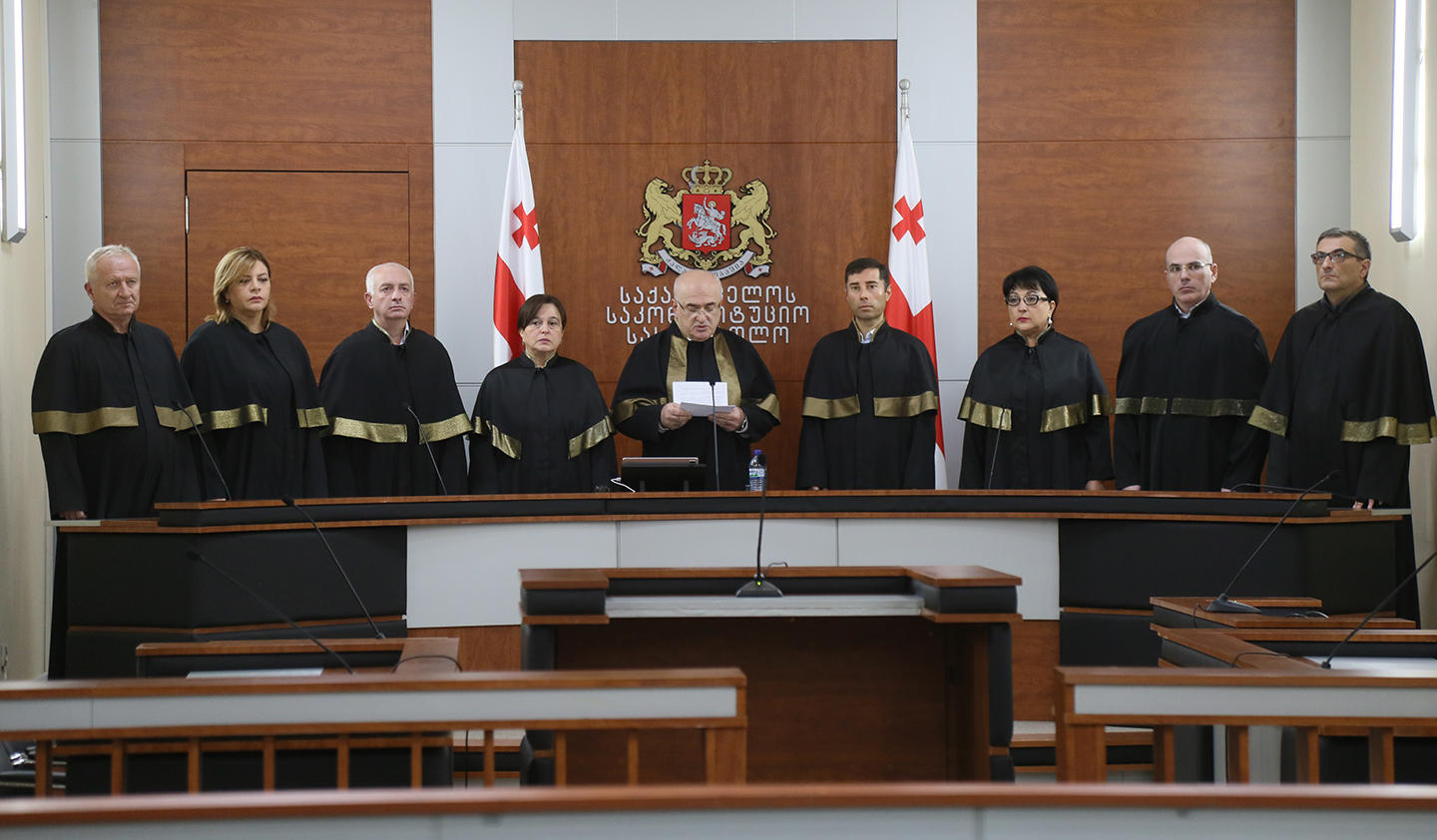
Violation of the provision established by one norm of the Constitution could not be justified under the pretext of observing another norm, including if it's done with good intentions, reads the press release on the decision of the Constitutional Court on the impeachment of President Salome Zurabishvili.
As it is noted in the statement, the fact that the President of Georgia was pursuing a legitimate goal provided by Article 78 of the Constitution of Georgia could not eliminate the fact of violation of Article 52 of the Constitution, could not neutralize it and/or could not acquire such an insignificant character that it would deprive the impeachment charge of a legal basis.
"The Constitutional Court analyzed the status of the President of Georgia and her place in the system of division of power. Based on the systematic interpretation and interrelationship of the structure of the Constitution, powers of constitutional bodies and relevant constitutional norms, the court pointed out that the President of Georgia, taking into account the parliamentary model of governance, is a politically neutral figure who does not possess political power. At the same time, explaining Articles 49 (Status of the President) and 52 (Powers of the President) of the Constitution of Georgia, the court pointed out that the powers corresponding to the status of the President in foreign relations are provided for only in subparagraph "a" of the first paragraph of Article 52 of the Constitution, and each aspect of the status of the President provided for in Article 49, as well as Article 78 of the Constitution, independently does not establish any powers of the President. According to the court's explanation, it is a requirement of the Constitution itself that any authority of the President is provided directly and by name by this or that norm of the Constitution.
At the same time, the Constitutional Court, for the purposes of Article 52, Clause 1, Sub-Clause "A" of the Constitution, explained the constitutional content of the exercise of representative powers and negotiations in foreign relations, their main characteristics and criteria, and also emphasized the exclusive authority of the Government of Georgia in this field and confirmed that under the existing conditions of the constitutional order, any foreign political activity of the President of Georgia was subject to the prior consent of the Government of Georgia; that the President has no right to invade the exclusive competence of the Government in the field of foreign policy implementation and implement an independent, parallel foreign policy. The court also explained that "obtaining the consent of the Government" meant the obligation of the President to act in concert with the Government in strategic and tactical matters.
The Constitutional Court clarified that Article 52, Clause 1, Sub-Clause "A" of the Constitution did not and could not allow the Government to give consent to the President in cases where the relevant activity of the President did not correspond to the main directions defined by the Government in the field of foreign policy, therefore, there was no basis claim that the President did not need the approval of the Government when her action was in accordance with these directions and did not deviate from the Government's policy.
The Constitutional Court considered it confirmed that the President of Georgia, without the consent of the Government of Georgia, in the capacity of the President, represented the state in foreign relations, and in all three cases held negotiations with the presidents of foreign states and international organizations on the issue of foreign policy.
The Constitutional Court also pointed out that the assessment of the constitutionality of the actions of the President of Georgia could not be affected by the provision provided for in Article 78 of the Constitution of Georgia, insofar as it obliged the constitutional bodies "within their own authority" to take all possible measures for the purposes of Georgia's European integration, which meant that this article also applies to the President of Georgia giving her the mandate to act only within the framework of her "own authority", and accordingly, any activity in this direction, where the President of Georgia represented Georgia in the field of foreign relations, was subject to the requirement established by Article 52 of the Constitution to obtain approval from the Government.
The court also explained that the violation of the provision established by one norm of the Constitution could not be justified under the pretext of protecting the second norm of the Constitution, including if it's done with good intentions. By itself, the fact that the President of Georgia was pursuing a legitimate goal provided for in Article 78 of the Constitution of Georgia could not eliminate the fact of violation of Article 52 of the Constitution, could not neutralize it and/or could not acquire such an insignificant character that would deprive the impeachment charge of a legal basis. The Constitutional Court emphasized that the oath of the President, which Salome Zurabishvili took, obliged her to protect the Constitution of Georgia. The court also explained that the President was well aware of the need for the government's consent in the exercise of representative authority in the field of foreign relations, which was proven by a number of circumstances and, at the same time, was based on a reasonable presumption that she was/should be certain about the scope of her authority.
The Constitutional Court discussed and answered a number of other legal issues, which were raised by the participants of the process during the oral hearing of the constitutional submissions. Based on all of the above, the Plenum of the Constitutional Court of Georgia confirmed in its conclusion that the President of Georgia, Mrs. Salome Zurabishvili, exercised her representative authority in the field of foreign relations during her working visits abroad on August 31, 1 and 6, 2023, without the consent of the Government of Georgia, thereby violating Article 52 of the Constitution of Georgia, provision of subparagraph "a" of the first paragraph of the article. The court concludes that this is a "violation of the Constitution" for the purposes of Article 48 of the Constitution of Georgia," the information released by the Constitutional Court reads.