Salome Zurabishvili: Despite the ruling party having taken a clear pro-Russian stance at times, they still pretend that they will somehow return to Europe - this issue began before the elections, with what, in hindsight, may have been the first sign of the Georgian Dream's Russian orientation. This started back in 2019, with the Gavrilov incident
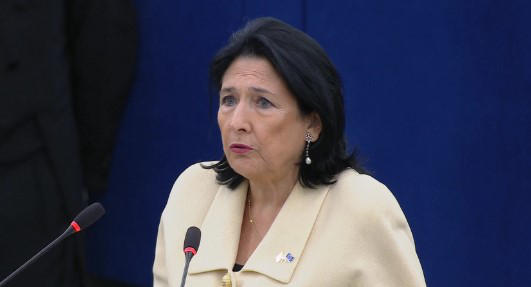
Despite the ruling party having taken a clear pro-Russian stance at times, they still pretend that they will somehow return to Europe - this issue began before the elections, with what, in hindsight, may have been the first sign of the Georgian Dream's Russian orientation. This started back in 2019, with the Gavrilov incident, - the President of Georgia, Salome Zurabishvili, stated in her speech delivered in the European Parliament.
As the President noted, "there is the Georgian people on one side and the repressive apparatus of a single party on the other side”.
“And there are no two sides in Georgia. There has been an attempt to portray a divided country, suggesting we are heading toward civil confrontation. But there are no two parts - there is the Georgian people on one side and the repressive apparatus of a single party on the other side. That is all. To emphasize this point further: despite the ruling party having taken a clear pro-Russian stance at times, they still pretend that they will somehow return to Europe. Why is that? Because even among their closest supporters, people want the European path. 80-90% of the Georgian population has consistently expressed this desire in every opinion poll and election since independence. Therefore, the leaders of the Georgian Dream, if they want any part of the "dream" to remain, must continue to uphold this hope.
This issue began before the elections, with what, in hindsight, may have been the first sign of the Georgian Dream's Russian orientation. This started back in 2019, with the Gavrilov incident, which you may remember, when a Russian figure was invited to assume the position of the Chairman of the Georgian Parliament. It seemed like an isolated incident, but then COVID-19 hit, and it was largely forgotten. But then came the rejection of the Charles Michel agreement, a much clearer sign of a shift away from the reforms the European Union had requested and a movement in a different direction. In February 2022, with the outbreak of the war in Ukraine, on February 25 (the day after Russia's aggression began), the Prime Minister visited Georgia's 1921 Russian occupation monument and declared, "Georgia does not intend to engage in financial and economic sanctions. This decision is based solely on our national interest." At that time, no sanctions had been imposed yet.
Then, in 2023, we saw the first Russian law, the reintroduction of Russian flights, and the growing Russian rhetoric about Ukraine: the Prime Minister even accused NATO of provoking or prolonging the war, if not starting it. In 2024, we saw the second Russian law, and the rhetoric reached new heights with a speech by Georgia’s leader, Mr. Ivanishvili, who talked about a "Global war party" and blamed our European and Western partners for almost everything. Meanwhile, behind these anti-Western and Russian narratives, there has been an undercurrent of LGBT-related rhetoric, with accusations that Europe and America are threatening our identity, our national values, and so on - rhetoric that many of you may have heard in another country to the north of Georgia," said the President.