Shalva Papuashvili: The OSCE/ODIHR has exposed the 5 main lies of the opposition – this conclusion is a watershed, where any harmful speculation regarding the integrity of the elections must end
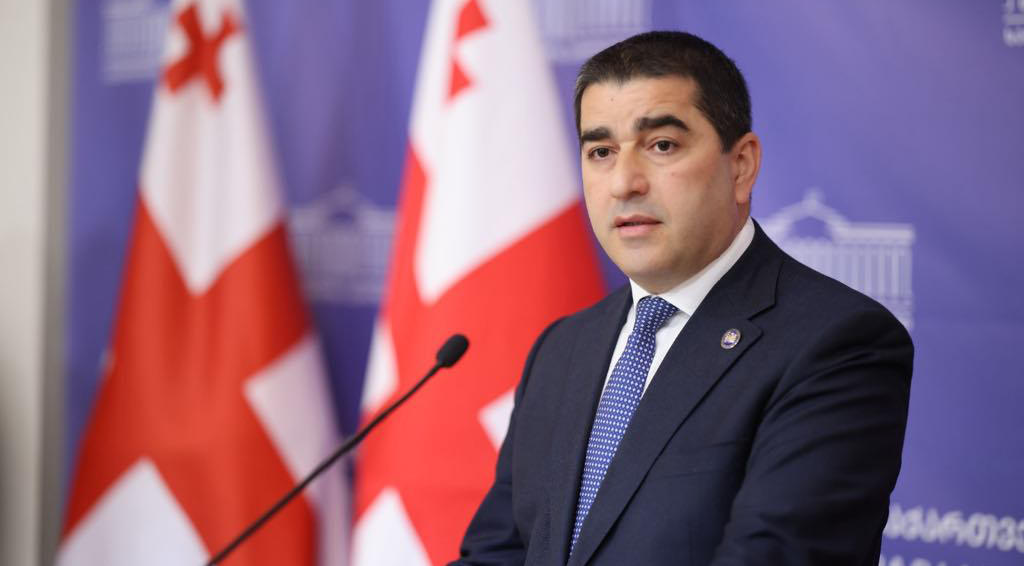
The main conclusions of the final report prepared by the OSCE/ODIHR, as expected, align with the assessments of the "Georgian Dream" and the criteria for competitive and free elections, said the Speaker of the Parliament of Georgia, Shalva Papuashvili, during today's briefing.
As the Speaker of the Parliament noted, the OSCE/ODIHR conclusion is the watershed, where all harmful speculation regarding the integrity of the elections must end.
"I would like to present to you the main conclusions of the final report on the parliamentary elections prepared by the OSCE/ODIHR, which, as expected, correspond to the assessments of the 'Georgian Dream' and the criteria for competitive and free elections. It is important that the OSCE/ODIHR mission expresses its readiness to cooperate with the elected government of Georgia for further improvement of the electoral environment and procedures.
First and foremost, I want to emphasize that the final report repeats the main conclusion of the OSCE/ODIHR's preliminary report, stating that on October 26, voters had 'a wide choice' and political parties were able to 'conduct their campaigns freely.' It is highlighted that the campaign took place in a calm environment, and information about 'isolated cases of violence' was received from both the ruling party and the opposition.
The report particularly praises the election administration for 'well-organizing and administering the elections.' The CEC deserved praise for the timely publication of the election results, while the State Services Development Agency was praised for effectively compiling the unified voter list. The report also mentions that in over 90% of polling stations on election day, the election process was assessed positively, and the handling of 'electoral documentation' was positively assessed in all 73 electoral districts.
The report also notes that the participation of local and international observers created an energetic observation environment. Significantly, the report criticizes the attempt of some political parties to present their representatives as election observers and send them to polling stations. As you may recall, our investigation revealed that 37 observer organizations directly linked to the radical opposition were involved in this effort," said Shalva Papuashvili.
According to the Speaker of the Parliament, "the most important criticism in the report pertains to the polarized political environment created in Georgia and the political bias of media outlets."
"According to the report, the OSCE is concerned about the subordination of television stations to political and business interests. The OSCE emphasizes that during the elections, commercial television stations were used for political propaganda, which damaged independent journalism and strengthened confrontational political rhetoric. The report highlights that the opposition avoided participating in debates on the public broadcaster. It is noteworthy that, unlike other observers, the OSCE/ODIHR report reflected the issue we raised when three opposition-owned TV stations violated the law by not allowing us access to free advertising time on their channels, taking away over five hours of free advertising time in total. One of the proposed solutions for addressing this issue in the future, according to the OSCE/ODIHR, is for the relevant media to be compensated for the lost advertising time.
It is important that the OSCE/ODIHR report highlights the violation of the Constitution by Georgia's acting president, Salome Zurabishvili, who, as stated in the report, "played an active role in the electoral campaign when she held consultations with the opposition on pre-election coalitions and the composition of the government, thereby potentially stepping outside the mandate of a neutral arbitrator between state institutions." Let me remind you that we publicly pointed out this violation, but apart from the OSCE/ODIHR, no other observer organizations reflected this fact in their reports.
The report also mentions the paradoxical behavior of ISFED, which refused to publish the results of the parallel vote tally. Let me remind you that this created the basis for continuing false narratives about discrepancies between the printed and uploaded protocols. We are still awaiting the publication of this document, but without success. Also, this fact was not reflected in the reports of other observers," said Shalva Papuashvili.
He also noted that "of course, like all other OSCE/ODIHR reports, both in Georgia and abroad, this report contains critical aspects and recommendations that we will respond to appropriately."
Amid the nearly two-month hysteria from the radical opposition, the main merit of the OSCE/ODIHR report is that it has finally exposed the opposition’s false accusations, which they have been using for the past two months to claim that the election results were falsified. Therefore, I would like to present the five main lies that the radicals built their revolutionary narrative upon, as revealed by the OSCE/ODIHR:
-
Unopened Polling Stations Abroad – The false narrative of radical parties, NGOs, and Salome Zurabishvili about restricting the voting rights of citizens living abroad has been completely shattered. This was even one of the reasons for an appeal to the Constitutional Court. Furthermore, Salome Zurabishvili presented this accusation as one of the main reasons for declaring the parliamentary elections unsuccessful. Against this false, noisy campaign, it is devastating for them that the OSCE/ODIHR report not only does not mention this as a problem, but it completely debunks the speculation about restricting the voting rights of our citizens abroad.
-
300,000 Falsified Votes – The OSCE/ODIHR report completely demolishes the false accusation from radical parties, NGOs, and Salome Zurabishvili about 300,000 falsified votes, which, according to them, appeared out of nowhere and were attributed to the "Georgian Dream." The report does not indicate, either directly or indirectly, that there was any falsification, manipulation, or so-called "electoral carousel" in the voting, counting, or protocol preparation process. Additionally, it debunks another false narrative regarding discrepancies between the population number published by Statistics Georgia and the number of voters determined by the CEC, which was falsely used to suggest the insertion of non-existent ballots. The OSCE/ODIHR confirmed that there are no questions regarding the accuracy of the voter lists.
-
17 Votes Cast by One Person – The false accusation from radical parties, NGOs, and Salome Zurabishvili about duplicate voter lists and "one person casting 17 votes" has been fully refuted. Independent audits by an American company and the OSCE/ODIHR report both confirmed that the issue of duplicate lists was excluded.
-
Russian Special Operation – Another shameful lie, spread by Salome Zurabishvili along with radical parties and some foreign allies, claiming Russia's interference in the elections, has been completely disproven. The OSCE/ODIHR did not just fail to find any evidence of Russian interference, but even expressed no suspicion about it, thereby definitively putting an end to the lie propagated by Salome Zurabishvili.
-
Leaked Marking on Ballots – Finally, the last straw that radical parties, NGOs, and Salome Zurabishvili clung to on the fifth day after the elections was the claim of a leak on the reverse side of the ballot marking. They tried to invalidate 90% of the precincts and disrupt the formation of the newly elected parliament. According to the OSCE/ODIHR report, 94% of their observations did not record any such occurrences on the reverse side of the ballots. In the remaining 6%, while they did observe marks on the reverse side, they only assessed this as a potential violation of secrecy, not an actual breach. The OSCE/ODIHR identified other main factors as risks to the secrecy of the vote, such as improper placement of ballots by the voter, large numbers of people at polling stations, and the internal setup of the precinct.
Thus, with a single report, the five main lies of radical parties, NGOs, Salome Zurabishvili, and their foreign supporters have been destroyed. They tried to undermine Georgian democracy and disenfranchise over a million voters, but their narrative has been thoroughly debunked.
I would like to remind the public that there is nothing new in the signature of these people. Since 2012, this is the eighth election that the radical opposition has declared to be falsified. They talk about unprecedented falsifications, while the opposition had a total of 24,000 commission members at polling stations, with the same number of representatives, of which only eight registered a differing opinion during the preparation of the election protocols. They talk about unprecedented violations, yet there was a record number of 25,000 local and international observers at the polling stations, and as a result, only 1,200 complaints were filed, whereas in the 2020 elections, more than 2,000 complaints were filed. They talk about unprecedented violence, yet in the context of over two million voters across 3,111 polling stations, the Ombudsman’s report recorded only 13 incidents of violence, and the OSCE/ODIHR described them as isolated cases.
This is precisely why, as in the previous seven cases, the radical opposition will ultimately have to accept the will of the Georgian people and return to the democratic framework. It is regrettable, however, that in the meantime, precious time is passing, and the energy and emotions of our people, which should be directed toward the advancement of our country, are being wasted.
The OSCE/ODIHR conclusion is the watershed where any harmful speculation regarding the integrity of the elections should come to an end. The opposition has received the share of power and the number of mandates that the Georgian people deemed necessary. It is also time to stop the attacks on Georgian democracy from abroad and recognize the will of the Georgian people, which was expressed in the only legitimate way—through elections.
Finally, I would like to thank the OSCE/ODIHR delegation for their work and the publication of the final election report. Of course, the Georgian government will thoroughly study their recommendations and continue to cooperate with the OSCE/ODIHR to ensure the proper conduct of future elections,” said Shalva Papuashvili.