Lela Jejelava: After the visit of the U.S. delegation, I did not notice a satisfied expression on the face of ‘Georgian Dream’ - we should assume that the discussion concerned new elections under new rules
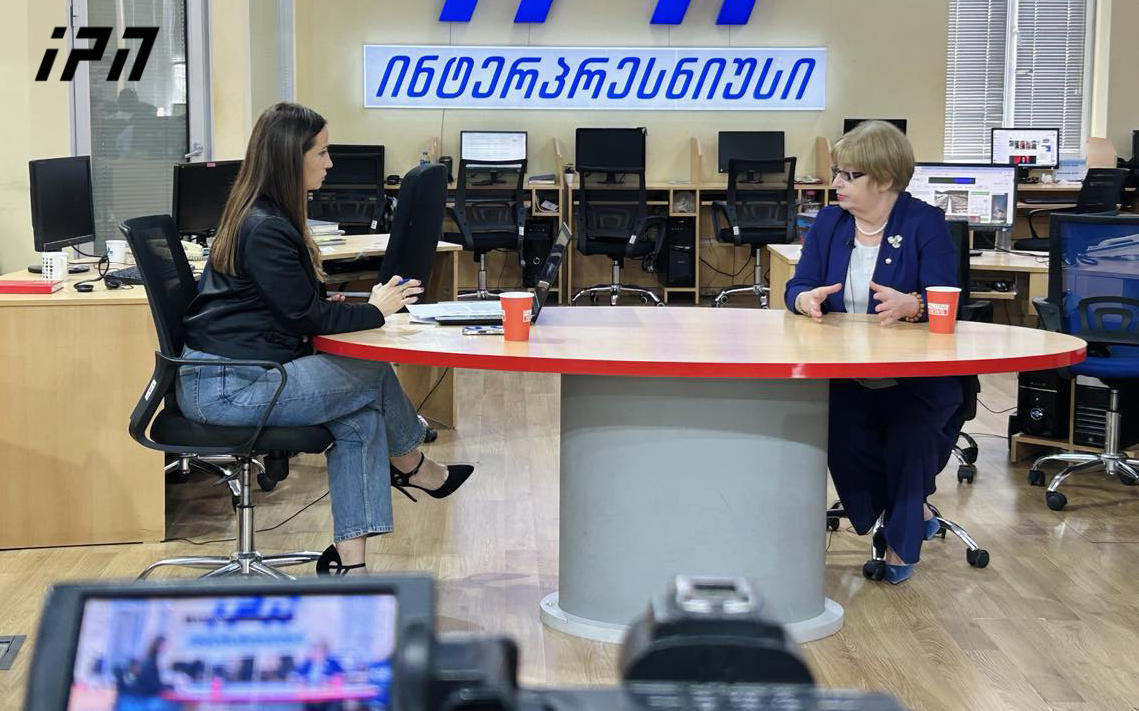
If we judge by the results of the meetings between the delegation and the government, and by the government’s reaction and attitude, it was clearly not a simple meeting. The government had been constantly saying that a reset with the U.S. was beginning and that there were good developments ahead, but after the delegation’s visit I did not notice such a satisfied expression on the face of ‘Georgian Dream,’” said analyst Lela Jejelava while commenting on the visit of the U.S. State Department delegation and the statement released by the U.S. Embassy during an appearance on the program “Day’s Newsroom” on PalitraNews.
According to Jejelava, the embassy’s statement is a diplomatically worded, carefully balanced, and coordinated text that should not have left room for interpretation, yet it still did.
“If we judge by the outcomes of the delegation’s meetings with the government, by the government’s reaction and attitude, it was not an easy meeting. The government had been constantly stating that a reset with the U.S. was beginning and that good news was coming, but after the delegation’s visit I did not notice such a satisfied expression on the face of ‘Georgian Dream.’ It seems that during the discussions a certain framework of actions was defined for both the government and the opposition, and that is a positive development, because there is no political process in the country.
U.S. geopolitical and geostrategic interests in the South Caucasus have become clearly visible. In this context, everything is already settled with Armenia and Azerbaijan, and now Georgia is the key factor. Before the Karabakh war, the West and the U.S. viewed regional prospects through Georgia; now it is the opposite — Georgia is being viewed through the prism of ongoing regional processes,” Jejelava said.
According to the analyst, opposition participation in political and institutional processes is important, but under conditions where the opposition cannot enter parliament, she believes the delegation’s talks with the government likely concerned new parliamentary elections.
“Favorable conditions for American business primarily mean national security, where the influence of countries unfriendly to the United States is minimized. The second issue is the participation of the opposition in institutions. This is impossible under the current policy pursued by ‘Georgian Dream.’ There can be no political stability in a country where political prisoners exist, where there is a threat of persecution of the opposition, and where cases are being initiated even against those who are not detained but remain free.
The opposition’s participation in institutional processes is restricted because they cannot enter parliament. We should assume that the discussion was about new elections under new rules. Bidzina Ivanishvili understands that an opposition must exist in the country, but he has his own position on this — he wants an opposition that is subordinate to him. Therefore, he considers ‘Neutral Georgia,’ ‘People’s Power,’ and Dimitri Khundadze as the opposition, as they are most often in a rebellious mode, which they are allowed to be in. He needs an opposition that is rebellious only with his consent,” Jejelava said.
Regarding whether “Georgian Dream” will fulfill U.S. demands, Jejelava assessed that the ruling party has no other choice, as regional developments and Russia’s weakening in foreign policy also play a role. According to her, in the context of processes in the South Caucasus and Ukraine, Russia does not have the capacity to confront U.S. interests.
“They have already created a narrative for their voters that Trump failed to defeat the ‘deep state,’ and that relations with such a U.S. are not beneficial for ‘Georgian Dream.’ It seems the ground has been prepared, but what alternative is there?
Let us look at developments on the Ukraine–Russia front, and also at the serious dissatisfaction growing inside Russia against the regime. Nikol Pashinyan’s elections are coming soon, and he has open support from the U.S. and Europe. Accordingly, what choice remains for Ivanishvili when, with Pashinyan’s victory, the U.S. strengthens its position in the South Caucasus?
They have assumed the worst-case scenario for themselves. They had the opportunity to make the right choice before the war in Ukraine, but they miscalculated when they opposed a country that was fighting for its homeland. Therefore, Russia is not in a position to confront U.S. interests; its goal will be to gain a role in political bargaining processes,” she said.
According to her, the U.S. trusted institutions rather than Bidzina Ivanishvili personally, which is why institutions must function properly and democratically, including with opposition participation.
“If the boycott ends, the opposition still cannot enter institutions or take part in them. Entry into parliament is impossible. I believe that under new elections, the opposition should participate.
The embassy statement repeatedly mentions trust, which reflects the fact that the U.S. does not see Bidzina Ivanishvili as a reliable partner, and instead places trust only in institutions. Therefore, the statement shows that the U.S. demands the proper functioning of institutions and democracy within them. I think the delegation’s mandate was limited,” Jejelava concluded.