PACE to debate report on Georgia today
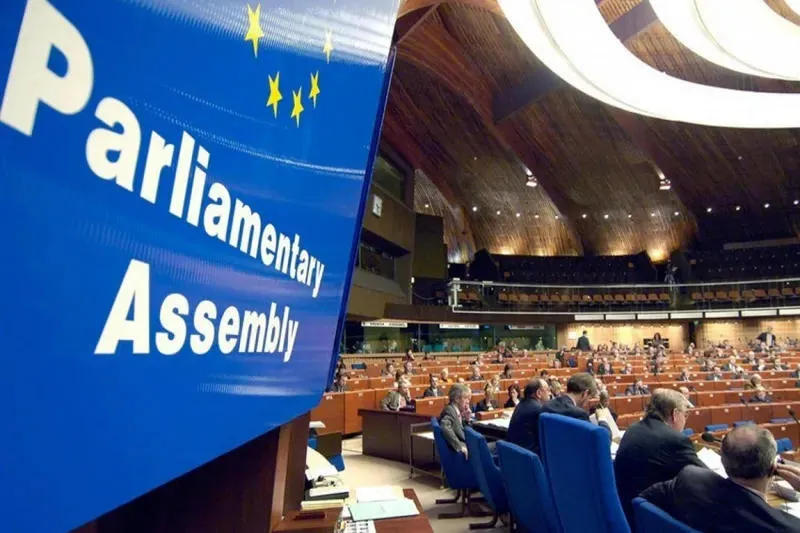
The Parliamentary Assembly of the Council of Europe (PACE) will hold a debate on Georgia today and vote on a resolution, according to information published on the Assembly’s website.
The report, entitled “The Functioning of Democratic Institutions in Georgia,” will be presented by rapporteurs Edite Estrela (Portugal, SOC) and Sabina Ćudić (Bosnia and Herzegovina, ALDE).
The draft resolution states that democratic backsliding in Georgia continues unabated, alongside ongoing pressure against civil society, the political opposition, and dissenting voices. According to the document, none of the Assembly’s urgent recommendations have been implemented.
“The continued collapse of democracy in Georgia and the lack of response to the Assembly’s recommendations on addressing this issue raise serious doubts about the authorities’ willingness to fulfill the obligations and commitments stemming from Georgia’s membership in the Council of Europe,” the document states.
At the same time, the draft resolution emphasizes that the Assembly remains committed to maintaining an open and results-oriented dialogue with the Georgian authorities, as well as with all other political and social forces in the country.
The draft resolution also states that the initiative to ban virtually all democratic opposition parties in Georgia and to prosecute their leaders on politically motivated and fabricated charges is unacceptable.
“The Assembly reiterates that, if this course continues, it would effectively establish a one-party dictatorship in Georgia, violating the fundamental principles of democracy and being incompatible with Council of Europe membership. It therefore calls on the Georgian authorities to immediately withdraw their application to the Constitutional Court seeking the banning of democratic opposition parties and to end the unfair and politically motivated criminal prosecution of their leaders,” the document says.
The resolution further stresses that, due to the “relentless suppression” of the democratic opposition, civil society, and independent media, as well as the extreme social and political polarization in the country, the conditions for genuinely democratic elections do not currently exist in Georgia.
“Accordingly, the Assembly once again calls on the Georgian authorities to launch an open and inclusive political process involving all political forces and civil society stakeholders, with the aim of restoring a genuinely free and democratic political environment in line with the clear expectations and aspirations of Georgian society,” the document notes.
The draft resolution also underlines that restrictions on freedom of expression and assembly - including through repressive legislation and the misuse of politically motivated legal proceedings against civil society, independent media, opposition groups, and individual protesters - must end immediately.
“Politically motivated prosecutions aimed at silencing dissent raise the risk of political prisoners and are incompatible with a democratic society and Georgia’s obligations as a member of the Council of Europe. In this context, the Assembly condemns the politically motivated and disproportionate sentences imposed on opposition leaders and others, including Nika Melia and Elene Khoshtaria, on clearly fabricated charges. The Assembly calls on the Georgian authorities to repeal in full the recently adopted repressive legislation, in particular the controversial amendments to the Criminal Code, the Law on Citizens’ Political Associations, and the Code of Administrative Offences. It reiterates its recommendation that the Code of Administrative Offences be replaced with an entirely new law developed in close consultation with the Council of Europe to ensure compliance with European norms and standards, including the European Convention on Human Rights,” the draft resolution states.
The Assembly emphasizes that a dynamic and pluralistic civil society is essential for a well-functioning democracy and that civil society plays a crucial role in the country’s democratic development.
“The Assembly condemns the increasingly shrinking space for civil society, which threatens its very existence. This trend must be reversed. The Assembly also condemns attacks on civil society organizations and their leadership, as well as on independent media, including through the misuse of controversial legislation. In particular, the Law on Transparency of Foreign Influence and the Law on the Registration of Foreign Agents (GEOFARA), together with the recent amendments to the Law on Grants, should be repealed in line with the recommendations of the Venice Commission,” the document states.
The Assembly expresses concern over the impact of recent education reforms on academic freedom and stresses that the independence of academic institutions must be safeguarded.
“Furthermore, in order to address understandable concerns regarding corruption, the Assembly calls on the authorities to establish a transparent and independent mechanism for managing the privatization of assets of any universities that may become surplus as a result of the new ‘One City - One Faculty’ reform,” the draft resolution says.
The Assembly also regrets that, despite numerous calls to do so, no credible investigation has been conducted into police brutality and other human rights violations during demonstrations, including allegations of torture and ill-treatment of protesters while in detention.
“The Assembly is particularly concerned by reports that prohibited chemical substances were used to disperse a protest in Tbilisi. A credible, independent, and effective investigation into these allegations must be carried out urgently,” the draft resolution states.
The Assembly calls on the Georgian authorities to fully implement the general measures required by the European Court of Human Rights in the judgments concerning Tsava and Others v. Georgia, Mekvabishvili v. Georgia, and Makharashvili and Others v. Georgia, as well as all other 77 judgments that remain pending execution.
“The Assembly takes note of the report prepared by the expert appointed under the OSCE Moscow Mechanism, which was invoked by 24 OSCE participating States. It fully shares the report’s conclusions, which are consistent with this and previous resolutions concerning democratic backsliding in Georgia. It calls on the Georgian authorities to fully implement the recommendations contained in that report,” the draft resolution concludes.