Maka Bochorishvili at the Dubrovnik Forum: Georgia is one of the best examples to talk about the importance of multi-vector diplomacy in practice - while Brussels’ attempt to respond to us with a policy of isolation is a strategic mistake.
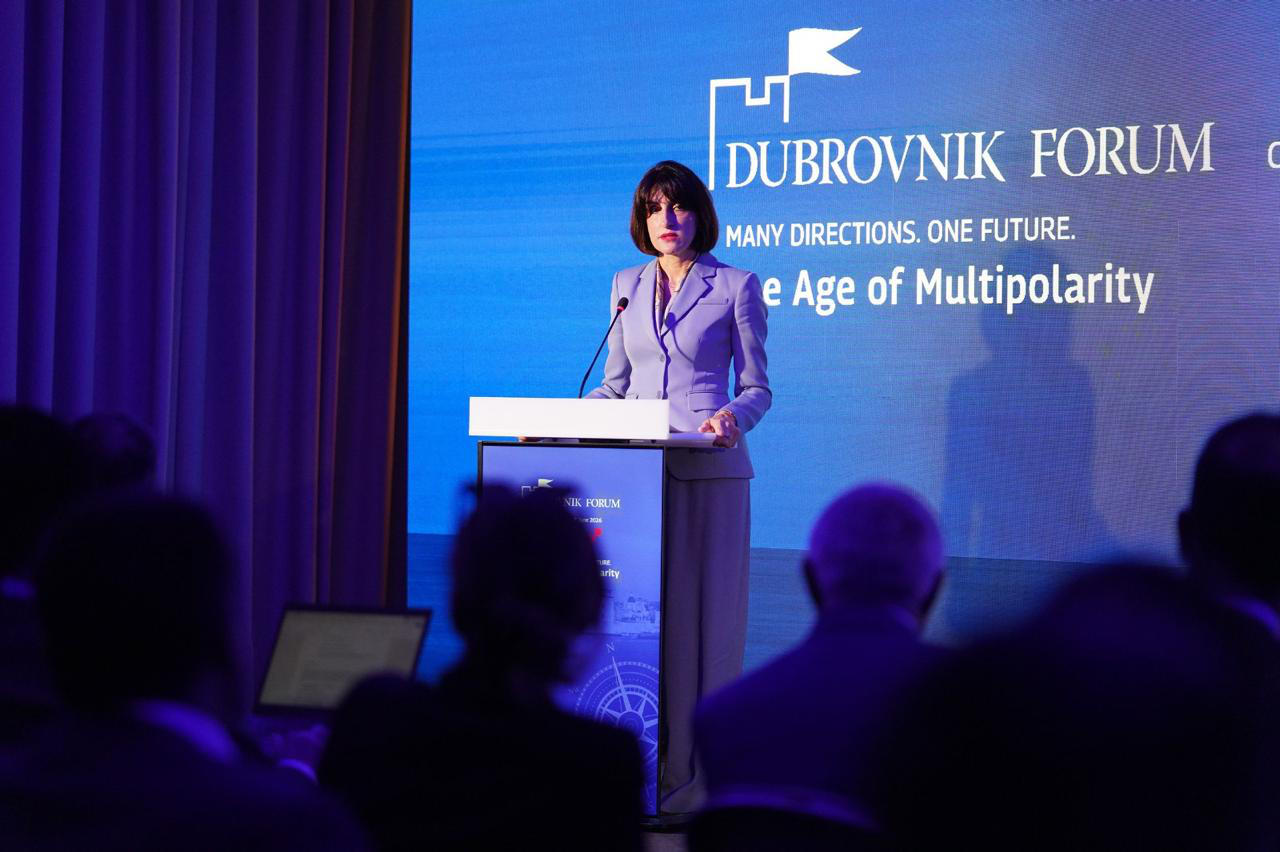
Today, as power centers are multiplying and economic competition increasingly shapes international politics, particular importance is given to countries that perform a connecting rather than a dividing function. Georgia has exactly such a role, — stated Georgian Vice Prime Minister and Minister of Foreign Affairs Maka Bochorishvili during her speech at a panel discussion titled “Between Centers of Power: Lessons of Multi-Vector Diplomacy,” held within the framework of the Dubrovnik Forum in Croatia.
The Minister spoke about global geopolitical transformations, the importance of multi-vector diplomacy, and Georgia’s role in regional and international processes.
“We are making decisions that determine not only the future of our countries but also the international order that is currently taking shape before our eyes. That is why I believe that today Georgia, with its history, challenges, opportunities, and policies, is one of the best examples in practice to talk about the importance of multi-vector diplomacy,” said Maka Bochorishvili.
According to her, against the backdrop of the transformation of the world order, the importance of countries that play a connecting role between different regions and economic spaces is growing.
“Georgia is truly located at a crossroads. The struggle of different forces, visions, and priorities around us requires exceptional caution and precision from us,” the Minister noted.
A significant part of her speech was devoted to the growing strategic importance of the “Middle Corridor.”
“The Middle Corridor is no longer just a transport route. It is a new geo-economic space that connects Europe, the South Caucasus, Central Asia, and the East. It is a space where trade, energy, digital connectivity, innovation, shared ideas, and interests meet,” Bochorishvili stated.
She added that one of the main tasks of both domestic and foreign policy is to ensure peace and stability.
“A country whose 20% of territory is occupied by Russia talks about peace more than others — not because it is weak, but because it knows the price of peace better than anyone else. That is why one of the main tasks of Georgia’s domestic and foreign policy is to ensure peace and stability,” the Minister emphasized.
According to Maka Bochorishvili, in recent years the country has established itself as one of the fastest-growing economies in the region, accompanied by infrastructure development, increased investments, and the expansion of trade partnerships.
The Minister clarified that multi-vector diplomacy for Georgia does not mean choosing between partners, but rather expanding cooperation: “Multi-vector diplomacy does not mean choosing between partners for us. It means acquiring more partners,” noted Maka Bochorishvili.
When speaking about Eurointegration, Maka Bochorishvili once again confirmed Georgia’s firm strategic choice.
“Georgia’s multi-vector foreign policy has never meant, and does not mean, any ambiguity regarding our strategic choice. Europe is not just a political or economic union for us. It is a space of values, and that is why integration into the European Union is Georgia’s firm, strategic choice,” the Minister stated.
In this context, the Foreign Minister drew attention to the current dynamics of relations between the European Union and Georgia, stating that an isolationist approach does not correspond to the interests of mutual cooperation.
“Brussels’ attempt to respond to Georgia — a country that is vitally important for Europe’s connectivity and has been a reliable partner for years — with a policy of isolation is not only unfair but also a strategic mistake,” noted the head of the ministry.
At the end of her speech, the Foreign Minister emphasized the necessity of dialogue and international cooperation in the modern world and noted that sustainable peace and progress are based precisely on joint efforts.