Lela Jejelava: Partsakhaladze’s patriotism did not suddenly appear - going to the Russian war is an obligation; Putin obliges businessmen to create their own armed groups, which they themselves will maintain and ensure are present at the front
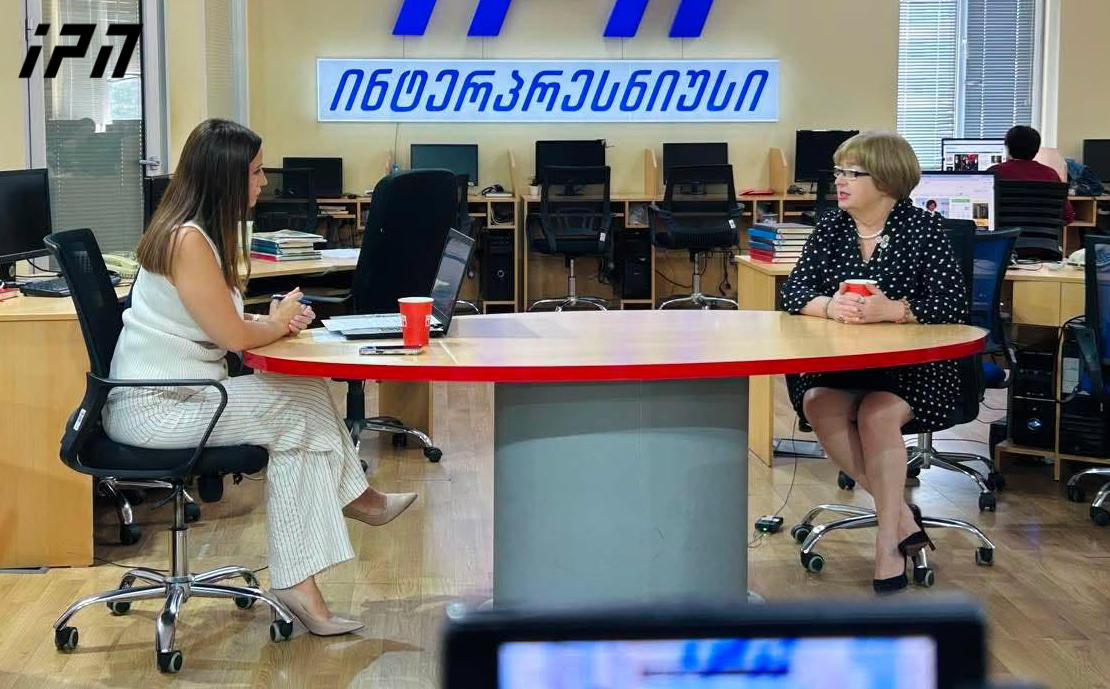
Partsakhaladze’s patriotism did not suddenly appear; going to the Russian war is an obligation, analyst Lela Jejelava stated on PalitraNews’ programme “Day’s Newsroom,” assessing the fact that Georgia’s former Prosecutor General Otar Romanov-Partsakhaladze has decided to fight on Russia’s side against Ukraine and has formed the volunteer unit “Georgievsky.”
As Jejelava noted, “Putin obliges businessmen to create their own armed groups, the so-called PMCs, obliges them to have armed forces which they themselves will maintain, arm and ensure are present at the front.”
“Whatever Otar Partsakhaladze adds to his surname, even if he adds Habsburg in addition to Romanov, or Windsor, I think it is not worth a separate discussion. Putin obliges businessmen to create their own armed groups, the so-called PMCs, obliges them to have armed forces which they themselves will maintain, arm and ensure are present at the front. Partsakhaladze’s patriotism did not suddenly appear, even if he rushed into the Russian war. This is an obligation.
I hope he does not turn the so-called PMC into an ‘Eleventh Army’ and does not have it in his head that he should enter Georgia. He may do this as well, and a modern analogue of the Eleventh Army may enter Georgia,” Jejelava noted.
As for other issues, she also assessed the letters of the imprisoned former Prime Minister Irakli Gharibashvili. In Jejelava’s opinion, “fear is visible in Irakli Gharibashvili’s letters.”
“This fear is natural and legitimate. I think the former prime minister knows perfectly well what can happen under the conditions of the system of which he himself was one of the creators.
It is possible that one fine day Irakli Gharibashvili may face risks to his physical security and he feels obliged to protect his physical security in this way. That he did not intend to engage in political struggle is also evident from the fact that his wife’s brother writes in one letter that ‘Irakli said that if Bidzina needs it, I will go to prison as well.’ What was supposed to happen after this for him to go into struggle against Ivanishvili.
Kobakhidze turned out to be much smarter than Gharibashvili when he simply removed responsibility; he said that what he was doing, including in relation to Gharibashvili, was done at Ivanishvili’s dictation, by his decision.
If Ivanishvili supposedly removed responsibility for the corruption existing in the country by throwing Gharibashvili, Liluashvili and this whole team into prison, sorry, he will not be able to do this so simply in relation to Kobakhidze,” Jejelava noted.
As for Gharibashvili as a possible agent of France and the information circulated in this regard in Azerbaijani media, Jejelava explained: “Gakharia was appointed by the ‘deep state,’ Gharibashvili was an agent of France, Zurabishvili is a complete agent, and who is this man himself? Are these people not brought by him? Whose agent is he himself? If the ‘deep state’ appointed Gakharia, as they say, then why did he appoint him? Why was he not so brave as he is in relation to Kobakhidze,” Jejelava noted.
In addition to domestic political issues, the analyst also spoke in the programme about global political issues, including the prospects for the end of the Ukraine-Russia war. According to Jejelava, Russia is considering all versions, including defeat, but it does not want defeat by Ukraine and may play out a scenario of defeat by Europe if it attacks some European country.
“The Russian information propaganda machine has long been preparing this issue that ‘look, Russia is involved in a war with Europe,’ ‘Russia is at war with NATO’… The complication of relations with Germany was expected following the analysis of these propagandistic narratives.
There is a possibility that Russia will provoke, start a direct military confrontation, but not a large-scale and prolonged one, but that this will happen with some European country and thus the cessation of this war will take place.
The concessions that Russia will have to make may be limited to a peace treaty concluded with Europe and not directly with Ukraine.
I do not see a prospect of the end of the war in a few months. It will indeed be difficult for Ukraine to continue the war, especially since we see that not only is Ukraine destroying Russia’s energy infrastructure, but the opposite is also happening,” Jejelava noted.
In addition, she also spoke about the victory of the far-right party in the parliamentary elections in the German state of Saxony-Anhalt and Friedrich Merz’s statement. As Jejelava noted, she does not expect that “Alternative for Germany” will be able to come to power. At the same time, she notes that Merz will indeed have to change his own policy.
“I think this is a topic for internal consumption before the elections. Weidel’s party says that it can no longer help Ukraine. This is a pre-election propagandistic method. It sounds good to citizens that your money will be spent on you and not on Ukraine. But when you are an opposition party and come to power, you realise how you have to maintain security. It is a separate issue how Europe’s security depends on Ukraine continuing the struggle; neither ‘Alternative for Germany’ nor others can escape this.
I do not expect that ‘Alternative for Germany’ will be able to come to power. Merz will indeed have to change his own policy and think more about migration issues; Germany is slowly becoming a hostage of its own values; if something does not change, Merz will have to take categorical measures,” Jejelava noted.