Prosecutor in the Giga Avaliani murder case: If it had not been for Nia Imnadze, the crime would not have happened and Giga Avaliani would be alive today
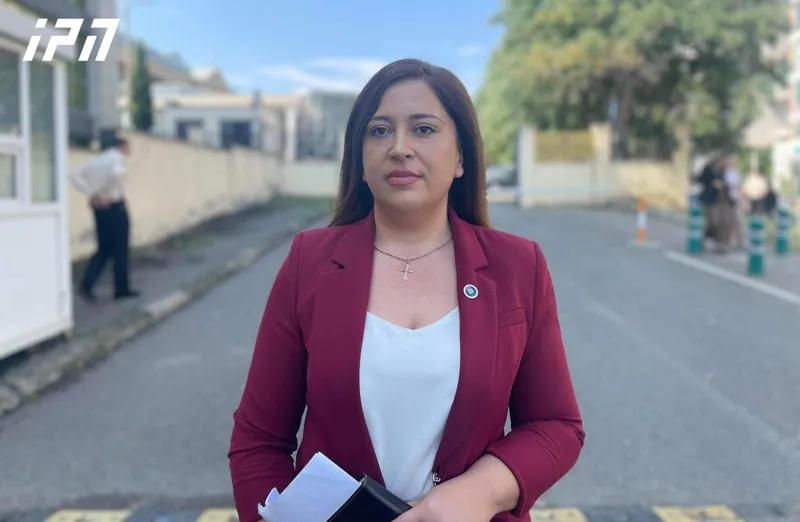
“If it had not been for Nia Imnadze, the crime in question would not have occurred, and consequently, Giga Avaliani would be alive today,” Ketevan Sonidze, the prosecutor in the murder case of teacher Giga Avaliani, said.
According to Ketevan Sonidze, the case contains a body of evidence confirming the crime allegedly committed by Nia Imnadze.
“At today’s court hearing, the parties will present their opening statements. In the opening statement, we will discuss our plans, what evidence we intend to present, and how we will prove the commission of the acts with which the defendants have been charged. The defense, naturally, will respond to this, after which the examination of the evidence will begin.
The case contains a sufficient body of evidence that will definitely confirm the commission of the acts with which both defendants have been charged. This includes, first and foremost, information we obtained from the mobile phones of other convicted individuals and the defendants, including detailed records of incoming and outgoing calls, as well as witness testimony.
It is an undisputed circumstance in the case that Nia Imnadze actually told her boyfriend, Aleksandre Gabashvili, about alleged inappropriate behavior by the teacher. This was misinterpreted by him, which was subsequently followed by an appropriate response from Aleksandre Gabashvili. To put it more clearly for the public, if Nia Imnadze had not been involved, the crime would not have occurred and, consequently, Giga Avaliani would be alive today.
October 14 is the date when Nia Imnadze was first questioned by investigators and first summoned by the investigative authorities. After leaving the investigative unit, she was presumably, as information from cell towers appears to confirm, at the location where Giorgi Malania lived. This gives us grounds to assume that Giorgi Malania and Nia Imnadze met with members of their families and discussed what had happened.
An important detail concerning this meeting was that we essentially regard Giorgi Malania and Nia Imnadze as accomplices in the same crime, so this would also constitute one piece of evidence. However, this is neither the only nor the primary piece of evidence proving their involvement in the crime; it is one piece of evidence that helps other evidence establish the objective truth,” Ketevan Sonidze said.
For reference, on August 6, the Prosecutor’s Office charged two more minors - Nia Imnadze and Anastasia Beruashvili - in connection with the death of teacher Giga Avaliani. Imnadze was charged under Article 25 and Article 117, Part 3, Subparagraph “L” of the Criminal Code, which concerns incitement to intentionally inflict serious bodily harm as part of a group and carries a sentence of up to 13 years in prison.
Anastasia Beruashvili was charged under Article 376, Part 2 of the Criminal Code, which concerns failure to report an especially serious crime. The offense carries a sentence of up to seven years in prison.
According to the prosecution, Nia Imnadze told her friends - Aleksandre Gabashvili and Giorgi Malania - that her teacher, Giga Avaliani, was allegedly paying excessive attention to her, thereby inciting Aleksandre Gabashvili to attack Giga Avaliani together with his accomplices. Ultimately, according to the plan developed by Aleksandre Gabashvili, Giorgi Rikadze and Demetre Chikovani, Aleksandre Gabashvili and Giorgi Rikadze attacked Giga Avaliani as a group. He died 23 days later at a medical facility.
A total of seven people have been arrested in connection with the case: Aleksandre Gabashvili, Giorgi Rikadze, Ani Nasqidashvili, Demetre Chikovani, Giorgi Malania, Nia Imnadze and Anastasia Beruashvili. Four of them - Aleksandre Gabashvili, Giorgi Rikadze, Ani Nasqidashvili and Demetre Chikovani - have been convicted.