Eka Gigauri: We need a clear policy from our partners toward Russian oligarchic rule in Georgia: a demand for the release of political prisoners and targeted sanctions - do not leave Georgian citizens alone in their struggle against the regime
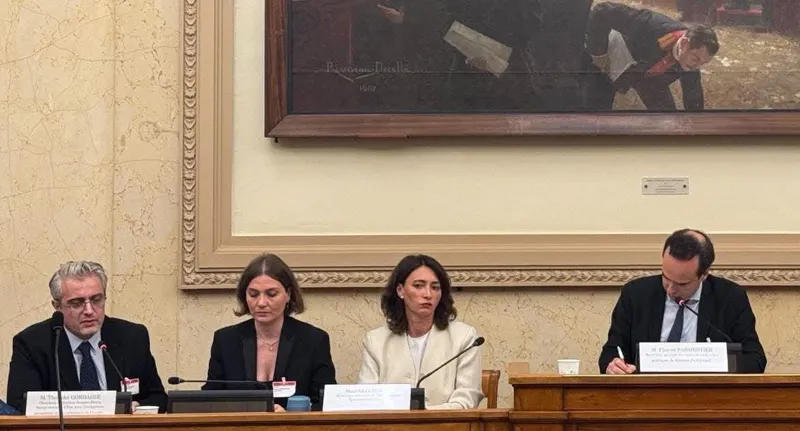
“Today, the following system is operating in Georgia: a single informal center of power controls the government, parliament, judiciary, prosecution service, security services, regulatory bodies, and a significant portion of the country’s economic resources,” Eka Gigauri, director of Transparency International Georgia, said during a discussion at the French National Assembly titled “Undermining Democracy after the October 2024 Elections” and “Culture as a Means of Resistance.”
According to Gigauri, the methods used by the system include pressure and intimidation of voters, the unlawful acquisition of personal data, vote-buying, mobilization of public servants, and the use of administrative resources.
In her speech, Eka Gigauri spoke at length about “how corruption has turned into a system of governance in Georgia.”
“Today I want to speak not only about individual acts of corruption, but about how corruption has turned into a system of governance in Georgia and what it has in common with the Russian system of governance. About how widespread corruption in Georgia helps advance Russian interests and dismantle our state.
As early as 2020, Transparency International Georgia assessed that corruption in the country had taken the form of state capture. This is the most severe form of corrupt governance, in which influential individuals shape policies, laws, and economic rules according to their private interests, while public institutions serve these private political interests rather than society.
Such a system of governance makes it easier for the ruling elite to maintain power. Elections may formally be held and institutions may formally exist, but all of this becomes a façade. The same system makes it easy to conduct propaganda, convince the population to believe lies, and change the country’s foreign policy course — something we are unfortunately witnessing in Georgia today.
This is precisely the system operating in Georgia today: a single informal center of power controls the government, parliament, judiciary, prosecution service, security services, regulatory bodies, and a significant portion of economic resources. Practically no institution remains in Georgia capable of resisting the will of Georgian Dream and its founder.
Bidzina Ivanishvili does not need to hold public office to exercise influence over the state. His power is based on appointing loyal individuals, distributing the state’s and the public’s financial resources and property, officials who have enriched themselves through corruption and become involved in other crimes, controlling people through intimidation, and ensuring impunity for those in his inner circle.
As a result, institutions formally exist in Georgia, but they have lost their constitutional functions: parliament no longer oversees the government; the judiciary no longer protects people from political violence; the prosecution service no longer investigates possible crimes and corruption linked to the authorities; and the security service is used against political opponents, non-governmental organizations, and the media,” Gigauri said.
In her speech, Eka Gigauri also discussed the judiciary and stated that “the Constitutional Court has also been captured.”
“This is an institution that should protect the Constitution, human rights, and political pluralism. It is currently considering a request by the ruling party to ban several major opposition political groups. If these parties are banned, individuals associated with them will also be prohibited from engaging in political activity. Thus, the Constitutional Court may be used not to protect the Constitution, but to legitimize one-party rule,” Gigauri said.
The civil society representative also highlighted her organization’s work in uncovering cases of corruption.
“In our research, we have documented more than 300 cases of elite corruption over the past five years involving high-ranking officials. Most of these cases have not been effectively investigated. A small number of people are becoming wealthy while the population remains poor for years.
State property, the budget, and public procurement are being used to reward political loyalty. Companies connected to the authorities receive contracts, access to resources, and state property, and these businessmen or individuals associated with them then donate money to the ruling party. In this way, citizens’ money is transformed into the economic and political power of the ruling elite. As a result, the ruling party has approximately three times, and in some cases four or five times, more financial resources than the entire opposition combined. State institutions do not respond to these corruption schemes.
This is no longer merely corruption — it is the use of state resources to maintain the ruling party’s political and financial monopoly. Taken together, this has the characteristics of classic kleptocracy.
The foundation of this system is a captured justice system. The prosecution service and the courts act in coordination when the target is a political opponent of the government, a journalist, an activist, or a civil society representative. You can torture a protester, impose an enormous fine on them without evidence, send them to prison for a critical statement, or use a chemical substance against them, and yet you, as a senior official, will not be punished for it. What system does this remind you of? Probably Russia!” she added.
Eka Gigauri noted that it is precisely the result of captured institutions and the justice system that Georgia has political prisoners.
“The result of captured institutions and the justice system is that we have political prisoners in Georgia. Transparency International Georgia individually examined the cases of people detained in connection with protests and, according to the Council of Europe’s criteria, identified 91 people as political prisoners. They include journalist Mzia Amaghlobeli, politician and my friend Elene Khoshtaria, as well as actors, doctors, students, businesspeople, and other citizens. These are patriots of Georgia, decent and law-abiding citizens. Their only crime is their love for Georgia,” Gigauri said.
According to Gigauri, the electoral administration has also been captured. Elections are formally administered by the Central Election Commission, but in practice the process is managed by an informal network formed around the State Security Service. The methods used by this system include pressure on voters.
“Pressure and intimidation, the unlawful acquisition of personal data, vote-buying, mobilization of public servants, and the use of administrative resources.
State capture is impossible without suppressing critical media and civil society. Critical media outlets are being financially strangled, fined, and threatened with the loss of their licenses. The adoption of the so-called ‘Russian laws’ was followed by unprecedented pressure on the civil sector — the freezing of organizations’ bank accounts, the seizure of personal data, and the threat of criminal liability.
My professional activities have also been made the subject of two investigations. Formally, I have the status of a witness, but in Georgia we know very well how quickly a witness can become a defendant. Due to laws adopted by the government and multifaceted pressure, we were forced to close all five offices of Transparency International Georgia in the country. The organization’s physical offices have closed, but our work and our struggle for Georgia’s democratic future have not stopped.
Georgia already has hundreds of government officials and individuals associated with the authorities who have been sanctioned or subjected to visa and travel restrictions. They include ministers, members of parliament, judges, prosecutors, and senior officials from the police and security services. The United States has also sanctioned Bidzina Ivanishvili himself for advancing Russian interests on Georgian territory.
In addition, two major pro-government television channels - Imedi and POSTV - have been sanctioned by the United Kingdom for spreading deliberate disinformation related to Russia’s war against Ukraine. This shows that their propaganda is not merely an instrument of domestic political control - it also serves Russia’s informational and strategic interests.
Why do I call this a Russian model of governance?
Because this model is based on the informal power of an oligarch, the dismantling of independent institutions, the use of the judiciary and prosecution service as political tools, the destruction of critical media, the labeling of civil society as ‘foreign agents,’ portraying the West as an enemy, and the consolidation of corruption and political loyalty into a single system.
This is strategic corruption - when corruption is no longer merely a means of personal enrichment but is used to change a country’s foreign policy course.
It is not necessary for every decision to be the result of a written order from Moscow. It is enough for the entire model of governance to weaken Georgia, destroy its democratic institutions, distance it from the European Union, and increase its dependence on Russia. That is precisely the Kremlin’s strategic interest.
Therefore, the struggle taking place in Georgia is not merely an internal political confrontation. It is a struggle between European democracy and the Russian authoritarian model. Despite unprecedented pressure, the Georgian people remain firmly committed to their struggle. They no longer have faith in any state institution, but I am certain that the unprecedented solidarity and activism we have demonstrated over the years will not be in vain.
First and foremost, I see the continuation of the Georgian people’s struggle as the way forward. We do not place responsibility on anyone else. We are fighting for our homeland. At the same time, however, this is also a struggle against Russia and for democracy, and it is an issue that requires us to join forces with our partner countries.
Therefore, we need a clear policy from our European partners toward the Russian oligarchic rule operating in Georgia: a demand for the immediate release of political prisoners; targeted sanctions against those organizing state capture, violence, and political persecution, as well as their financial networks; and making cooperation with the Georgian authorities conditional on clear and measurable democratic conditions.
The majority of Georgian citizens have chosen the European path. Despite the risk of imprisonment, violence, and losing their jobs, people continue to defend this choice.
Our request is simple: do not leave Georgian citizens alone against a regime that places state capture, corruption, and repression at the service of Russia’s strategic objectives. We will continue our struggle. We believe that strength lies in unity,” Eka Gigauri said.