Turkish Deputy Trade Minister: Facilitating transit between Azerbaijan, Georgia and Türkiye will create new investment opportunities
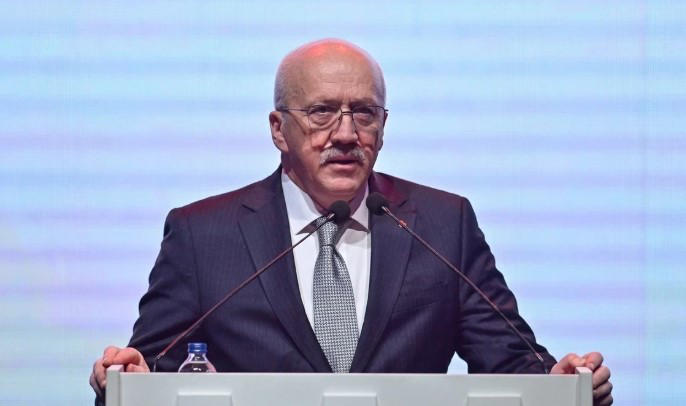
“One of our main goals is to simplify transit procedures between Azerbaijan, Georgia and Türkiye, reduce waiting times at border crossing points, and create infrastructure that facilitates trade and transit by introducing international standards in these countries,” Turkish Deputy Minister of Trade Sezai Uçarmak told journalists at the fifth meeting of the Trilateral Committee on Customs Affairs between the governments of Azerbaijan, Georgia and Türkiye, according to Azerbaijani media.
“Today, the heads of the customs administrations of the three countries are holding our fifth meeting. These three countries play an extremely important role in international transit and neighboring relations, as well as in trade along the East-West route. Therefore, we attach great importance to this meeting. We discuss these issues at every meeting.
“One of our main goals is to simplify transit procedures, reduce waiting times at border crossing points, and create infrastructure that facilitates trade and transit processes by introducing international standards in these countries,” Sezai Uçarmak said.
According to him, significant investments are being made in road, railway and maritime transport infrastructure in Georgia, Azerbaijan and Türkiye.
“We can clearly see this. When I periodically visit Georgia, I observe the development of roads. We see similar infrastructure development in Azerbaijan. Here, we must acknowledge one thing: consumption takes place in the West, while production takes place in the East. Naturally, there is significant movement of cargo and goods in this direction.
“However, in the geographical area where we are located — namely, along the route of the Middle Corridor — transit capacity is currently quite low. We believe that by developing infrastructure, simplifying procedures, harmonizing all processes and bringing them under a unified system, this transit flow will increase further.
“I do not view this issue solely from the perspective of transportation; this process will also attract new investments. The point is that trade in goods has its own specifics: significant economic value cannot be created simply by moving goods from one point to another. You cannot generate income solely from the transportation component of the process. If you process these goods and turn them into another product, you can generate additional revenue. The countries have, in fact, understood this,” Uçarmak said.
He emphasized that improving the investment environment and implementing various projects can create opportunities to attract new investors.
“Azerbaijan is a country that plays an important ‘bridge’ role in the East-West corridor. Crossing the Caspian Sea is largely connected with countries such as Kazakhstan and Turkmenistan. Naturally, facilitating the process of crossing the Caspian Sea is also necessary.
“As we can see, the investment environment is improving in all these countries, various projects are being implemented, and investors are being attracted from different parts of the world. However, we must acknowledge that in order for an investment to be made somewhere, there first needs to be an appropriate opportunity and profitability.
“Customs procedures and other processes should also be approached from this perspective. No one will invest with the approach of ‘let it be small, but let it be mine.’ If the approach is based on the principle that ‘it should be large-scale, beneficial to all countries and to the countries with which you cooperate,’ then new opportunities emerge.
“We can see this very clearly. We are closely monitoring developments in these countries — Georgia, Azerbaijan and Iran,” the Turkish deputy trade minister said.