Giga Lemonjava: The provisions concerning Georgia and its occupied territories in Russia’s foreign and security policy doctrine are identical to those found in Georgian Dream’s constitutional lawsuit
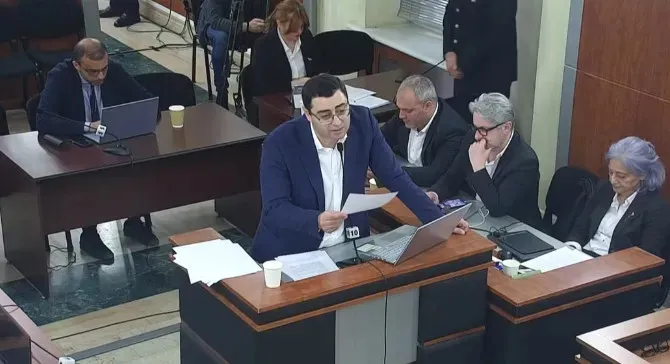
If the Constitutional Court accepts the arguments presented in the lawsuit, its ruling could provide a legal basis for an interpretation that Georgia’s policies at the time contributed to Russia’s occupation, while Russia’s actions were a response, Giga Lemonjava, a representative of the Coalition for Change, told the Constitutional Court during hearings on the lawsuit seeking to ban opposition parties.
“The so-called ‘new reality’ described in Russia’s foreign and security doctrine, in the sections concerning Georgia and its occupied territories, is reflected in exactly the same terms in Georgian Dream’s constitutional lawsuit,” Lemonjava said.
According to Lemonjava, if the Constitutional Court establishes the arguments presented in the lawsuit as facts, a Georgian state institution would, for the first time in the country’s history of independence, grant domestic legal legitimacy to a Russian narrative.
“This fundamentally weakens Russia’s responsibility as the state that carried out military intervention on Georgian territory and reinforces the so-called ‘new reality’ created by Russia through the authority of Georgia’s own court. Russia’s ‘new reality’ doctrine is directly linked to Georgian Dream’s constitutional lawsuit. Russia’s foreign and security doctrine on the ‘new reality’ is a direct reflection — a mirror image — of the passages contained in Georgian Dream’s constitutional lawsuit. In other words, what is written in Russia’s foreign and security doctrine concerning Georgia and its occupied territories is reflected in exactly the same terms in Georgian Dream’s constitutional lawsuit.
“For example, two key arguments in the lawsuit — first, the artificial restoration in 2007 of the borders of the former South Ossetian Autonomous District, and second, the claim that Georgia started the 2008 war — correspond word for word, at the level of direct quotations, to Russia’s doctrine. If the Constitutional Court establishes these arguments as facts, a Georgian state institution would, for the first time in the country’s history of independence, grant domestic legal legitimacy to a Russian narrative, even though the European Court of Human Rights and the International Criminal Court have already established Russia’s responsibility,” Lemonjava said.
His remarks prompted a clarifying response from the respondent side.
“Did it rely on our lawsuit? Did Russia’s doctrine rely on our lawsuit? That’s what he said!” Archil Gorduladze remarked.
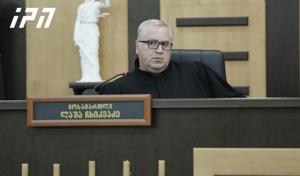
Constitutional Court Chairman Revaz Nadaraya then refused to allow Lemonjava to continue speaking and described his remarks as unethical.
“You have now gone beyond Georgian politics as well — what doctrine, which doctrine?!
“You have started in a very unethical manner. How can a lawsuit be based on the doctrines and assessments of a foreign state? If this is your political assessment, you are a politician and can make it wherever you want. Let us discuss the lawsuit itself. As far as the lawsuit is concerned, you have gone completely beyond its scope! Your political assessments are not relevant to the court. When something is relevant to the case, I do not interrupt you. But when you cross every boundary, including those of ethical conduct, that is unacceptable. It is a breach of ethics to claim that we are hearing a lawsuit derived from some foreign country’s doctrine. Do not argue with me! Do not explain it to me!” Nadaraya said.
In response, Lemonjava reminded the Constitutional Court that it was not making a purely legal decision, but one on which the country’s fate depended.
“You must be aware of the dangers that could follow if this constitutional lawsuit is upheld.
“You are making a decision of strategic importance. Your ruling is not merely a dry legal decision. The decisions made by this court affect the fate of the state. This is a court of such significance,” Lemonjava said.
“There is no need for demagoguery! We are examining whether the circumstances and facts presented in the lawsuit comply with Article 23 of the Constitution,” the judge explained.
Lemonjava also said that Article 78 of the Constitution must not be overlooked, arguing that granting legal force to the substance of Georgian Dream’s lawsuit would ultimately conflict with Article 78.
“Then say that — that is exactly what I am telling you. Say that!” Judge Nadaraia responded.