


Revaz Nadaraia expelled Nika Gvaramia from the courtroom with the words: "You have crossed the line, you are expelled, your place is not in the courtroom, remove this rude man," to which Gvaramia replied: "You are a shameful man, the time will come and I will hold you accountable"
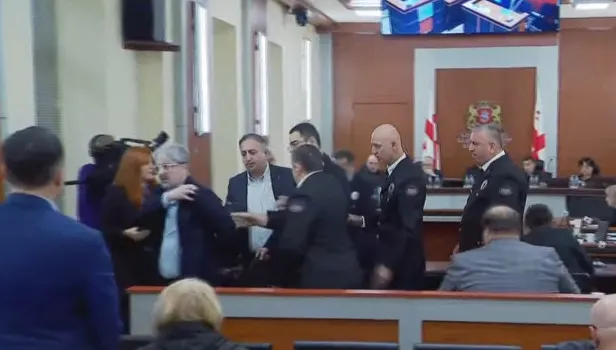
"Remove this rude man from the courtroom,"—with these words, the President of the Constitutional Court, Revaz Nadaraia, addressed the bailiffs and expelled Nika Gvaramia, one of the leaders of the Coalition for Change, from the courtroom.
The expulsion was preceded by a verbal confrontation between Gvaramia and Nadaraia, triggered by questions posed to the claimant side during the Q&A session. Judge Nadaraia reprimanded Nika Gvaramia for asking the claimant side the same question repeatedly.
"We are hearing the exact same thing several times," Revaz Nadaraia addressed Nika Gvaramia, to which the opposition politician remarked:
"Because the claimant is not answering the question. I am trying to ask from different angles so that perhaps I can get at least something out of them," Gvaramia replied to Judge Nadaraia.
"When you ask the exact same question, even from several angles, the court realizes that you are asking the same question. When the court realizes this and the answers from the claimant side are also identical, all of this confirms that it is the exact same thing. Well then, try forcing them [to give you an answer]," Nadaraia addressed him.
"You can force them; this is an inquisitorial process—tell them to answer the question, you can very easily force them," Gvaramia replied.
"Do not lecture the court; know your place. Something that the court did not do and did not force upon you—demanding that you give a specific answer whether you want to or not—forcing them to give me this or that answer is completely unacceptable. When you ask the exact same question with different phrasing and the content is identical, the court will remove it because when identical answers keep coming, it loses all meaning," Nadaraia addressed Gvaramia.
"I am interested in where the standard was established that the claimant is allowed not to answer, and then you evaluate it as them having answered. This is not the standard of the Constitutional Court. The Constitutional Court must establish facts. Do you not intend to establish facts regarding this case? Neither did the claimant establish them—not a single witness has been questioned and cited in the lawsuit, not a single piece of evidence has been requested and cited in the lawsuit—and on top of that, when the claimant answers nothing, the court tells me... I do not consider your attitude to be fair or lawful; surely I am allowed to say that? And I am saying it. I truly do not consider it so, because both stages have simply been derailed. Now, on top of that, you have followed up by abolishing the Q&A stage. Q&A is an adversarial debate.
The claimant and I are sorting out this matter; why are you helping them? Whether it is repeated or not repeated, why are you helping them with this? I genuinely do not understand—let them answer for themselves! Can a party claim for everything that a question is being asked for the tenth time?" Gvaramia addressed Nadaraia, to which Nadaraia asked Gvaramia to specify how he was helping the claimant side.
"You are helping them in everything. First of all, you abolished the stage altogether. You abolished the stage of examining evidence for us. I would not ask them any questions at all; I would sit right here and examine the evidence. Do you know why I am asking so many questions and why I am interested in extracting information from at least one side? Because I no longer have the stage where I could do this without them [Georgian Dream representatives]," Gvaramia addressed the judge.
"You cannot answer my question as to how the court's assistance to the claimant is manifested. If you interrupt me again, you will lose the opportunity to be here. You were already given a chance once when I allowed you back into the hearing. That is regarding interrupting. When the court speaks, be so kind—whether you like it or not—as to listen until the end. Incidentally, that is the problem: when a party speaks, you are unable to listen and let them finish.
You cannot prove that I am helping a party. What you are saying is a falsehood—the court has not abolished any stage. When you ask how the court interferes in the conversation between the parties, who else is supposed to interfere? It is precisely the court that must interfere, and the court must exercise control so that identical questions and identical answers do not take place, because the court and the parties have already strayed from the working process. If there are identical questions and identical answers, it is the court's obligation to interfere. Granting you an advantage is not the court's obligation. You are demanding to be granted an advantage. What the court did not do toward you, do not demand toward the claimant. This is not an interrogation; when you tell a party 'give me that answer whether you want to or not,' you are unequivocally lying," Nadaraia addressed Gvaramia.
"Choose your words carefully when speaking to me, please; you have already stepped outside the bounds of the trial—you are leaving the trial with these words. You are allowing yourself way too much; you are a judge and you have procedural powers to speak with me, but what you are doing right now is not your business. Neither lecture me—especially pointlessly, since I do not agree with you on anything—nor say rude things to me; that is not your right, neither the law grants it to you, nor the Constitution, nor do I grant it to you personally," Gvaramia addressed Nadaraia.
"Those were insolent and rude statements. Stand up; you have crossed every boundary and you are expelled. Your place is not in this courtroom. Remove this rude man from the courtroom," Nadaraia declared.
"You are a shameful man, the time will come and I will hold you accountable for that!"—with these words, Gvaramia left the courtroom.










