There are no taboo topics between Israel and Georgia
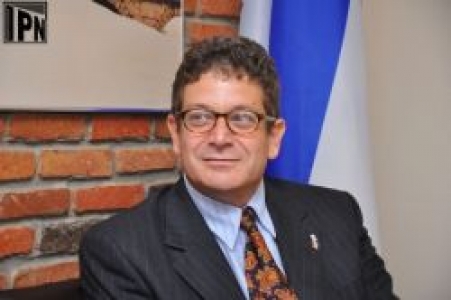
In reference to the 66th anniversary of Israel, InterPressNews sat down with Israel’s Ambassador to Georgia Yuval Fuchs to discuss relations between Georgia and Israel.
--As long as our meeting commemorates the 66th anniversary of Israel, we would like to ask you about what 66 years of independence have brought to the country.
-According to the Hebrew calendar, we celebrate this landmark event, Israel’s Independence Day, on May 6. As per the Gregorian calendar, Israel’s Independence Day is celebrated on 14 May. I do credit that by forming the independent state of Israel, we have witnessed a glorious miracle; by creating a hub of democracy, stability and economic well-being, we made the impossible possible.
As long as you have focused on consequences, I would like to mention that when in 1948, May 14, Israel declared its independence, only 600 thousand Jews resided in the country, while today 8.2 million people – out of which as many as 7 million are ethnic Jews live there. We have not witnessed such kind of calm and prosperous country with so many Hebrews after a large-scale persecution against us was launched. I want to underscore that Israel is also a shelter of non-Jewish ethnicities the number of which hits more than a million. And here these people – Christians, Muslims, and the representatives of other religious groups -- do enjoy democracy to the fullest; they are within our parliament, Ministries, army and, in a nutshell, they are actively involved in the country’s affairs. That is the reason why I unabashedly state that Israel is a hub of democracy in the Middle East. Despite the fact that it’s battle-hardened warriors had gone through a number of wars to defend their people and state, Israel has remained one of the most stable countries in the world.
Israel is also a member of the organization of the countries with advanced economies; this body incorporates more than 30 states; and this once again bolsters up the claim saying that Israel is a stable state with a rather fast growing economy. According to different data, Israel is not only neck and neck with other developed countries but it also overtops them in some spheres, healthcare system, for instance -- life expectancy is one of the highest in Israel. The same can be said regarding the agriculture system, irrigation; to cut it short, in a number of spheres, Israel tops other countries.
Total GDP of Israel runs up to $ 274 billion; thanks to this figure, Israel takes the 49th position among other countries across the entire world. Around 4 million people are employed in the country; as low as 7 percent of our people are benchwarmers. In previous years, Inflation was only 1.7 per cent here.
If in the 1960s, Israel’s economy was founded on agriculture, in 1980 some positive changes emerged and today the export of hi-tech computer technologies and different kinds of innovations are a key source of income of Israel.
-Since Israel was founded, it has had to deal with almost insurmountable obstacles; by stating this, we refer to a confrontation between Palestine and Israel as well as a conflict between Israel and Egypt, Israel and Jordan as well as Israel and Syria. In your opinion, what enabled the Jews to get over all the obstacles they have encountered during the 66 years of their independence?
- I’ve not defined the fact that Israel has been molded as a powerful state as a miracle by chance. As a country, Israel saw the daylight 3 years after the WW II the so-called holocaust. Jews had only one option on the table – to form a Jewish state for the Jewish people. The Jews refused to search for shelter in Uganda or Canada and build their country there. They were strongly determined to form their state on their own land. Jew refugees desperately begged God to help them return to their homeland which they had lost years ago. And at last we returned to our native land after around 2 thousand years, and thanks to our vigorous exertion and great desire to build a country on our historic land, Israel was formed as a state. Israel, in fact, is not in possession of any other treasure but human resources; I mean, in fact, we do not have natural resources. And the fact that Jews are distinguished by their creativity is truly paramount for us. I do credit that Israel’s history is based on the people’s will and determination to shape their future with their own hands; the Jewish people were moved with a strong desire to build a well-fare state and they did it.
- What kind of problems does Israel face today?
- One of the greatest our challenges is to bring peace in our country and repel all dangers and threats we face. We have negotiated deals with our neighbors, Egypt and Jordan, with which we countered in the bygone days. But today we have managed to cultivate relations with these as well as other neighbors of ours. Despite our great exertion, we do not live in a fully peaceful atmosphere today; however, we still managed to create our own miracle by forming and maintaining a well-fare state.
Two key challenges we are faced with today – Iran and terrorism. As a matter of fact Iran that has not seen through its nuclear projects thus far is an excruciating headache for the entire world. Our Prime Minister has reiterated that we do not intend to calmly watch how Iran is making its nuclear weapon. Hence, this state is our number 1 problem.
The second challenge with which we have to negotiate is different terrorist organizations such as Hamas, Helsbol and Al-Qaida, which has jeopardized the safety of Israel and its people. They have stubbornly refused to recognize Israel as a state, and even today they have declared in stentorian tones that Israel as a state must not exist. As we have expanded on the issue of long-term peace and stability we should point out that not so long ago, Israel intended to complete a deal with Palestine on continuing negotiations with its leadership. However, prior to signing the deal, we had been notified that Palestine’s leader had finalized a cooperation agreement with Hamas, a terrorist organization, which is our archenemy straining to level Israel to the ground day and night. We have repeatedly met their request to release 1000 terrorists from prisons, however, their leader Mohamed Abas went in league with the leaders of this terrorist organization; despite this, we hope that the negotiations will be resumed and we will hammer out a solution to the issue of Palestine once and for all.
- The Arab world has changed its stance after not so extreme Hassan Rouhani, who even built ties with the U.S., took the helm of the country. After Iran rolled back sanctions against Israel, the country has been faced with a new reality and new challenges. Could you gauge the present situation in the Middle East as well as the tasks Israel has to handle today?
-I do not think that Iran has changed its posture. The present developments in the country have once again reminded us of the fact that if a government is strongly determined to form and nurture democracy, it must pass really serious reforms, and if necessary, change the system to the core. If the country wants to be defined as a democratic entity it must lay foundation for really powerful democratic institutions. A happenstance giving us basis to think that Iran decided to follow a path of democracy has not occurred in the region. I do not think that we have witnessed “Iranian Spring.” It is true that they have held elections in which a more or less right-thinking candidate won a seat, but . . . we truly want to credit that they have driven a change in the country, however, the actual fact is that they have refused to recognize Israel as a state so far; they simply cannot inure themselves to the fact that Israel exists; Iranian leaders call Israel a “crippled dog” and even a “tumor of the Middle East”. And they still support the terrorist organizations of Hamas, Hisbol, they fuel the war in Syria and exert an all-out effort to destabilize the situation in the region; in parallel to this, they have executed different nuclear weapon projects.
I would also like to touch upon the Iran-Georgia relations. Recently, a meeting was held between the Iranian leader and Georgia’s ambassador to Iran. At this meeting, the latter expended on the importance of Georgia-Iran relations and the leading role of the Poti region for this country. Israel cannot hide its great gratitude to the Georgian Government that has supported the sanctions imposed against Iran and has collaborated with Israel. The Georgian leadership must not be misled; they must not think that Iran has changed its aggressive posture; this country simply endeavors to rid itself of sanctions the International Community has sat against it.
- Recently, Israel has legalized visa-free travel between Israel and Georgia; do you know whether this decision from your authorities has resulted in an increased number of Georgian tourists in Israel?
- First of all, I must underscore that I am immensely glad that our countries have really moved forward in establishing harmonious relations with each other.
As for the newly established visa-free travel between our countries, this was an absolutely natural step from us; Georgian top officials – first Bidzina Ivanishvili and later Premier Irakli Gharibashvili -- have paid two important official visits to Israel; the visit from the premier even resulted in the formation of the Economic Cooperation Commission between the countries.
I do emphasize that allowing visa-free travel is an absolutely natural step from us; in the last two months, the flow of Georgian tourists in Israel has really increased; and I am sure that their number will be doubled and even tripled soon.
- As far as I am concerned, the two countries’ foreign Ministers run the State Commission for Economic relations between Georgia and Israel. As you know, a number of Israeli businessmen with interesting and promising projects have visited our country. With what kind of novelties can the economic ties between Israel and Georgia can be followed in the foreseeable future?
-The parties have signed a protocol on cooperation . . . around 40 thousand Israeli tourists visit Georgia annually; within two months, a flow of Georgian tourists has considerably increased. As for our agriculture and Israel’s Development Agency in Georgia, I must state that this agency is involved in active cooperation with the Embassy; they do also plan to finalize different deals in the agricultural sphere; we do also intend to carry out a consultation project that will teach the Georgian farmers the tricks of trade.
As for different investments, in March, potential Israeli businessmen who have taken interest in your infrastructure and are moved with a desire to execute different projects in your agriculture, visited Georgia; they met with PM Gharibashvili and held a forum on introducing innovations in your country.
When we talk regarding business relations between the two countries, it’s worth pointing out that the Governments cannot make decisions for their businessmen; we can only play the role of mediator; whether this way or that, we do hope that our businessmen will be involved in active cooperation soon.
- Security issues have remained acute for Georgia. As reports go, Georgia and Israel are expected to get involved in cooperation in the military sphere too; could you expand on this matter?
Last year, in December, Georgia’s Defense Minister paid visit to Israel. We do express complete readiness to cooperate with your country and discuss a range of issues of paramount importance with your Government. Our countries have rather successfully fought against terrorism together. Georgia is rather close to the Middle East; and geographical proximity really means a lot.
When it comes to security issues, I cannot refrain from defining the cooperation between our countries as immensely successful; there really are no taboo topics between Israel and Georgia when it comes to these issues . . . the Georgian and Israeli people have built ties much earlier than our governments; and amicable relations between our people have finally resulted in friendly relations between the two governments. The fact that both, the Georgians and the Israelis celebrate their independence day on May 6 must also be symbolic. I want to use this unique chance and congratulate the Georgian people on this landmark day in advance.
Koba Bendeliani
InterPressNews