“By ‘European Georgia’ I do not mean necessarily one that is a member of the European Union” – Salome Zurabishvili
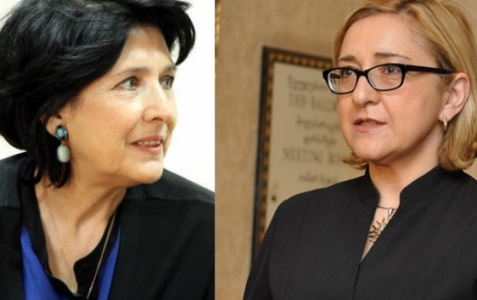
Unexpected staff turnover of the Georgian government met a pergent reaction from the public, especially after the country’s former Minister of Defense and then former Minister of Foreign Affairs talked about threats to country’s European future. Ex-Foreign Minister Salome Zourabishvili gave Georgian Journal her opinions on changes that have occurred in the country as well as the new minister’s potential and the country’s foreign policy.
– Mrs. Zourabishvili, how would you evaluate the appointment of the new Foreign Minister Tamar Beruchashvili? What potential does she have on the international arena and with the international community?
– As a former Foreign Minister, it certainly would not be correct for me to pass judgment on a new colleague, who has taken on a very challenging task – that of leading Georgian diplomacy at a very challenging time for our country, our region, and in the global arena. I have known Mrs. Beruchashvili since the time of my tenure as Foreign Minister and she certainly has a longstanding knowledge of European issues, having followed, at different levels and in different functions, these questions under three successive governments: that of Shevardnadze, Saakashvili, and ultimately under the Ivanishvili-Garibashvili coalition. I think that it is about time we moved past the signing of the Association Agreement to actual implementation of the latter, and it falls to the minister in charge to be the one who masters all the technical aspects of this crucial agreement. Nevertheless, I would like to say that Georgia has not fully used all of its cards and has probably missed a chance to let its own priorities leave a deeper imprint when negotiating the agreement; we could have negotiated terms that would have been more favorable, especially when it comes to lifting the numerous limitations imposed on Georgian products that are allowed to enter the European Market.
At the same time, being a Georgian Foreign Minister is much more than being the Minister in charge of European integration or dealing with European bureaucracy. I think that this post implies putting Georgia back on the map and making it a relevant partner in most of the regional and global issues. From being part of the debate on the fate of Ukraine, defining a policy towards Russia on Ukraine that that adequately responds to recent Russian steps in Abkhazia or on the administrative border between Georgia and the Tskhinvali region, to the fight against ISIS, which is now extending to the North Caucasus, the fate of Syria and its refugees, some of whom are flooding Georgia, Iran nuclear talks and the role of Iran in the region after an agreement and that of its neighbors such as Georgia who have had a tradition of dialogue with Teheran.
It is crucial that Georgia develops its own positions on these numerous issues, manages to open dialogues with all, to be heard and to be part to the discussions. To impose itself on the world arena on these issues or even other global issues, such as energy flow towards Europe, climate change in which Georgia could have a specific role, dialogue between Islam and Christianity, which has been a traditional role for Georgia. Even more importantly, trying to prevent the eruption of a new war in Nagorno-Karabakh region, promoting new inter-Caucasian talks. All of that is on the table for Georgia, but only if she is willing and able to be up to these geopolitical challenges, to have her own strategy defined and to be ready to fight for being present everywhere where her own fate is at stake.
The task I have just described is immense: not only does it take a Foreign Minister with eagle-like political vision and excellent standing; it also requires a government that shares this vision beyond simple pro-European or pro-Western statements of intention and is united behind such a foreign policy. It also takes a population and a political elite that stops being distracted by everyday petty political ambitions and squabbles – that understands that today’s challenges can only be won by a united Georgia, which is clear about its aspirations, strong in its convictions and confident in its European and national destiny.
– How principled do you think she is going to be? After all, when Maia Panjikidze resigned, claiming that the country’s European orientation was endangered, Mrs. Beruchashvili said that she couldn’t have done anything else, considering the course the events were taking.
– A foreign minister’s function requires both commitment to principle and obstinacy: your partners in negotiations, both friends and foes, have to know that once your last world is said, it is indeed the last word; otherwise they will continue to try to push your limits, even beyond the acceptable. This is why it is regrettable that a “principled” position held a day earlier was suddenly rescinded. More than in any other job, diplomacy also requires flexibility and capacity to compromise but this should not be mistaken for lack of clarity or uncertainty of purpose.