Michael Gahler: I appeal to all to assume their seats in the Parliament - If opposition raises argument in the Parliament, I think it would have more effect
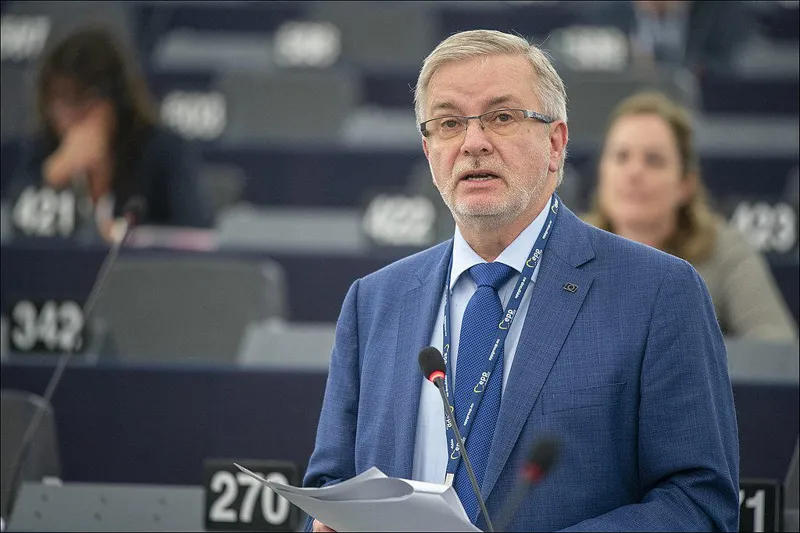
Given the relevance of the ongoing parliamentary crisis in Georgia and the forthcoming Eastern Partnership summit, InterpressNews spoke with the European People's Party spokesman on Foreign Affairs, MEP Michael Gahler. In the interview, the MEP discussed in detail the topics such as Ivanishvili's departure from politics, the October 31 parliamentary election, Georgia's foreign policy, prospects of European integration. In addition, while speaking about the current COVID pandemic, the MEP also reviewed the political aspects of the vaccination process in the Eastern Partnership countries.
On January 21, the ECHR published its verdict on the case of Georgia v Russia. The Strasbourg Court ruled that Russia continued exercising effective control over Abkhazian and South Ossetian regions after 2008 August 12 and thus is responsible for various violations that go against the number of Articles of Convention on Human Rights. In Georgia, the decision has been held as historic. What does ECHR’s decision mean for Georgia as a political and legal tool against Russian occupation?
It has confirmed the realities on the ground, it is the de facto rule by Russia. And accordingly, Russia is responsible for what happens on the ground. And there has been this verdict, I'm afraid, they will simply ignore it, as they have done with other verdicts. But for the international discussion and for the legal responsibilities, it is good to have such clarification from the court.
The upcoming EaP Summit is supposed to be held physically in March. On January 1, Portugal took over the EU Presidency and outlined ‘Global Europe’ as one of its top priorities. There is also an ongoing discussion about the need for the EU’s strategic autonomy. With this respect, do you think that we can expect the upcoming Summit to be crucial for the Associated countries in terms of EU integration? Especially for Georgia - considering the ruling team’s pledge that Georgia should be ready to apply for EU membership by 2024?
First of all, the Summit will, of course, assess where we stand, we have six partnership countries, and the situation is very diverse. In Belarus, there is ongoing opposition against the dictator; we have unfortunately witnessed the war between Armenia and Azerbaijan, where as a consequence, now we must concentrate. We are only one and not the major player in this field, but we should offer from our side a whole spectrum of possibilities to facilitate a dialogue, to help with reconstruction where areas have been destroyed. And I think that we can play a positive role as we are not automatically on the one or the other side, but perceived as honest brokers. And, of course, focusing on the people that are concerned - we do not want more refugees, we do not want people to be expelled. We want people to be able to return to where they belong. And that requires trust. I think, to have only Russia and Turkey, as major players in this neighborhood is not something satisfactory neither for the people concerned, nor for the immediate neighbors like Georgia, we should also offer our constructive engagement.
Otherwise, we have the three who have opted for the so-called full board, so to say, full DCFTA and Association Agreement, that is Ukraine, Georgia and Moldova. We are quite optimistic now - looking forward to Moldova after the election of Maia Sandu as a very pro-European president, and hopefully, they will soon have elections in the parliament not so delayed, because as the President in Moldova is only a representative figure and not an executive president - it requires a working government and a majority in the parliament, and hopefully a pro-European one. We have seen in Ukraine the change and the challenges where the old forces are fighting back and trying to dismantle the entire set of reforms, that is a real threat and a danger, but we are confident that there are enough forces inside Ukraine also supported from all those who want European development, so we are confident that the country will retain its reform course.
Well, Georgia now, we have witnessed as European Union, in the last year, the political turmoils, we have tried our very best. And I think our mission on the ground has delivered an excellent job in the negotiations and in mediation - getting the different political forces around the table and to agree on something. I note, unfortunately, that as a result of the election, there is still this awkward situation. Independent of how fair the election was, whether there was a level playing field or not, I'm in every country, including Georgia, appealing to all to assume their seats in the parliament. If you have something to criticize about an election, it's far more relevant when you say it from the podium, from your microphone in the parliament in the session, in order to criticize what needs to be criticized. And still, we have a government with the comfortable majority. When discussions come up about the election, about how it went, I would then say that I have been observing many elections, including last time (not the 2020 one) in Georgia - and that election is about the entire process, and the legal setup, the preparation, it's not only Election Day, or whether the people count correctly, or whether there are people in front of the polling stations that are intimidating perhaps or posturing in a strong way. We have seen that again, I've seen it last time. These are unfriendly habits and that should not be the reality for the voters. But I would say we are appealing in the framework of our cooperation to fully implement, of course, all the aspects of what we have agreed on part thereof is good governance and fair democratic setup. So I would say when we have this summit, and we look at the different countries, we do a thorough assessment in detail. And what needs to be criticized, will be criticized, but what can be welcomed is welcome. But overall, the full implementation of what we have agreed with Georgia is still a long way to go and that is your task. But we also from our side, on the EU side, we should offer more in the sense that we cannot say - well, the last 10 years of the Eastern Partnership is what we will see in the next 10 years. No, there must be more, there must be a more ambitious agenda, opening further areas for cooperation, for including you into European Union programs and cooperation possibilities. At some point, I would wish that Georgia can, with good conscience, so to say, demand or request membership, because it has fulfilled what has to be done, but you are by no means there yet, unfortunately. But I see that in policymaking there is a huge consensus with this objective. In civil society also - there are many people, especially also young people who are engaged in this way. So the prospects I would say can fill us with optimism, although currently, the political polarization is not conducive to giving us the impression that there is a country really on a good track currently, because of this domestic turmoil that is ongoing.
Just to add up on the opposition's boycott in Georgia. I think that the opposition's general narrative is a bit different from how the EU sees the whole process, because, for example, European Georgia and United National Movement - the two biggest opposition parties in Georgia, which are also European People's Party (EPP) members - think that the October parliamentary election was characterized with so many deficiencies that it could have changed the final outcome. That's the major problem they see and that is why they believe that all those problems could not be sorted inside the parliament - they simply think that it is not legitimate to be there. And thus, they demand snap elections.
Well, I take note of that, still, the same argument that they raise, if they raise it in the Parliament, I think it would have more effect also in the public than let's say somewhere in the press conference. The parliament is the place to argue, especially when you feel there was a foul play from the ruling party. If they face it in the plenary of the Parliament, I think that has another effect. For instance, when it comes to the allegations - if there there is so to say a review or an investigation, I'm very much in favor that it must cover all aspects, it cannot only be about counting or re-counting the votes. Because as I tried to explain - an election is a whole setup of circumstances and when there are many aspects that are alleged and or even proven from an opposition side, that must also be part of any investigation. The ruling party was agreeing to some aspects and I think that is not enough. I mean that the votes cast showed quite a significant outcome. Even if you deduct some points for unfairness or foul play, I'm not so sure whether it would have brought about the reverse result. I know that these two parties are our partner parties, but that doesn't mean that I would automatically at 100% take all the arguments. We are criticizing especially also in our Eastern Partnership countries. We have many partners, and I recall rapporteur on Ukraine, when Mr. Poroshenko was to the President - we made our criticism as well to his government as to now the new government, because my point is always to clarify - the agenda is the same regardless who is in government or opposition. But if the agenda, this European agenda that is coming closer, is something that is shared, and I've seen this latest Resolution from the parliament, (of course, those who do not take up their seats are not part of it), I think there is this European path. It is such a broad agenda, and one should perhaps try and build on such an important and essential policymaking and try to find common ground and dialogue. We know how democracies are even in stable ones, we've seen in the United States that our crazy guy - the former president can lead even as stable and established democracy to such a situation, that people are storming the parliament and are not able to listen and don't believe anything anymore. So that can even happen on our side. So such situations when there is no political dialogue possible, when there is mistrust around, that is something a country like Georgia cannot afford. It's about the people at the end of political power play. The people must have the feeling that with democracy come development - also for themselves, not only for some happy few who profit from it. But the path that Georgia is on in principle, and which it wants to pursue, that must be a path where the people have a perspective that is credible, and where they believe that those who they have elected are credible and working for the sake of the people. But frankly speaking as well, when you have as alternatives Mr. Ivanishvili and Mr. Saakashvili, they have their reputation, both in the country and outside the country and if that is the choice, perhaps some people are getting a bit desperate, to put it this way.
On January 6, 13 Foreign Ministers of EU member-states called on the EU to facilitate access to COVID vaccines for neighbors, EaP countries. Later on, the Commission proposed purchasing extra vaccines partially for neighbour countries. Can we expect that the EaP countries will be able to get a certain dose of vaccines from the EU in near future?
We are currently in a situation that everybody wants it all at the same time. And that is the problem inside the EU. That is the problem with the immediate neighbors in the Western Balkans and in the eastern neighbourhood and, of course, even more so in the southern neighborhood. So I hope that we will be in a position to share some of that with us. I hope that the shortage that we are facing currently will be overcome as soon as possible. We are aware that there is a need to supply our immediate partners because there are, shall I say, unwanted others, I mean, if Russia were in a position to pretend that they are the ones who are helping and the others not, it would be disastrous so to say for the political discussion. If it were that this Sputnik vaccine would be the only thing that would be available for Georgia - I think that is politically not wishable. So I think we are perfectly aware of the need to offer this perspective. I am not the expert on that. I cannot even promise my own district. At home, I see the announcement that there were no vaccinations because of a lack of vaccines and that is just outside Frankfurt, in the middle of Germany. So imagine when we have this situation currently here. Yes, I understand all the need in Georgia and other countries, but we are currently really overwhelmed by the need and the shortage of production.
Tbilisi is usually not vocal about the ongoing regional developments. We have not heard their positions with regards to the Election in Belarus and what it followed; the same goes for Navalny’s poisoning and now his arrest. Do you think that Georgia’s passivity in this regard can be justified, given that the listed instances go against the cause that Tbilisi should be naturally fighting for - as the Baltic countries have been demonstrating for years now?
Well, I would, of course, wish that any of our Eastern Partnership countries would take a principled stand. When we see the events in Belarus, we see all the same events - it's not that it's different in the perception of Georgia or Ukraine or Poland, or Germany or Italy, to name a few of member states and neighbors. We are always welcoming when EaP countries are joining EU positions and when you choose to support the democratic development in Belarus is of course, very much welcome. And when it is not the case, that is also taken note, we are not the ones who are urging you to do something, but we welcome when you do something that goes in our line. I would always wish that Georgia that is on this dedicated path towards Europe would on the way there express itself clearly when human rights are violated in the Eastern Partnership area and accordingly, take positions. I understand perfectly when in your immediate neighborhood there is a war ongoing between Armenia and Azerbaijan, that it is very sensitive, apart from calling to calm and to cease-fire that is the general wish. I would not from our side, advise you on anything when it comes to these two countries, because you are the closest neighbors and you have to face any consequences of a statement that you do. So I think in this regard, it is your full autonomy to take a position.
Lastly, with regards to Ivanishvili’s departure, as you know Ivanishvili resigned from the ruling Georgian Dream chairmanship and quit politics two months after the Election. How does this affect the accountability in Georgian politics given that the country is currently facing the political and economic crisis?
Well, we have seen him coming and going several times. It's not the first time that he leaves and my spontaneous reaction was well, is that true? Does he really so to say go into pension at 65? Is that the real intention or is it not rather that he leads from behind having installed in many ways people that he trusts and that also are grateful to him for being in this position? Well, I take note of what he says, I take note that there is a successor Irakli Kobakhidze - I know him, we've met before - of course, I wish him well as I wish everybody well who has a decisive function in a neighboring country. I hope that Irakli will be in a position from his side to open the necessary dialogue with the opposition parties in this phase. On the other side, I hope that the opposition will be in a position to respond. It is about dialogue and not about a confrontation in such a situation where everything is overshadowed by COVID and all the other problems that remain are even aggravated through that. So the people will realize when policies go on, whether Bidzina is really in pension, or whether he plays it from behind, and they will have to assess that and judge about that. I mean, normally when you vote, as it was unanimously for a new chairman, you should have the authority to make the decisions and be supported and not have the feeling that there is somebody in the backyard or somebody ruling from behind. It is natural that this is the expectation from a new chairman that he has definitely the power and the competence to take the decisions. But we'll see. I am too far away to look into the details behind the scenes. But to as I said my spontaneous reaction is - can that really be that such a powerful figure with all his network simply goes out and that's it? Normally, that's not the case.
Giorgi Jgharkava
InterPressNews