

Viola von Cramon: If I was a voter in Georgia, I would expect everyone to take over his or her mandate
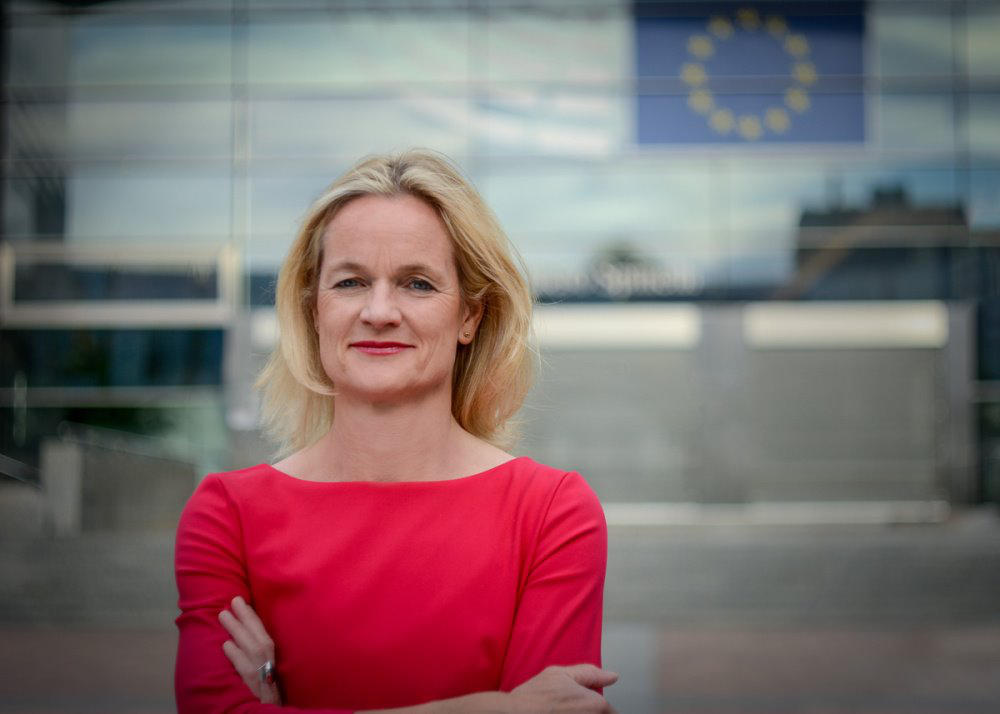
Last year, in addition to the new government program, the Georgian Parliament approved the resolution on foreign policy. According to the government program and the parliamentary resolution, the ruling team's main goal for upcoming years will be to prepare Georgia to apply for EU membership by 2024. InterPressNews spoke to MEP Viola von Cramon, a member of the Euronest Parliamentary Assembly, about these and other issues ranging from Strasbourg Court's decision over the 2008 War to the parliamentary crisis in Georgia.
At the end of last year, the ruling Georgian Dream adopted the government program “Building the European State”. The government program’s main goal is to prepare Georgia to be ready to apply for EU membership by 2024. The same pledge was included in the Parliament's Resolution on Foreign Policy. How does the GD’s ambition resonate with the EU's agenda in terms of enlargement?
Well, you know, the European Union and the Treaty of the European Union, of course, allow it, according to Article 49 - each and every European country can apply for membership of the European Union. So, this is fair enough for countries to do so. And it's good because it gives incentives to the Georgian society, the government to really strive for serious reforms in terms of human rights, in terms of social and labor law or code, also political culture and everything which could, of course, be very beneficial for the Georgian society as such. But whether this will be accepted, what might be the scale, what could be a reasonable timeline for this, it's really hard to reconsider now while you know that the political situation, the internal political situation, within the European Union is not easy. Nevertheless, I think it's good and a very important signal towards the Georgian society, also coming from the government which is - we are ready to go for more, we are ready to go for tougher reforms to integrate our society and our economic framework more towards the European Union.
The next Eastern Partnership Summit is scheduled for March. There are quite a few analysts and as well as MEPs saying that the EU should offer a more ambitious plan for EaP, especially in the context of the ongoing discussions about the need for EU’s strategic autonomy. What are your expectations for the Summit?
Well, I think there are a lot of successes of the Eastern Partnership as such, and I'm very proud that Georgia, your country was always a driving force within this set of the six states and it's important to see that you have front runners who are looking for more and who are very ambitious. But, nevertheless, you have to also consider that during the last years, not everything which is provided in the EU Trade Agreement and also in the Association Agreement is already fulfilled and used. So, I think it is good for us to first of all, really implement everything which is provided in the ratified agenda of the DCFTA of the AA and go for, let's say, also some other reforms in the political sector, look for the targets of the European Green Deal, and work together to overcome the pandemic crisis. There are many, many, many steps ahead of us where for some of them you really need your neighbors in the region. I think for European Union it is smart on one hand, to give individual incentives to Georgia as well as to have this leading role, what they had before as a front runner within the six. But, nevertheless, it should try to keep them together and try to have this concept for the entire Eastern Partnership as it was, to have an ambitious framework in terms of rule of law, in terms of democracy, in terms of market economy, and so on. But, nevertheless, I see that Georgia would be also ready to have, let's say, an additional, like an 'Eastern Partnership Plus' or something - and this needs to be discussed.
To continue the discussion regarding the individual and grouping approaches within the EaP - the same document (government program - Building the European State) states that Georgia should search for new opportunities within Eastern Partnership alongside Ukraine and Moldova. On January 14, the FMs of the listed countries held an online meeting regarding the same issue. What’s your take on the so-called trio+1 format which would enable the Associated countries to have a separate platform with the EU for further integration?
Well, when you look at Belarus, and also the governmental change in Amenia, one and a half year ago, and even Azerbaijan is now hopefully in the near future might take some modernisation steps - if we go only with the three states, as you have mentioned, Georgia, Moldova, Ukraine, and we would leave the other ones out and concentrate our resources, and also our attention, our awareness to the three and if we leave them out - Russia would be happy. I think this would be a mistake. So, we are very much in favor and grouping, while at the same time we have a strict conditionality. And when we see that there is a need for more on individual sectors, well also do it, let it be a trade, let it be educational support, exchange of students or something like this. What we see, for example, now in Belarus, we have emerging, let's say, support for independent media, for people who have to leave the country, for political prisoners, and so on and so forth. And I mean, we take this money from the Eastern Partnership, but of course, it needs an individually addressed solution now, and the same is true for other countries. So, I would keep it as it is, and this is also the same for the majority of my colleagues here in the European Parliament. But, nevertheless, I ask and request Georgia to stay as the leading country and as the front runner for all these aspirations for European Partnership or European membership, as well as for democratic efforts, reforms, and so on and so forth. So, this is not an either-or question for me.
Amid the negotiations with the opposition, Georgian Dream announced the introduction of two bills:
- The first bill envisages termination or suspension of state funding for the political parties which do not fully claim their Parliamentary mandates;
- The second bill aims to abolish the election registration of a political party whose pre-election campaign participant will be a political leader who does not meet the constitutional requirements for active voting rights.
The second bill naturally concerns the United National Movement, the biggest opposition in Georgia, whose leader is former President Mikheil Saakashvili. Saakashvili doesn't hold Georgian citizenship and is sentenced to prison, which, according to the draft bill, can lead to the abolishment of his party's election registration.
Georgian Dream adopted both of the bills in the first hearing. However, they paused the process and sent both of the drafts to the Venice Commission for consideration. How would you assess the initiatives in terms of their political context/motivations?
Well, let me give my impression of the overall process after the election. First, I think that if I was a voter in Georgia, I would expect everyone to take over his or her mandate. I know that it's very sad that due to the pandemic we as the European Parliament, members of the European Parliament, couldn't join the election observation mission - that was indeed very regrettable. We asked the European Parliament's president to really join the existing mission. But, nevertheless, there were international observers, and we could see that even if there were violations, and there was some fraud, but this would not have significantly changed the entire result. So, I think it is good that in the end, the international community, our ambassador, some other ambassadors, have started this negotiation process again, and I do hope and ask everyone to be, let's say, as reasonable as possible and think about their own role in this political system as an elected parliamentarian. What I've seen from the last polls from NDI, the majority of the public in Georgia actually expect that from the elected members of the Parliament. And also, for me, as a member of the European Parliament, I need colleagues, I would like to work together, I'm the leading member of the DEG (European Parliament's Democracy Support and Election Coordination Group) in the European Parliament, I need partners, how can I work? How can I get a kick off from the Georgian Parliament if nobody picks up and takes up his or her position - if we do not have committees working, if we do not have reforms being initiated, either by the opposition or by the ruling party? So, for us, it would be of big help if we could find a compromise as soon as possible to really get this Parliament back to work. So, these would be my general remarks. Coming back to your concrete question, I would frame it as, let's say, a strange move, to be honest. I mean, if Georgia had a regulation, with which you would distribute the money for political parties which are elected - this is a financial regulation and you should keep it. This is obviously a politically motivated move to increase the political pressure on some of the political parties, the opposition parties. I think this is a very, let's say, obvious and from a democratic point of view not an acceptable move. I guess the Venice commission will rule in a similar way. When it comes to forbidding or rejecting parties to be registered, because one of their supporters is not a Georgian citizen, this is completely absurd. I mean, that obviously contradicts the EU principles. For me, it's very populistic. If you would like to fight, you do it in a political - democratic way, you do it in a political framework, not this fake legal way. So, this would be my personal conclusion to this. I hope that both Georgian Dream and opposition parties would find ways of working together in a constructive way. That's what we expect from all of them here in the European Parliament, in the international community. But, I guess it's also the same from the Georgian public, as they have voted for either this or the other side.
To continue the discussion on the issue of opposition boycotting the parliament - I think that the opposition's perspective is different compared to the EU. The EU's position is that there were irregularities, but it couldn't have affected the final result. Contrary to this, the opposition deems that the irregularities observed during the last election could have changed the outcome of the whole process, especially given the bigger proportional share in the election system that Georgia has now. However, it seems that the EU and other international partners aren't going to change their position. What would be the solution for the opposition?
As I've mentioned, I guess there are different reports from different election observation missions. I mean, they are outspoken when it comes to violation and fraud.This is nothing which was neglected, neither by the domestic observers, like if ISFED or others, neither by OSCE/ODIHR or NATO Parliamentary Assembly - but none of them have claimed that even without those violations, the result, the outcome of the election would have been significantly different. So, even if we go for repetition of the elections, even if we have smaller corrections, like 2 or 3% - I mean, yes, it would be easier for the opposition to work. But nevertheless, the majority would probably be on Georgian Dream's side, and it's not up to me to speculate on this. While I saw that, for example, this domestic observation platform, which is normally very bipartisan, really balanced, they have no personal interest in that game, and not that I could figure out - they show pretty clearly that the difference is not as large as the opposition parties would claim it. And so, I think we need a face-saving solution for the opposition to finally take back their roles and understand that it's not time now to bring people on the street, because people look for constitutional solution, they look for a legislative solution, and not for a solution which we had in 2003 and 2004, when we had the first Rose Revolution, this will not work in 2021. People expect from their elected representatives in the parliament to work. And so, this will be our expectation too and to make sure that we have less fraud and less violation and hopefully no pandemic at the next election. I guess there will be some local elections and other elections and we together need to make sure that it will be definitely fairer, but as I said, the outcome in general would be a bit different, but not significantly different.
Bidzina Ivanishvili has left his position as the Chairman of Georgian Dream and quit politics. As Ivanishvili states, one of the main reasons for his decision is his age (turning 65). He also stresses that he accomplished his mission and quits politics proudly. On the other hand, the opposition believes that he’ll switch to behind-the-scenes-governance just to distance himself from the political-economic crisis that the country is facing. What type of message does it send to international partners, when the leader of the ruling team leaves politics 2 months after the Election?
Well, this is actually a clearly domestically driven question by the party Georgia Dream, and it's not up to me to make any assessment on this. Let me just comment that the logic of Bidzina Ivanishvili, a very special logic that he has achieved everything and now he can leave - I mean, this would be questionable, but otherwise, I would say that it's up to the members of the party to decide whom they would see as the leader, as the chair of their own party, it's not up to an international member of parliament to comment on that. And I mean, he has said before that he's going to leave office, and he's going to leave politics and so on. So, let's wait and see what will be the final decision on that and how much influence he still has on this party and on the acting chairs, or prime ministers or other representatives. But, nevertheless, of course, we will observe the developments in the party, and hopefully it will, let's say, have a good outcome in terms political result and the will for compromising, but in the end, it's not up to us to have a saying on what a party in Georgia does or whom they vote for.
Lastly, on the ECHR’s verdict on the case of Georgia v Russia. The Strasbourg Court ruled that Russia has been exercising effective control over two Georgian regions since 2008 August 12 which makes her responsible for a number of human rights violations, including torture of war prisoners, killing civilians, looting, administrative practice with regards to the inability of Georgian nationals to return to their respective homes, etc. In Georgia, the decision has been held historic. Do you think that the ECHR’s verdict will facilitate Georgia's efforts with regards to raising the Russian occupation issue on the international agenda?
Well, first of all, it's a great and important, let's say, symbolic victory, and it's very good that Georgia has succeeded in those cases. What we all know is that Russia does that already for I don't know actually already before 2008. Of course, long before the war, Russia has started this kind of human rights violation, occupation, restricting the accessibility to their own territory, violation of territorial integrity, deploying soldiers on Georgian territory and so on and so forth, provocating the border guards, and we have been following these sad and tragic events long before the 2008 War started. And so, it's good that it's finally proven by ECHR. But, we also know that Russia doesn't care a lot about the multilateral legal framework. So, unfortunately, even though this is a big victory, even though it is an important proof for these kinds of violations - I, unfortunately, wouldn't expect any bigger change neither in the Russian agenda nor in the international agenda. But, it is good and we should bring it to the agenda and we should raise the awareness of the things which are happening also regarding the borderization, where you see that actually, almost every night, a square meter of Georgian territory is stolen in a very secret and very mean way. There is an observation mission, which of course, monitors this, but doesn't bring this to the international agenda. And maybe with this verdict, we can more easily try to make this as a topic, either in the UN Council or on the European level - OSCE and the Council of Europe. So, there is a chance at least, that we can use that for the agenda. But, nevertheless, and that was your question, to get Russia to change direction, to make it accountable, to have any sanctions, to have a real punishment in terms of compensation or anything, to be honest, unfortunately, I don't expect any change from the Russian side.
Giorgi Jgharkava
InterPressNews