


Shalva Papuashvili: Hostile actors seek to exploit our weaknesses, and undermine our democratic processes, they aim to erode trust in our institutions
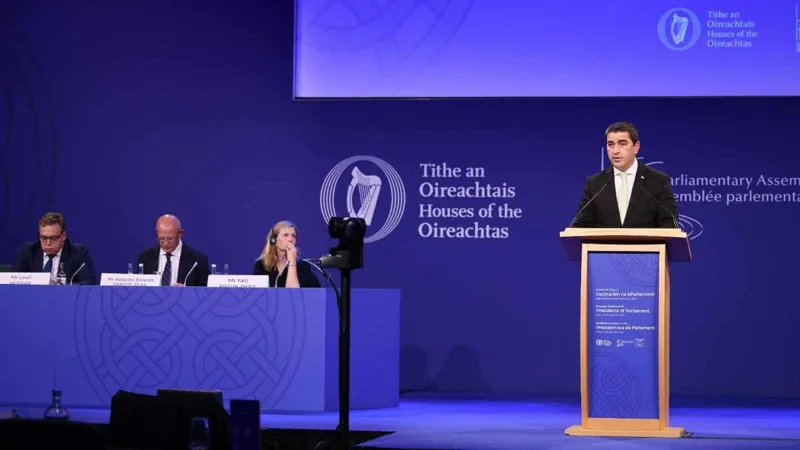
“Our democratic systems are under attack from various threats, including disinformation and foreign malign interference. These threats not only erode trust but also fuel radicalism and pose a significant danger to the very foundations of representative democracy”, the Chairman of the Parliament of Georgia, Shalva Papuashvili stated in his speech delivered at the PACE European Conference of Presidents of Parliament in Dublin.
As the Speaker highlighted, democracy is based on the principles of transparency, accountability and the will of people; it is a system that empowers individuals, engages them in the decision-making process and ensures their voice are shared.
“However, in recent years, we have witnessed a rise in disinformation campaigns that aim to manipulate public opinion and distort the truth. These campaigns spread false narratives, sow division, and undermine the trust we place in our democratic institutions”, - the Speaker stated adding that disinformation is like a wildfire covering social media platforms, when the algorithms shift the priority from accuracy to interaction, which results in instant dissemination of misinformation that create the ideal milieu for manipulations.
According to the Speaker, foreign malign interference has become an increasingly prominent threat to our democracies.
“Hostile actors seek to exploit our weaknesses, and undermine our democratic processes. They aim to erode trust in our institutions, sow discord and confuse citizens, and ultimately weaken our democratic foundations. Their tactics range from cyberattacks on critical infrastructure to covert influence campaigns aimed at shaping public opinion. During times of elections, these threats become even more prominent. Elections are the bedrock of representative democracy, allowing citizens to choose their leaders and shape the future of their nation. However, when disinformation and foreign interference come into play, the very essence of free and fair elections is compromised. Citizens are bombarded with false information, making it difficult to distinguish fact from fiction. Trust in the electoral process is eroded, leading to a disillusioned electorate and a weakened democracy”.
According to the Speaker, the roots of democracy in our region are extremely fragile, especially against the background of unprecedented doubled challenges, which, on the one hand, consists of foreign political pressure and intervention, and on the other hand, domestic political radicalism and populism.
“Governments that pursue democratic practice are increasingly challenged by radical factions, who want to seize the opportunity and use extremely tense geopolitical situations for undermining the rule of law and the constitutional order. Over the last ten years, unlike the previous decades, Georgia has made enormous strides in democratic development that was proved many times by well-known international rankings on rule of law, transparency, rights and freedoms, effective state institutions, fight against corruption, a few to name. This has been achieved with substantial support from our Western partners as Georgia has firmly stood on EU and NATO membership paths and has put significant efforts into strengthening democratic values and institutions as well as improving legislative base in order to approximate with European standards. However, unfortunately, there is often a noticeable gap between Georgia’s impressive democratic achievements, on the one hand, and the country’s (mis)perception abroad, on the other. In the historic period for Georgia on its EU accession path, the Georgian government has to constantly deal with premeditated and well-coordinated defamation campaigns that inflict huge harm on the reputation of our country”.
In addition, the Speaker underlined that countering threats and protecting democracy requires solid actions, namely, the investments shall be directed to media literacy and critical thinking, and enhancement of cybersecurity mechanisms, especially for safeguarding the electoral process.
“Traditional methods of communication are no longer sufficient in an era dominated by social media and instant access to information. Parliaments and political actors must adapt to this changing landscape by utilizing a wide range of platforms to reach out to citizens, listen to their concerns, and address their needs as well as by engaging all stakeholders in constructive conversations and finding common ground. By doing so, we can bridge the disconnect between citizens and their representative institutions, fostering a sense of trust and engagement. In addition, we hope that we all will learn how to swift-sail through current tsunami of disinformation, not to succumb to false perceptions and instead, follow the evidence-based narratives. It will strengthen democracy, ensure that the will of the people prevails and our democracy becomes resilient to internal and external threats”, the Speaker stated.










