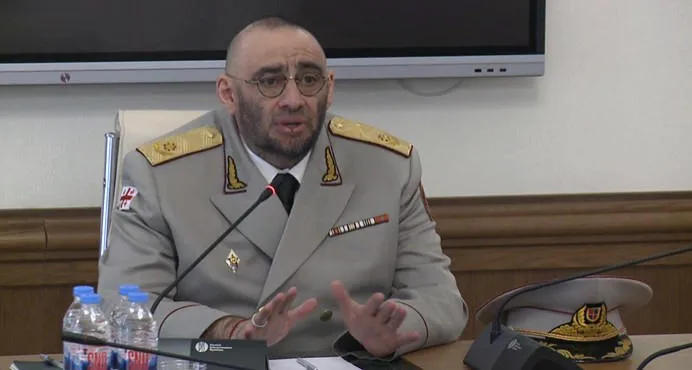
Mamuka Kurashvili described the events that took place during the days of the August 2008 war at the investigative commission
Ossetians' demand was that someone should come and look after them because, as they claimed, Georgians were leveling them to the ground.
They decided to address the diplomatic corps. I can tell you with certainty that the Russian ambassador was there; he had arrived, but they did not let him in. Since they had arrived, we did not miss this opportunity and took them to Nikosi, where we showed them the burned roofs, the burned-down houses—it was a catastrophic situation.
This was stated by General Mamuka Kurashvili, head of the Peacekeeping Operations Staff during the August 2008 war.
He is currently being heard by the temporary parliamentary investigative commission studying the activities of the government of the United National Movement. He is providing a detailed account of the events of August 2008.
"On the 4th, the fierce attack continued. In Nikosi, houses and roofs were burning—it was a catastrophic situation, and it was already difficult for me to stop all of this. In order for the Georgian side to prove its truth, a decision was made to ask the ambassadors accredited in Tbilisi to visit the conflict zone. This happened on August 5. The first initiative came from the opposing side. Their request was granted, and a convoy of diplomats was organized. The Ossetians' demand was for someone to come and take care of them because, as they claimed, Georgians were leveling them to the ground, so they decided to appeal to the diplomatic corps.
[The opposing side] addressed the international community, claiming they were in an unbearable situation, that Georgians were leveling them to the ground, and that they needed help. However, they had nothing to show, so they did not let the diplomats in and turned them back from Ergneti. At the time, Kokoity's co-chairman, Boris Chochiev, was there. I can't say exactly, but I can tell you that it was a convoy of about 16 pickup-type vehicles. I can tell you with certainty that the Russian ambassador was there; he had arrived, but they did not let him in. Since they had arrived, we did not miss this opportunity and took them to Nikosi, where we showed them the burned roofs, the burned-down houses—it was a catastrophic situation," Kurashvili stated.
In response to Tea Tsulukiani’s question about who else was present with the ambassadors, the general replied that Eka Zguladze was also there.
"I asked the Russian ambassador to come with me to the cemetery in Nikosi, where there was evidence—a cemetery with an iron fence that had been hit by heavy-caliber machine gun fire. I wanted him to see this fact firsthand. It was extremely hot, and many people were reluctant, but I did not miss the opportunity to prove this fact. There were many ambassadors, and they were not reluctant—they came up. From that dominant height, half of Tskhinvali is visible... Mr. Zaza Gogava was there; he spoke comprehensively. I had direct contact with him. I am a military man, and I was directly in contact with the general. Every shot fired, every moment of tension, and all times were recorded," Kurashvili stated.
When asked what the reaction of the ambassadors was to what they saw, the general replied that everything was sent to Brussels.
"For me, it was a relief that they saw it and that it was sent to Brussels. There were reactions to it. But, as it seems, based on events, there was a counter-reaction—shooting increased. On the 6th, we lost two corporals. It was a tense situation. Due to shootings, including the explosion of large-caliber shells, one was killed on the spot at a checkpoint, and the other bled to death. Kulakhmetov did not offer condolences. We had such a relationship that he should have expressed condolences. Two of my men died, and he neither offered condolences nor gave me the opportunity to provide timely assistance to save them. When he could not answer me and could not meet my demand, he used as an excuse that someone had died due to the shooting, but it turned out that no one had actually died. He avoided fulfilling the task. This was a sign that I was alone. Also, an infantry vehicle had been blown up," Kurashvili said.
In response to Tea Tsulukiani’s question about whether he found corpses there when he arrived on August 7, the general replied that they had already been removed. When Tsulukiani asked if he had participated in their removal, Kurashvili responded:
"What do you mean, I didn’t participate? Then who decided this? Why did Kulakhmetov send people there and have them removed? I participated in everything. Unfortunately, I didn’t carry the dead on my back and take them out, but what are you asking me? Nothing was decided there without me! I did everything to calm the situation; I had no other option. On the 7th, I came from the hospital; the supreme commander-in-chief had arrived to see the wounded. I met him and then left. The shootings had stopped."
When asked why it was necessary for Mikheil Saakashvili to be greeted, the general replied, "It was an order."
"I received all orders from the Chief of the General Staff. There was no shooting; it was calm on the 7th... You can see footage of when [Saakashvili] gets out of the car, when he sits down, who follows him, where we enter the corridor, and where we exit," Kurashvili said. Tsulukiani then jokingly added that Saakashvili was walking so fast that the cameraman might not have had time to film him, adding, "Sometimes, if you don’t joke, it doesn’t work."
"Regarding 2008, my request is that, considering the Hague Tribunal, Madam Tea, I have an obligation—I came, I am not avoiding this, but I have another obligation: not to put myself in danger. Our enemy is watching this; they are looking at everything through a magnifying glass," Kurashvili stated.
To this, Tsulukiani asked where the threat was coming from. Kurashvili replied, "From Russia."
"Maybe not just for you; Georgia is occupied," Tsulukiani told him. Kurashvili then responded that his request was for "special caution when discussing this matter." However, Tsulukiani told him that she would still have to ask certain questions.