The Economist publishes an article titled: “Georgia is dousing the last embers of democracy”
The Georgian Dream party believes that populist-right leaders will soon win power across the EU, and then roll out the red carpet for Georgia, according to an article in The Economist titled “Georgia is Burning the Last Shards of Democracy.”
“IN many formerly democratic countries, the road to one-party rule has been long and winding. Georgia’s ruling Georgian Dream (GD) party seems to have decided to take the expressway. On November 6th prosecutors charged eight of the country’s leading opposition figures, including a former president, Mikheil Saakashvili, with plotting to carry out a coup. They face up to 15 years in prison. Six are already behind bars. A week earlier, GD had asked the country’s constitutional court to outlaw Georgia’s three largest opposition parties.
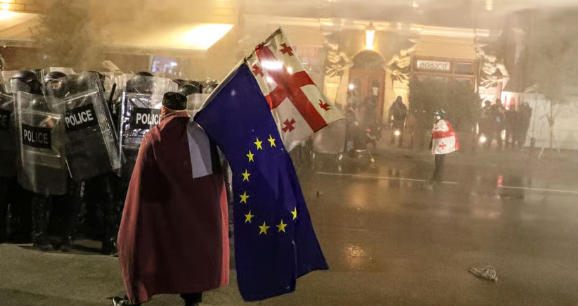
The price of dissent is going up quickly in Georgia, and not only for politicians. In the past month police have arrested dozens of people involved in protests against GD that began in late 2024, when the government decided to halt accession talks with the European Union. Those who attempted to storm the presidential palace on October 4th, the day of local elections, are being accused of taking part in a coup. Some have been jailed merely for wearing a face mask or blocking traffic. “Last year the fine was 500 lari ($185),” says Inga, a protester outside parliament. “Then it was 5,000 lari, and now it’s 15 days in prison.
The ban on the opposition parties looks like a foregone conclusion. The judiciary, including the constitutional court, is beholden to GD. Some believe the parties may attempt to reconstitute themselves under new names. Salome Samadashvili of Lelo, one of the parties facing closure, entertains no such illusions. “If we try to register as a new party, the justice ministry will refuse,” she says. “With total control of the state, they can do whatever they want.”
Founded by Bidzina Ivanishvili, Georgia’s richest man, GD came to power in 2012. It initially hewed to the pro-Western course charted by its predecessors, especially Mr Saakashvili. This paid off in 2023, when the EU, galvanised by Russia’s invasion of Ukraine, formally accepted Georgia as a candidate for membership. It had already done so for Ukraine and Moldova, but Georgia was delayed by doubts over its qualifications.
For there were already frictions with the West and signs of democratic rot. GD, once a coalition of parties, had become a vehicle for Mr Ivanishvili’s business interests and ambitions. Officials began to hound LGBT groups, as did the Georgian Orthodox Church. Georgia pledged not to help Russia evade Western sanctions, but refused to impose any of its own," the article states.