Michael O'Flaherty calls on Georgian authorities to repeal the Foreign Agents Registration Act and to significantly revise or repeal other restrictive laws to ensure compliance with the Convention
During his meetings with the authorities in Georgia, the Council of Europe Commissioner for Human Rights, Michael O'Flaherty, expressed concerns about the impact of several laws related to "foreign influence" on civil society organizations, human rights defenders and journalists, the Office of the Council of Europe Commissioner for Human Rights says in a statement following Commissioner Michael O'Flaherty's visit to Georgia on 14-15 April.
According to Michael O'Flaherty, "during his meetings with the authorities, he expressed concerns about the impact of the law on "foreign influence transparency" on human rights."
“The Commissioner’s visit to Georgia focused on the continued lack of accountability of state agents for the violent dispersal of protests in 2024 and early 2025, the increasing restrictions on the rights to freedom of expression, peaceful assembly and association and on the human rights of persons in and displaced from the occupied territories of Abkhazia and Tskhinvali region/South Ossetia.
Regarding increasingly restrictive legislation affecting the rights to freedom of expression, peaceful assembly and association, the Commissioner notes the cumulative impact of these laws and observes that the authorities have since adopted even more restrictive measures. New amendments to the Law on Assemblies and Demonstrations require that prior notification is given to the police if a demonstration is held where vehicles or persons are moving, empower police to change the venue or time of the demonstration if it threatens the unhindered movement of vehicles or persons, and even prohibit protesters from ‘blocking’ the pavement.
In his meetings with the authorities, the Commissioner raised concerns about the chilling effect of several laws relating to ‘foreign influence’ on civil society organisations (CSOs), human rights defenders (HRDs) and journalists,’ as well as administrative and criminal proceedings against dozens of CSOs for receiving foreign funding and/or for alleged involvement in aggravated sabotage. “In my discussions with the authorities, I pointed out my position regarding the human rights implications of the Transparency of Foreign Influence Law. I also expressed concern about the Foreign Agents Registration Law (GEOFARA), which requires legal and natural persons to register as ‘agents of a foreign principal’, the Law on Grants, which prohibits CSOs from receiving foreign funding without official permission, and the Law on Broadcasting, which bans foreign funding to media outlets for the production or transmission of programmes. While increasing transparency regarding the funding of CSOs may be a legitimate objective, the wide-ranging restrictions appear inconsistent with the criteria of legality, legitimacy, necessity and proportionality within the meaning of Articles 10(2) and 11(2) of the Convention, as well as with the principle of non-discrimination. I call for repeal of the GEOFARA law and for repeal or substantial revision of other oppressive legislation to ensure compliance with the Convention,” said Commissioner O’Flaherty.
“I further recall that CSOs, HRDs and journalists play an essential role in safeguarding human rights and civic space. I therefore call upon the Georgian authorities to ensure that the ongoing administrative and criminal proceedings into dozens of CSOs are in strict compliance with the state’s obligation under the Convention.”
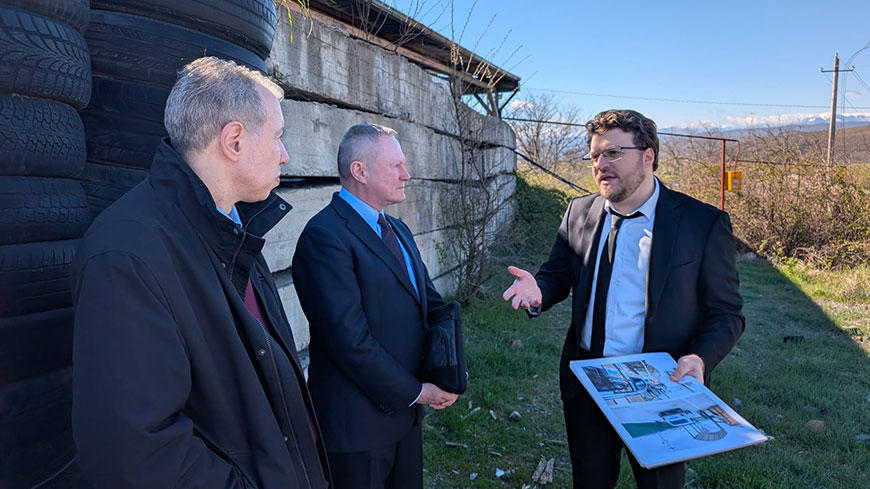
During his visit, the Commissioner met with the Prime Minister, Irakli Kobakhidze; the Minister of Foreign Affairs, Maka Botchorishvili; the Minister of Internal Affairs, Gela Geladze; the Minister of Internally Displaced Persons from the Occupied Territories, Labour, Health and Social Affairs, Mikheil Sarjveladze; the State Minister for Reconciliation and Civic Equality, Tea Akhvlediani; the Prosecutor General, Giorgi Gvarakidze; the Auditor General, Giorgi Gabitashvili; and the Public Defender of Georgia, Levan Ioseliani. He also met the UN Resident Coordinator in Georgia, Didier Trebucq, as well as representatives of Georgian civil society organisations. He went to the occupation line in Odzisi and met IDPs in the Tserovani settlement”, reads the statement.