Shalva Papuashvili: According to the opposition’s count, today is the 666th day of the “protest” - the group of political protest activists has transformed into a pseudo-religious movement
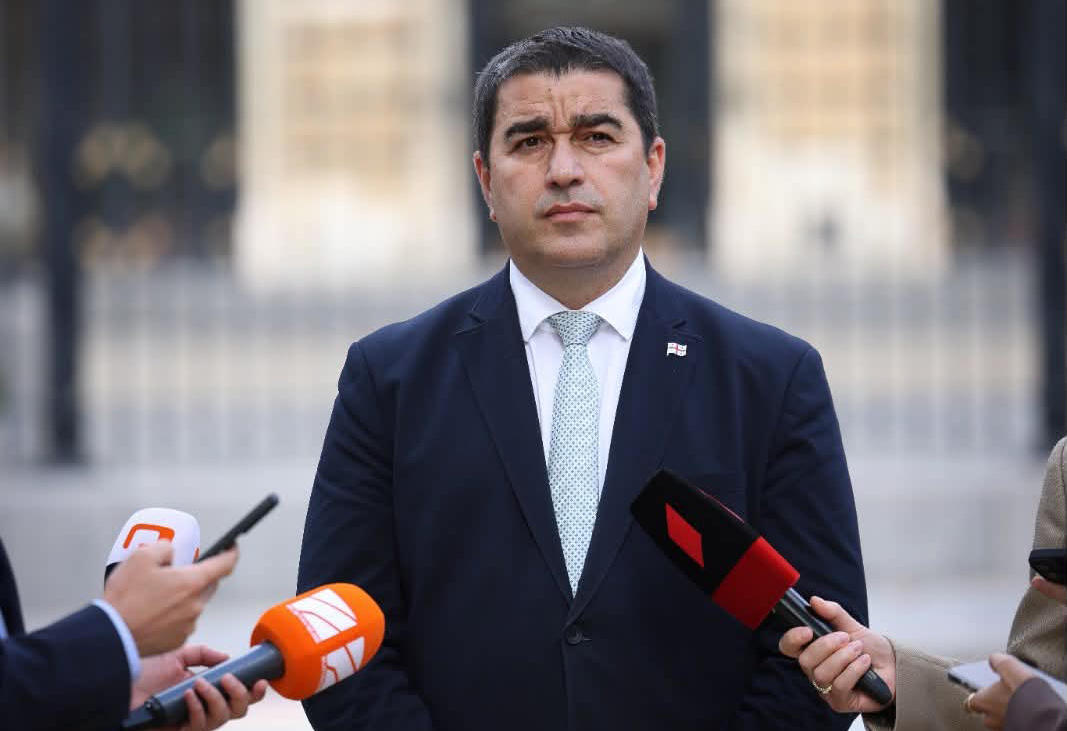
“According to the opposition’s count, today is the 666th day of the ‘protest.’ This round number provides a good opportunity to thoroughly describe how a group of political protest activists has transformed into a pseudo-religious movement, and how what initially appeared to be a traditional campaign has turned into an aggressive community — a pseudo-religious fundamentalist sect — with its own rituals, symbols, calendar, and internal moral order,” Parliament Speaker Shalva Papuashvili wrote in a social media post.
According to Papuashvili, “in the dogma of this pseudo-religious sect, the European Union is the ‘Promised Land,’ Article 78 is the creed, resolutions are commandments, and a foreign politician is the supreme priest.”
He also said that “when a political movement can no longer justify its existence through a specific result, it often chooses a path where continuation itself is declared a success, while form becomes detached from substance and turns into an end in itself.”
“Almost 700 days have passed since the 2024 parliamentary elections. That is 100 weeks.
The elections, which part of the opposition declared a referendum, did not end with the result they wanted. The refusal to recognize the result was followed by another political process on the streets, which was later given the marketing label of ‘continuous protest.’
According to the opposition’s count, today is the 666th day of the ‘protest.’ This round number provides a good opportunity to thoroughly describe how a group of political protest activists has transformed into a pseudo-religious movement, and how what initially appeared to be a traditional campaign has turned into an aggressive community — a pseudo-religious fundamentalist sect — with its own rituals, symbols, calendar, and internal moral order.
A prolonged protest does not in itself mean sectarianism. The turning point begins when a movement refuses to acknowledge mistakes, declares a different opinion to be treason, and responds to failure by demanding unconditional loyalty.
When a political movement can no longer justify its existence through a specific result, it faces a choice: assess the path it has taken, change its tactics, revise its goals, or end the campaign. But there is another option — to declare continuation itself a success. At that point, gatherings, marches, and symbolic actions gradually become ends in themselves, according to the principle: ‘We continue, therefore we exist.’
This is precisely where the problem that has also emerged in the Rustaveli protest becomes apparent: form gradually becomes detached from its original substance and itself becomes the substance. Performing the ritual becomes the main idea of participation.
This is where the signs of a pseudo-religious transformation emerge:
1. Sacred space
A religious community has a place where ordinary space acquires special significance. In the ‘continuous protest,’ Rustaveli Avenue and the area around Parliament perform a similar function.
The repeated ritual of gathering turns this place into a symbol of group identity. Coming to Rustaveli is no longer merely an expression of a political demand; it also confirms belonging: ‘I am here, therefore I am one of you.’
A congregation gathers in a church; protest participants gather under the arches of Parliament.
2. Political liturgy
A ritual requires repetition.
The same time, route, march, chanting, flags, music, arrival at Parliament, and dispersal create an almost liturgical cycle.
The actual product of the ritual is not always a change in the government’s decision. Its product can be the re-creation and strengthening of the group itself and confirmation of its existence. A mechanism of guilt is also used here — falling out of the ritual becomes a kind of betrayal, a sin that weighs on you and calls you toward repentance and return.
3. Its own calendar
Established communities have dates that periodically reactivate collective memory. The Tbilisi protest has also been filled with special days: the date the protest began, days of arrests, anniversaries, and other round numbers.
Such a calendar allows the movement to create its own historical time. Political events change, but the ritual continues counting time.
The problem arises when the date itself becomes the justification for gathering and the question of what this gathering should change is no longer asked. A closed circle is created: a new date, a new expectation, and then preparations for the next date.
4. Martyrs
A ritualized movement needs martyrs. Therefore, a person who has been imprisoned, injured, dismissed from a job, or paid another personal price naturally becomes an important part of the movement’s memory.
The political problem begins when the loss suffered is presented as proof of the movement’s infallibility. Initially, the logic is: ‘We are fighting, and therefore we have victims.’ It is then replaced with: ‘Because we have victims, our struggle is therefore right.’
It is precisely from this substitution that the sacralization of heroes begins. Prisoners’ letters are read, their names are mentioned, and their portraits are drawn. A hierarchy is also formed within this symbolic world: someone is an ordinary hero, someone else is the sect’s principal martyr.
The substance for which these people were imprisoned has long been lost; now their imprisonment itself has become the substance. This is precisely why the sect needs prisoners most of all — to maintain the foundation for its existence.
5. Symbols
Flags, songs, photographs, and slogans are ordinary elements of political communication. But under conditions of repeated ritual, they acquire another function.
A special iconography emerges — visual and auditory signs whose use no longer has merely an informational purpose. They become markers of group belonging.
Waving a flag or chanting no longer only says what a person demands. It says who that person belongs to.
6. Prophecy
Long-term mobilization requires a promise of the future: ‘Victory is near,’ ‘just a little longer,’ ‘one more major gathering,’ ‘it will happen, but not without you,’ ‘in the end we will still win,’ ‘until the end.’
Time passes and the promised turning point does not come. A new date arrives, followed by another. At this point, the group can reconsider its assumptions, but it can also postpone victory once again. In the latter case, the prediction gradually resembles a false prophecy: it avoids verification, while its failure is presented as another test of faith.
7. Dogma
A political position is subject to judgment: tactics change, demands are refined, and compromises are made. In politics, this is normal.
In a dogmatic system, the opposite principle applies. The main characteristic of dogma is that a fact cannot directly invalidate it. Therefore, all questions about substance disappear. Any political dispute is transferred into moral categories, leaving only one question: ‘Which side are you on?’
This is precisely why, in the dogma of this pseudo-religious sect, the European Union is the ‘Promised Land,’ Article 78 is the creed, resolutions are commandments, and a foreign politician is the supreme priest who possesses the quality of infallibility.
In this way, matters of state and politics are transformed into symbols of faith. Discussion about them is replaced by a demand for obedience.
9. Final transformation
Every doctrine, whether religious or pseudo-religious, needs territory, living space, and scale. In Georgia, there is no empty niche — we have a state, society, church, morality, identity, rules, and culture.
The sect claiming comprehensiveness has attacked all of these pillars in an attempt to gain living space, created a parallel state and a false president, preached a new morality to society, replaced faith with an invented ideology, and ordained politicians abroad as local priests. However, despite all attempts, it has not gone beyond the real or virtual Rustaveli.
A political movement exists because it is supposed to change something. However, after ritualization, the process changes. If initially the group exists for a goal, later the goal begins to justify the group’s existence.
At this stage, ritualization has already provided this group of people with a social environment, collective identity, daily ritual, a sense of moral significance, victims, symbols, special dates, and designated enemies.
That is why failure to achieve a political goal does not automatically lead to the dissolution of such a group. For a participant, ending the process may mean not only the end of a specific political campaign, but also the loss of the social environment, identity, daily ritual, and sense of moral significance that the process has brought into their life.
This is precisely where the most accurate parallel with a pseudo-religious community lies: the movement is no longer merely a means of changing the outside world. It becomes an independent social world that itself creates meaning for its members.
When the result can no longer justify the process, the process itself must begin to justify its existence. Ritual is one of the mechanisms through which this happens, and when continuing the ritual itself becomes the goal, a political movement gradually transforms into a closed pseudo-religious sect.
Today, on Rustaveli, on the 666th day according to the count, we see this combination of signs.
There are still hundreds of days until October 28, 2028. Most of today’s prisoners will simply serve their sentences and be released, where they will find a sect bearing their names and discover themselves depicted on icons.
These people will still have a personal choice: to continue living as members of a normal society, where differences of opinion and views are the norm, or to continue linking their identity to the same movement and its rituals that sacrificed them to martyrdom in prison.
However, this problem does not concern only these people.
The process initiated by this group of people, due to the transformation described above, has itself become not only a struggle but also the bankruptcy of an idea.
Therefore, ‘continuity’ is no longer a word denoting time. It is already a doctrine — the doctrine of a pseudo-religious fundamentalist sect,” Papuashvili wrote on social media.